


Washington has floated the resumption of Russian gas supplies as part of efforts to reach a broader understanding with Moscow. The EU remains committed to phasing out Russian gas, while Moscow has also responded cautiously. Behind the debate lies a multibillion-euro question: how much could resumed Russian supplies save European buyers – and what risks would Europe take on in return?
Washington has floated the resumption of Russian gas supplies as part of efforts to reach a broader understanding with Moscow. The EU remains committed to phasing out Russian gas, while Moscow has also responded cautiously. Behind the debate lies a multibillion-euro question: how much could resumed Russian supplies save European buyers – and what risks would Europe take on in return?
Russian gas could once again flow through Ukraine to Europe if American negotiators have their way. According to a report in the Wall Street Journal dated 2 November 2026, Steve Witkoff and Jared Kushner discussed such a model during talks in Moscow and Kyiv in September. Under the proposal, a US intermediary would handle the sales, while the proceeds could be deposited in an escrow account in a third country. No agreement has yet been reached.
According to the report, the idea was initially sidelined in October. A renewed escalation of attacks on energy infrastructure subsequently gave fresh urgency to efforts to secure an “energy ceasefire”.
Moscow has not signalled that the proposal could be implemented anytime soon either. Kremlin spokesman Dmitry Peskov said on 2 November that conditions on the ground made such plans impossible for now. He did not rule out future supplies, saying that these would depend on buyers’ interest and sellers’ willingness and capacity, Interfax reported.
For Europe, the proposal raises a fundamental question. The EU has enshrined the phase-out of Russian gas imports in law. Washington, by contrast, sees renewed supplies as a potential incentive for negotiations.
Decision-making is spread across several levels: Washington can propose an arrangement, the European institutions set the legal framework, and companies decide on specific purchases within that framework. Without transit agreements with Ukraine and actual supplies from Russia, the deal would remain on paper. None of these decisions can substitute for the others.
Washington’s proposal: diplomacy and business interests
The American approach combines economic interests with a political objective. Russia would gain the prospect of renewed access to a major market, Ukraine could once again collect transit fees, and European buyers would gain additional supply options. According to the Wall Street Journal, the proposal is intended to facilitate an agreement between Russia and Ukraine to halt attacks on each other’s energy infrastructure. Renewed gas supplies would therefore also serve as a tool for securing a limited energy ceasefire.
The transit of Russian gas through Ukraine stopped at the beginning of January 2025 following the expiry of the previous contract. A resumption would require agreements covering transit, operations and offtake.
Control over the proceeds is a particularly sensitive issue. Depositing them in an escrow account is intended to prevent Russia from using the money to finance the war. The effectiveness of this safeguard would depend on who controls the account, when funds are released and how their use is monitored.
The fact that Washington is discussing such a deal, even though American companies sell liquefied natural gas to Europe, is not necessarily a contradiction. LNG exporters and potential intermediaries have different business models. Exporters earn revenue from selling gas, while intermediaries could profit from brokering Russian supplies. Additional pipeline volumes could, however, affect demand for individual LNG cargoes and European market prices.
For the US government, there would be an added diplomatic benefit. The proposal would therefore have to fulfil two conditions: it would need to be commercially attractive to European buyers while also offering a sufficient incentive for a political agreement.
Brussels’ red line: origin rather than intermediaries
EU Energy Commissioner Dan Jørgensen takes a clear opposing stance. As the Wall Street Journal reports, he told a Hungarian newspaper in October: “I certainly would not trust Russia. Even if there were peace tomorrow, which we all hope for.” His office confirmed the statement. In his view, the import ban should remain in place permanently.
Underlying this is the distinction between a peace agreement and a reliable supply relationship. Speaking to Deutsche Welle in August 2023, energy analyst Mikhail Krutikhin warned that, even at low prices, European customers would remember that Russia could break contracts for political reasons. His assessment at the time was: “It’s not possible to rely on signatures and contracts made by Russian officials.”
A US intermediary could alter payment and contractual arrangements. However, the physical supply of gas would remain dependent on Russian producers and export decisions.
There is also the EU legal framework to consider. According to a Council of the EU press release dated 26 January 2026, the full ban on Russian LNG imports will take effect at the beginning of 2027, followed by the full ban on pipeline gas imports in autumn 2027. Transition periods for existing contracts are expiring in stages.
What matters is where the gas was produced. Russian gas does not cease to be Russian simply because a US company resells it. An intermediary or an escrow account does not, in itself, remove the legal barriers to importing it. The Commission may suspend the ban for up to four weeks in the event of a declared emergency and a serious threat to security of supply. This provision cannot, however, serve as the basis for a permanent resumption of imports.
Nor can previous business relationships be readily re-established. An analysis by the Real Instituto Elcano from April 2025, citing Jonathan Stern, Katja Yafimava and Agnieszka Ason, highlights the additional hurdle posed by terminated long-term contracts, particularly the contract between Uniper and Gazprom. Other contracts remained in force at the time. The companies involved would therefore have to establish, on a case-by-case basis, what contractual foundation remained for new supplies.
Germany’s gas supply: price is not everything
For Germany, the debate brings two priorities into focus: competitive prices for energy-intensive industry and protection against economically damaging supply disruptions.
According to the Bundestag’s account of a committee meeting on 25 June 2025, Federal Minister for Economic Affairs Katherina Reiche saw no long-term future for Russian pipeline gas in Germany’s energy supply. Her priorities included new gas-fired power plants, further expansion of renewables and the development of a hydrogen economy. She called for a balance between security of supply, climate protection and affordability.
That statement reflects her policy approach at the time, but leaves open how Berlin would assess the details of the US proposal now under discussion.
Germany’s cost considerations go beyond the gas price on offer. Other crucial questions include what volumes would be reliably available over the long term, what safeguards a contract would provide and how quickly a shortfall could be covered. Diversification serves a specific purpose: preventing problems with one supplier from putting the entire supply system under pressure.
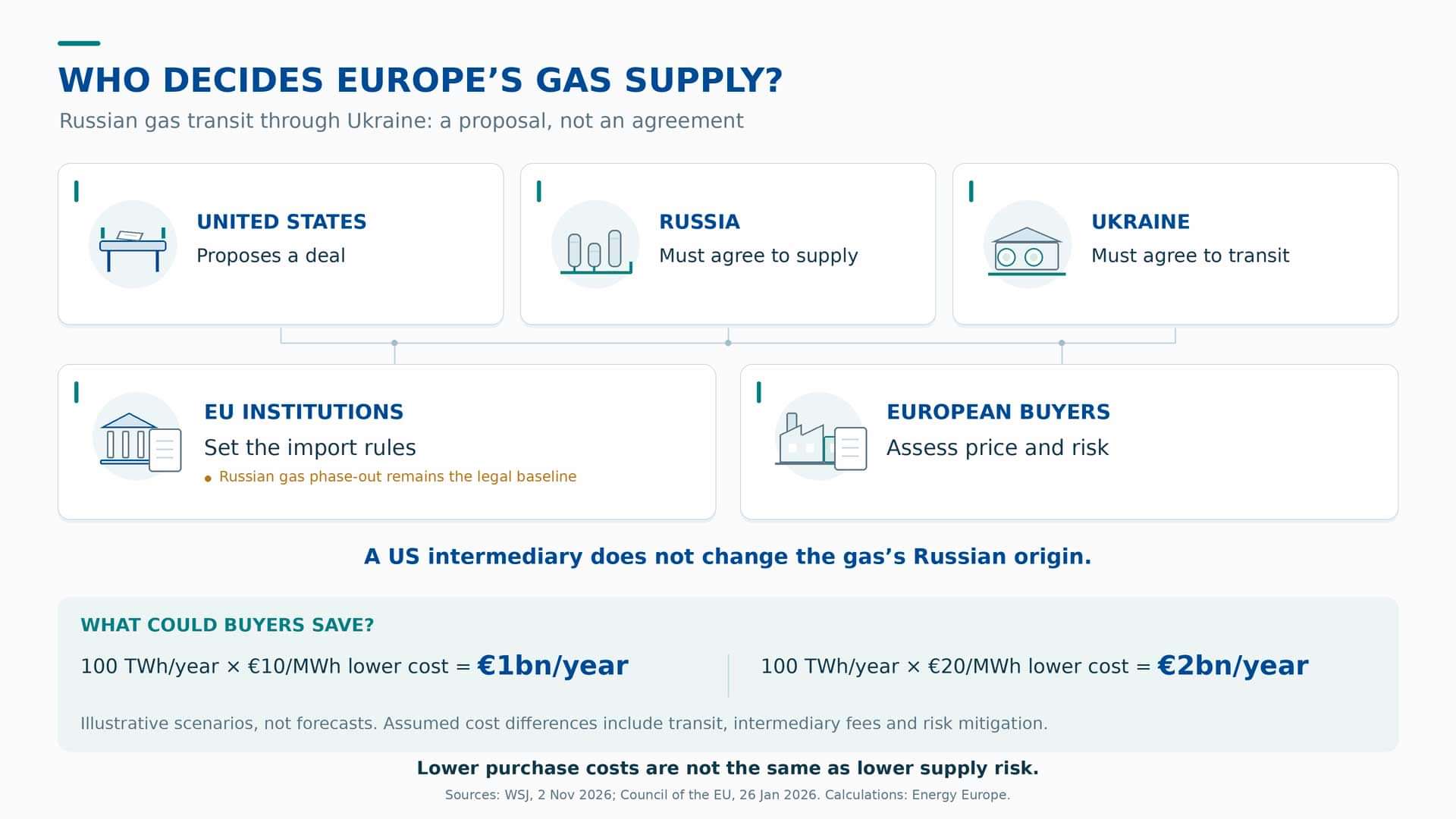
Europe’s gas supply: decision-makers and illustrative savings scenarios. Graphic: Energy Europe Editorial Team.
How potential savings can be calculated
Independence from Russian gas does not mean independence from gas imports altogether. European buyers must continue to choose between supply sources, delivery routes and contract offers.
The proposal does not yet provide enough information to calculate how much a complete phase-out would cost compared with a partial resumption. It is possible, however, to illustrate how different assumed cost advantages would translate into savings. The following calculation is a scenario, not a price forecast.
For annual supplies of 100 terawatt-hours, an all-in cost advantage of €10 per megawatt-hour would yield savings of €1 billion a year. An advantage of €20/MWh would yield €2 billion a year. The assumed cost differences include transit, intermediary fees and risk mitigation. Whether such a price differential would actually be available remains unknown.
Low production costs alone do not guarantee a favourable selling price. Gas market expert Mike Fulwood of the Oxford Institute for Energy Studies wrote in an analysis quoted by Reuters in February 2025: “While Europe, and Germany especially, may have been hooked on Russian gas, given the volume of imports, it was not cheap.”
In this context, Reuters energy columnist Ron Bousso noted that Russian supply prices have historically been linked to oil prices and European gas market prices. This argument concerns price formation, not the specific terms of a new offer that remains unknown.
A separate question is how additional volumes would affect overall market prices. Increased supply could also reduce costs for other buyers. Whether this effect would be significant depends on demand, available alternatives and the volumes supplied. Bousso’s assessment at the time was cautious; it was not a calculation of the current proposal’s impact.
Furthermore, even falling wholesale prices would not immediately translate into equivalent reductions in end-user bills. Procurement contracts, network charges, taxes and other government-imposed charges affect the savings ultimately passed on.
The economic value of security of supply
A fair comparison must consider not only purchase prices but also the costs of potential disruptions. These include short-term replacement purchases, production losses and, where applicable, government support. Alternative supplies also entail costs for transport, infrastructure and risk mitigation.
In its phase-out roadmap from May 2025, the Commission envisaged additional LNG supplies, alternative supply sources and declining European gas demand. A coordinated, gradual replacement of Russian supplies was intended to limit the impact on prices and security of supply. How cost-effective this transition proves to be will depend on whether the assumed supply and demand trends materialise.
Conversely, even a peace agreement would not guarantee reliable Russian supplies over the long term. For European companies, the crucial question would therefore be whether an offered discount sufficiently compensated for the contractual and political risks. The same supply arrangement might appear attractive to an individual buyer while increasing a country’s dependence. Business and government assessments need not therefore coincide.
Who ultimately decides
Europe’s gas supply has no single decision-maker. The EU sets the legal boundaries, member states pursue their security-of-supply interests, and companies assess specific offers. Russia and Ukraine, for their part, would have to enable supplies and transit.
Washington can broker a supply arrangement. It cannot, however, guarantee Russia’s willingness to make political concessions, Ukrainian consent to transit or compliance with EU import rules. Moscow’s cautious reaction so far underlines that Russia, too, has made no commitment to implementing the proposal in the short term.
As long as the EU import ban remains in force, new supply arrangements must comply with its requirements. Yet even a legally permissible deal would not necessarily make economic sense. The decisive question is whether its price advantage would justify the associated risks – both for the individual buyer and for Europe’s security of supply.