


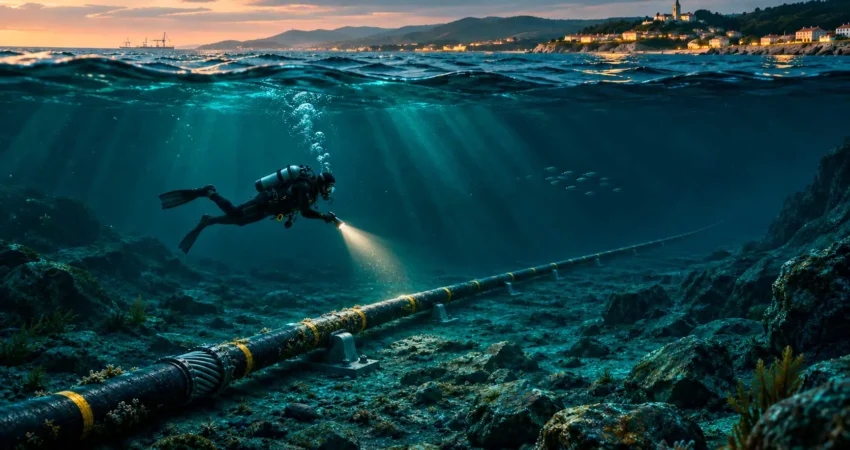
As Europe reduces its reliance on imported fossil fuels, submarine electricity cables are helping to create a more interconnected energy system. Unlike oil and gas pipelines, they transmit electricity that can be generated from renewable and other domestic sources, allowing countries to share power across borders and make better use of their energy resources. But electricity infrastructure also carries geopolitical risks. Disruptions in the Baltic Sea and mounting tensions in the Mediterranean reveal a new strategic challenge: the infrastructure designed to strengthen Europe’s energy independence must itself be protected against political disputes, accidental damage and potential sabotage.
A New Frontline Beneath the Waves
For decades, Europe’s energy security debates revolved around oil and gas pipelines, suppliers and transit routes. Russia’s invasion of Ukraine in 2022 reinforced concerns about this infrastructure, prompting European governments to diversify energy imports and accelerate investment in renewable power.
The transition is also changing the nature of energy dependence. As European countries increasingly rely on offshore wind farms and cross-border electricity trading, cables running across the seabed are becoming indispensable to the continent’s energy system.
Unlike oil and gas pipelines, which transport fuels that can sometimes be stored for months, electricity interconnectors transmit power in real time. Their disruption can immediately reduce transmission capacity, affect electricity prices and complicate the balancing of national grids.
Interconnection allows countries to balance fluctuations in renewable generation, share available capacity and compensate for local shortages. These benefits, however, depend on the reliability of the connections themselves.
Recent developments illustrate both the opportunities and the risks. The proposed Great Sea Interconnector between Greece and Cyprus has become entangled in maritime disputes involving Turkey. Meanwhile, incidents in the Baltic Sea have demonstrated how vulnerable underwater electricity and telecommunications cables can be to damage.
The challenge is considerable. According to the European Commission, approximately €584 billion in investment is needed to modernise and expand Europe’s electricity grids during the period from 2020 to 2030. This estimate covers electricity networks more broadly, not submarine cables alone.
The EU also aims for member states to achieve electricity interconnection capacity equivalent to at least 15% of their installed electricity generation capacity by 2030.
The Mediterranean: A Cable Caught in Maritime Disputes
The European electricity market is built on a degree of cooperation that allows countries to exchange power across national borders. Yet even projects intended to strengthen connections within the EU are not immune to political tensions.
One of the most striking examples is the Great Sea Interconnector (GSI), designed to connect Cyprus to the European electricity network through Greece.
Cyprus remains heavily dependent on imported fossil fuels for electricity generation. Its geographical isolation limits opportunities to exchange electricity with neighbouring markets, making the country particularly exposed to fuel price fluctuations and supply risks.
The proposed interconnector would change this situation. According to the project’s official website, the initial Crete–Cyprus section will include approximately 900 kilometres of submarine cable and have a transmission capacity of 1,000 megawatts.
The connection would allow electricity to flow in both directions, giving Cyprus access to the wider European market and creating new opportunities to integrate renewable energy.
For Greece, the project carries political significance beyond electricity supply. It would reinforce the country’s role as an energy gateway between the eastern Mediterranean and the European market. For Cyprus, it offers the prospect of ending its electricity isolation.
The project has received approximately €657 million in EU grant support. The project company now lists French infrastructure investor Meridiam as its majority shareholder with 66%, alongside Greece’s Independent Power Transmission Operator (IPTO) with 34%. Regulatory and financing questions, however, remain unresolved.
The most sensitive issue concerns maritime jurisdiction in the eastern Mediterranean. Turkey has challenged survey activities in areas where maritime rights are disputed, while Greece maintains that the project can proceed in accordance with international law.
These disagreements have repeatedly complicated the planning and execution of seabed surveys. The cable’s route has therefore become more than an engineering question: it is also connected to longstanding tensions over maritime boundaries and regional influence.
The United States has also expressed support. As Reuters reported in October 2026, US Secretary of State Marco Rubio backed the project as a way to diversify energy supplies and said Washington would use diplomacy to help remove obstacles. This diplomatic support should not be read as a guarantee of implementation.
As Kathimerini reported on November 16, seabed surveys resumed on November 12, 2026, with the French-flagged Abeille Marengo operating east of Karpathos. The newspaper attributed the restart to a working arrangement reached through French–Turkish diplomatic contacts. This enabled survey operations to proceed; it did not resolve the underlying maritime dispute.
The timetable and final cost remain uncertain. On October 20, 2026, Cyprus’s energy regulator CERA reported that a Nexans letter, forwarded by the project promoter, indicated a revised completion date of January 1, 2031. This is a reported project schedule, rather than a guaranteed delivery date.
For Cyprus, the connection could end electricity isolation and widen access to energy sources. Delivering these benefits still requires a workable regulatory and financing framework, diplomatic coordination and sustained cooperation over the cable’s route.
The Baltic Sea: From Technical Failures to Security Threats
Even when infrastructure is already in place and the countries involved share common strategic interests, underwater electricity cables face significant risks from accidental damage and potential sabotage.
The Baltic Sea has emerged as one of Europe’s most sensitive areas for underwater infrastructure. Since 2022, the region has experienced multiple disruptions affecting electricity cables, telecommunications connections and gas pipelines.
The incidents have raised concerns about the security of infrastructure that is essential not only to individual countries but also to the functioning of the wider European energy market.
One particularly significant case occurred on December 25, 2024, when the EstLink 2 electricity interconnector between Finland and Estonia was damaged.
The approximately 145-kilometre submarine cable has a transmission capacity of 650 megawatts. Its failure reduced electricity transmission capacity between the two countries. Fingrid’s half-year report confirms that the connection returned to commercial operation on June 20, 2025. Before the repair, Elering estimated its total cost at €50–60 million, to be shared equally with Fingrid; this was an estimate, not a confirmed final bill.
Finnish investigators focused on the Russia-linked tanker Eagle S, which was suspected of dragging its anchor along the seabed for approximately 90 kilometres, damaging EstLink 2 and four telecommunications cables.
The incident also exposed the legal difficulties of protecting infrastructure located in maritime areas governed by international law.
In October 2025, a Finnish district court declined to examine criminal charges against three crew members on jurisdictional grounds. On August 27, 2026, the Helsinki Court of Appeal overturned that decision. It held that Finnish courts had jurisdiction because the alleged offences had consequences in Finland and that the conduct described in the charges did not qualify as an incident of navigation under Article 97 of the UN Convention on the Law of the Sea.
The case was returned to the district court to consider the charges. The appellate decision did not establish the crew members’ guilt.
The case illustrates two separate challenges. The first is establishing the circumstances of the damage and whether negligence or deliberate misconduct played a role. The second is determining which national authorities have jurisdiction when incidents occur beyond territorial waters.
The crew members denied intentional wrongdoing. Determining responsibility requires technical evidence, maritime investigations and legal proceedings rather than assumptions about the circumstances of the incident.
Beyond the legal difficulties of investigating damage, the seabed itself creates challenges for building and protecting cable networks.
Uneven seabed terrain and the concentration of power cables, telecommunications lines and pipelines complicate route planning, monitoring and repairs. Coordination between operators and public authorities is therefore essential.
In April 2026, industry association WindEurope published recommendations on protecting offshore wind infrastructure against physical threats. The association warned that the expansion of renewable energy generation must be accompanied by stronger security measures for offshore assets and their connections to the electricity grid.
A densely interconnected electricity system can compensate for an individual disruption if sufficient alternative transmission capacity is available. Simultaneous damage to several routes or critical hubs, however, could have much more serious consequences.
Network planning must therefore combine interconnection with geographically diversified routes, sufficient reserve transmission capacity, operational flexibility and protection against damage.
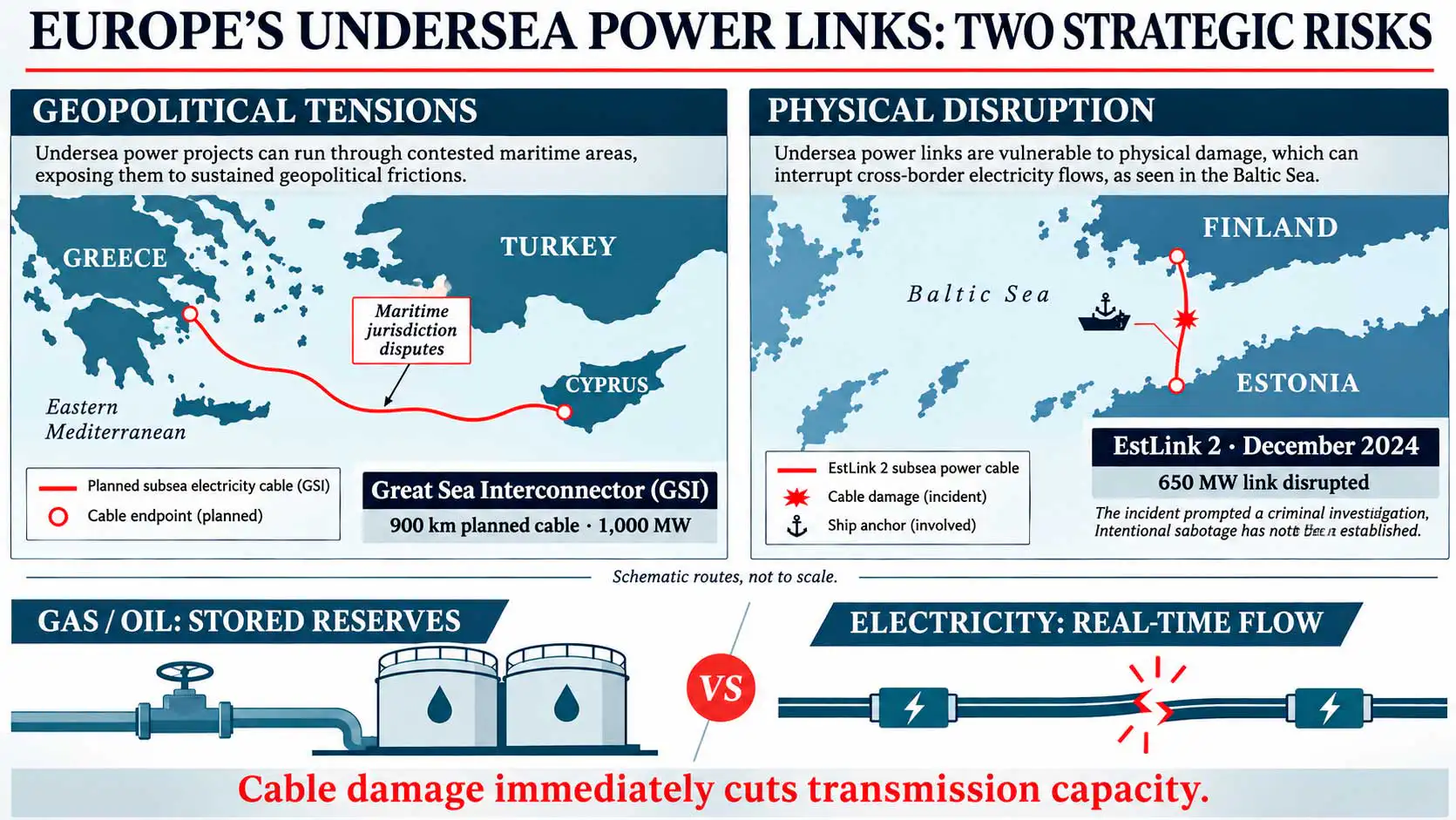
Geopolitical and Physical Risks to Europe’s Electricity Infrastructure. Graphic: Energy Europe Editorial Team.
Can Europe Protect Its Energy Transition?
Europe’s emerging underwater security challenge extends beyond the protection of individual cables. As renewable electricity generation expands and cross-border trade becomes more important, the reliability of transmission infrastructure increasingly affects the energy security of the entire European Union.
Naval patrols, surveillance technologies and closer maritime cooperation can improve the detection and deterrence of hostile interference. Yet they cannot eliminate accidental damage, prevent every deliberate attack or guarantee the uninterrupted operation of all connections.
A broader approach is therefore required, combining physical security with network planning, rapid repair capabilities, legal cooperation and diversified electricity supply.
The European Union has begun developing such an approach.
In February 2025, the European Commission and the EU’s High Representative for Foreign Affairs and Security Policy adopted an Action Plan on Cable Security, addressing threats to both submarine data cables and electricity infrastructure.
The plan covers prevention, detection, response, recovery and deterrence. Its central principle is that protecting critical underwater infrastructure requires coordinated action across national borders.
In February 2026, the Commission published the Cable Security Toolbox, following the EU risk assessment issued in October 2025. The toolbox recommends measures to reduce identified risks and improve protection and response. Its accompanying announcement also explains the funding context.
For power networks, resilience also depends on strengthening grid infrastructure, developing alternative transmission routes and improving coordination between national transmission system operators.
These measures are particularly important as the EU pursues its electricity interconnection targets. The more countries rely on cross-border exchanges, the greater the need for common standards of security, maintenance and emergency response.
The two cases expose different weaknesses in Europe’s electricity integration. In the Mediterranean, political disputes can prevent new connections from being built. In the Baltic, damage to existing cables tests repair capabilities, legal jurisdiction and the availability of alternative routes.
Redundant routes, faster repairs and stronger surveillance can reduce the risks, but they cannot resolve maritime disputes or substitute for political trust. Europe’s energy transition therefore depends not only on generating more electricity, but also on maintaining the physical, legal and diplomatic conditions that allow it to move across borders.