


A substantial share of Europe’s industrial production could already run on electricity instead of natural gas and other fossil fuels. Much of the technology is available, and some solutions are already operating successfully. Yet many companies remain reluctant to make the switch. Technical feasibility does not necessarily translate into commercial viability. High electricity prices, expensive plant upgrades and uncertain investment conditions make electrification a difficult business decision. For European manufacturers, the question is not simply whether they can replace fossil fuels, but whether they can afford to do so while remaining competitive internationally.
According to Eurostat, industry across the European Union consumed around 2,450 terawatt-hours of energy in 2024. Electricity accounted for roughly one-third of that total, with natural gas contributing almost as much. Together with coal and oil, fossil fuels still supplied nearly half of industrial final energy demand. Energy consumption is particularly high in the chemical industry, the production of glass, cement and other non-metallic mineral products, and food processing.
The transition is especially challenging for energy-intensive sectors such as chemicals, steel, glass and cement. Chemical plants require large quantities of steam and process heat, while steelmakers may need to change not only their furnaces but also parts of their production processes. Glass manufacturers operate melting furnaces that run almost continuously for years, making conversion economically viable in many cases only when major refurbishment is already due. In cement production, electric technologies for the particularly energy-intensive process of clinker manufacturing have yet to become commercially established. Across these industries, electrification often involves far more than replacing a gas boiler. It requires substantial investment, which must be justified against the continued use of existing equipment that may still have many years of service life.
Much of the Technology Is Already Available
Electrification is most advanced in industrial processes that require relatively low temperatures. These include large parts of food and paper production, as well as certain processes in the chemical industry.
Industrial heat pumps could play an important role. Unlike electric boilers, they do not simply convert electricity into heat. They also recover heat from the surrounding environment or from industrial processes. This allows them to deliver several kilowatt-hours of useful heat for every kilowatt-hour of electricity consumed.
Systems operating at temperatures of up to around 150°C are already commercially available. New high-temperature heat pumps can now reach up to 200°C in certain applications. At higher temperatures, electric steam generators, resistance heating systems and specialised industrial furnaces offer further options. However, these technologies differ considerably in both efficiency and cost.
Finnish paper manufacturer delfort offers an example of how far the technology has progressed. In February 2026, the company commissioned a large steam-generating heat pump alongside an electrode boiler at its Tervakoski facility. According to the company, the plant can now produce speciality paper entirely without fossil energy. The heat pump recovers waste heat from production and uses it to generate the steam required by the manufacturing process.
Progress is also being made in much higher-temperature applications. Glass manufacturers Saint-Gobain and AGC operate a hybrid melting furnace in Dubí, Czechia, combining electric energy with conventional heating. In June 2026, following a year of continuous operation, the companies reported a 66% reduction in fossil fuel consumption compared with the reference level. The project is also providing a basis for further investment in glass furnaces with a higher degree of electrification.
Industrial electrification has therefore moved well beyond the laboratory. Whether these technologies achieve widespread adoption now depends increasingly on their economics.
When Electricity Costs More Than Gas
Operating costs are often the biggest obstacle. Electric equipment can be more efficient than the fossil-fuel systems it replaces, but what ultimately matters is the cost of delivering the heat a factory needs.
An industrial heat pump that produces three kilowatt-hours of heat from one kilowatt-hour of electricity can remain economical even when electricity prices are relatively high. The calculation is different for an electric steam boiler. Although it converts almost all the electricity it consumes into heat, it cannot offer the same efficiency advantage. When electricity is substantially more expensive than natural gas, steam production costs rise accordingly.
The scale of the differences across Europe is illustrated by a market report from the European Union Agency for the Cooperation of Energy Regulators (ACER). In the first half of 2025, large industrial consumers using between 70,000 and 150,000 megawatt-hours of electricity annually paid an average of around €188 per megawatt-hour in Germany, compared with just €85 in Sweden. Actual costs vary according to consumption levels and contractual arrangements, but the figures demonstrate how strongly location can influence the economics of electrification.
A 2026 analysis by the International Energy Agency reached a striking conclusion. Around 40% of the EU’s industrial low-temperature heat demand is located in countries where heat pumps already have lower lifetime costs than gas boilers under the price conditions examined. Another 35% is in countries where the cost difference is no more than 5%.
Yet actual deployment remains limited. Favourable operating economics alone are clearly not enough to trigger investment.
For businesses, the cost of producing a kilowatt-hour of heat is only part of the calculation. New equipment requires capital, modifications to existing production lines and potentially interruptions to operations. Whether those costs can be recovered within an acceptable period is often uncertain.
In May 2026, researchers examined the potential economics of installing a high-temperature heat pump at an Italian paper mill. With an estimated investment of around €800,000 and annual savings of approximately €94,000, the project had a simple payback period of 8.4 years. This is not a representative figure for all industrial heat pumps, but it illustrates the financial considerations involved. The findings were published in a scientific study.
A company whose existing gas boiler can operate reliably for many more years must decide whether to invest that money immediately or use the capital elsewhere. The prospect of lower energy bills is not always enough to justify an early replacement.
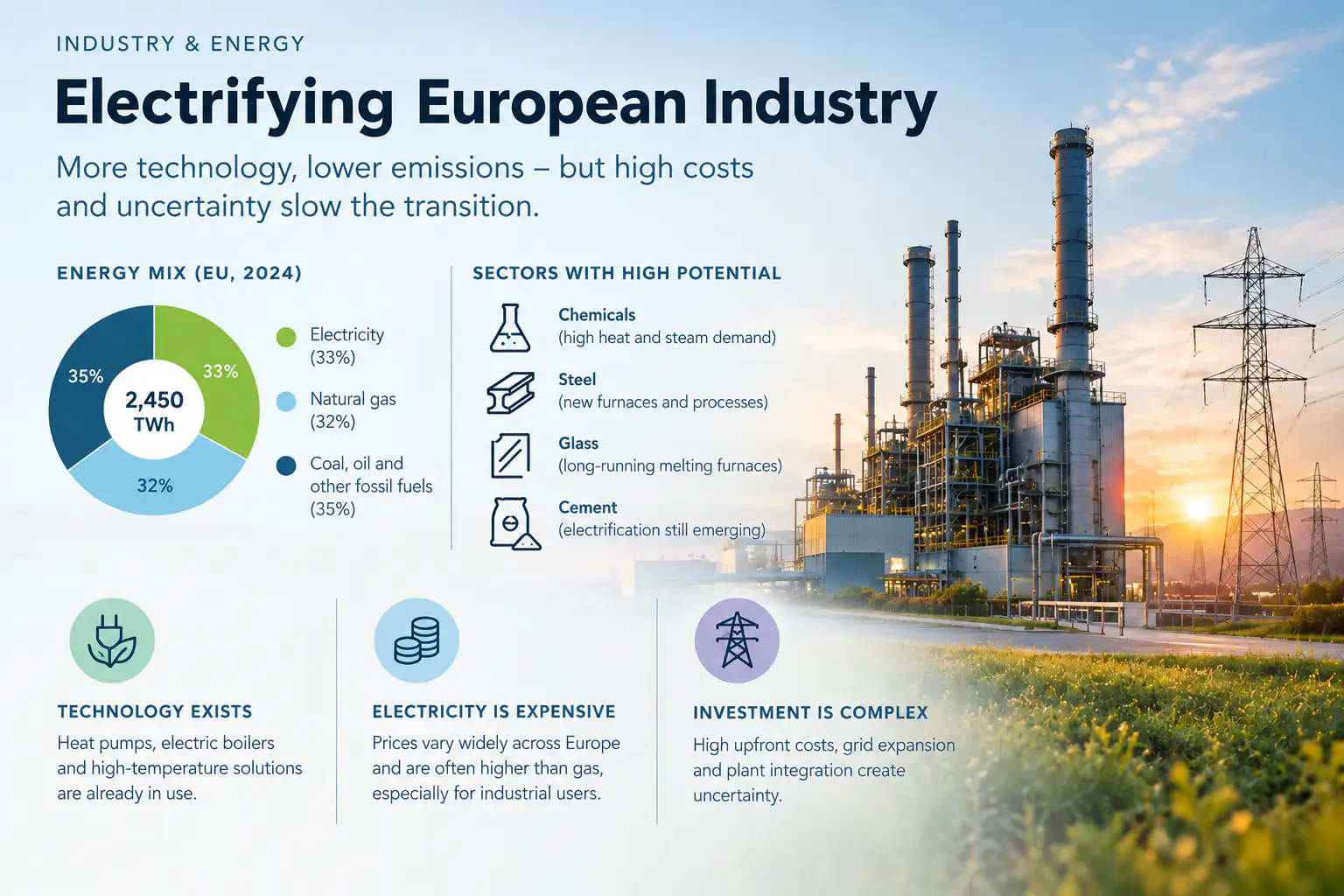
High costs and uncertainty slow industrial electrification. Graphic: Energy Europe Editorial Team.
Investment Requires Certainty
Large industrial facilities face an additional challenge. Many production processes have evolved over decades and are closely interconnected. Replacing a single heat source can affect an entire plant’s energy system. A new furnace or industrial heat pump must therefore not only deliver the required output but also integrate reliably into existing operations.
Grid access presents another obstacle. While a gas-fired furnace draws its energy from an existing gas pipeline, an electric alternative may require substantially more grid capacity. If the current connection is insufficient, additional power lines, transformers and permits may be needed. Even companies ready to invest could then face delays while electricity networks are upgraded.
Steelmaker ArcelorMittal illustrates the importance of financial safeguards for such investments. In February 2026, the company announced plans to invest around €1.3 billion in an electric arc furnace at its Dunkirk site in France. The facility is expected to produce up to two million tonnes of steel annually and begin operations in 2029. Government support and a long-term electricity supply agreement are intended to reduce the project’s financial risks.
Electric arc furnaces have been used in steelmaking for decades. What is new is not the technology itself, but its planned role in a broader transformation of steel production. Even so, electric arc furnaces cannot directly replace every stage of conventional primary steelmaking. Producing iron from iron ore requires additional processes and raw materials.
New facilities are also being developed in the chemical industry. BASF is building an industrial heat pump with a thermal capacity of almost 50 megawatts at its Ludwigshafen site in Germany. The system will recover waste heat from production and use it to generate steam for formic acid manufacturing. Commissioning is scheduled for mid-2027. BASF has received a federal funding commitment of up to approximately €310 million for the project under Germany’s Climate Protection Contracts programme.
Such support can tip the balance when an investment makes technical sense but remains too expensive or risky under current market conditions. It also raises a fundamental question: how quickly can industrial electrification progress if major projects continue to depend on public funding?
The European Commission is increasingly seeking to address these economic barriers directly. Alongside existing funding programmes, new instruments are intended to support investment in electric process heating. The focus is not only on the upfront cost of equipment but also on the additional operating expenses compared with fossil-fuel alternatives.
These measures could, however, make differences between European industrial locations even more pronounced. Countries with affordable electricity, sufficient grid capacity and predictable support schemes are better positioned to attract new industrial facilities. Where electricity remains expensive and grid connections take years to secure, companies may postpone investment or expand production elsewhere.
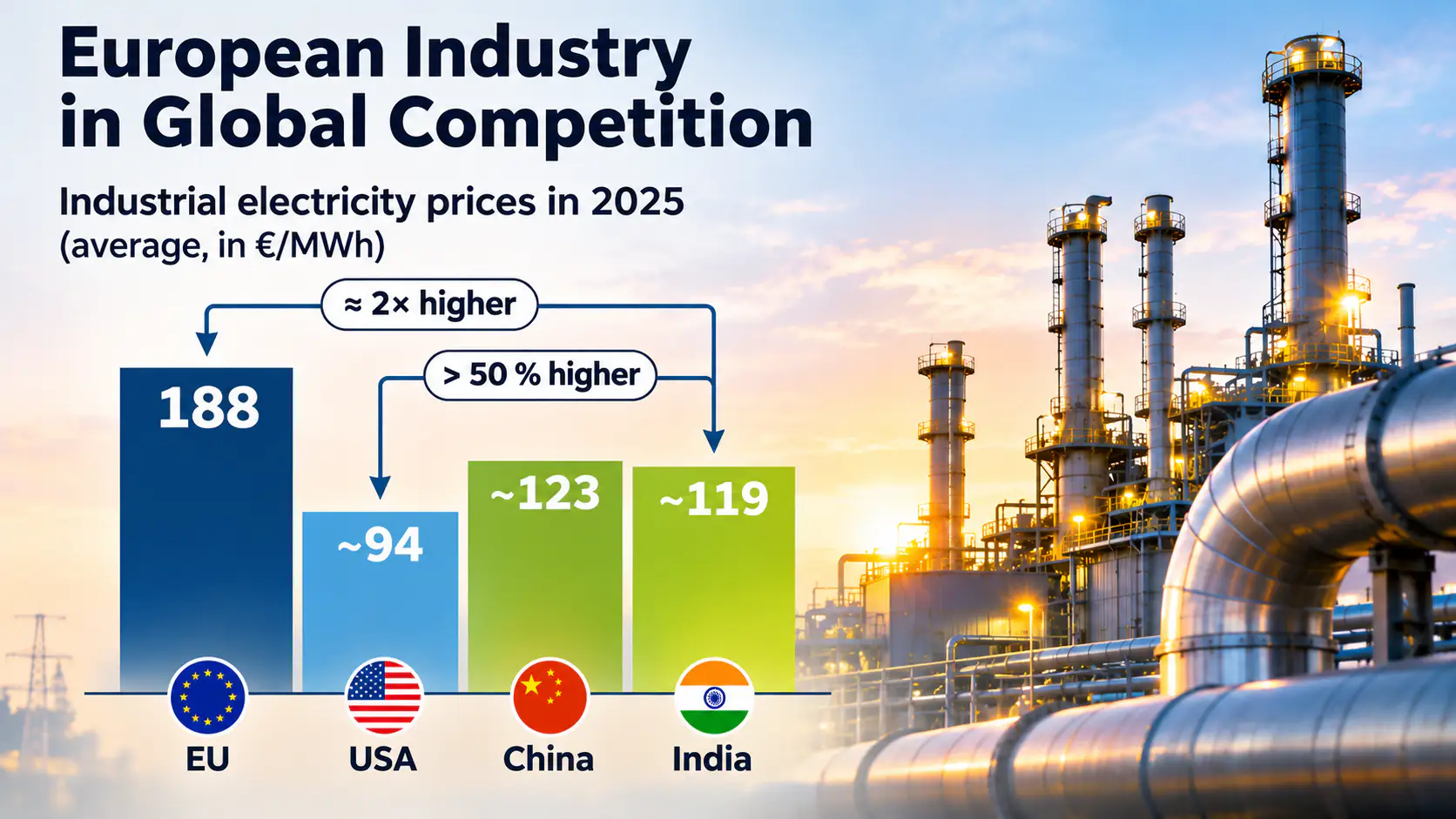
High electricity costs impact Europe’s industrial competitiveness. Graphic: Energy Europe Editorial Team.
European Industry in Global Competition
Europe also faces pressure from competitors beyond its borders. According to the International Energy Agency, electricity prices for energy-intensive industries in Europe were, on average, approximately twice as high as those in the United States in 2025 and more than 50% higher than in China and India. European companies that electrify their production could therefore initially face higher energy costs than competitors operating outside the region.
Over time, more efficient equipment, thermal energy storage and long-term electricity supply contracts could improve the economics of electrification while reducing Europe’s dependence on fossil fuels. But as long as electricity remains expensive and the transition demands substantial capital investment, Europe faces a contradiction: the technology needed to replace fossil fuels in industry is increasingly available, yet the economic conditions required to make that transition viable are still missing in many locations. The decisive question is therefore not how quickly European industry can electrify, but whether it can remain internationally competitive in the process.