



Europe is pouring billions into artificial intelligence and new data centres. Yet access to electricity, rather than available capital, is increasingly deciding whether projects go ahead. Congested grids, lengthy connection queues and rising infrastructure costs are changing where companies choose to invest. They also raise a pressing economic question. Who will pay to power Europe’s digital future?
In October 2026, a project in Essex, England, offered a striking example of how energy infrastructure can determine the fate of AI investment. Microsoft withdrew from an agreement for a planned data centre designed for 50 megawatts of capacity and more than 23,000 Nvidia graphics processors. The electricity connection, however, was not expected to be available until the 2030s. Microsoft ended the agreement for that site while maintaining its wider partnership with data centre developer Nscale, Reuters reported.
The case points to a challenge emerging across Europe. Technology companies and investors are drawing up plans for new data centres faster than power grids and electricity supply can accommodate them. The International Energy Agency (IEA) expects global data centre electricity demand to rise from around 485 terawatt-hours in 2025 to approximately 950 terawatt-hours by 2030. In the European Union, the European Commission projects an increase from 68 terawatt-hours in 2024 to 114 terawatt-hours in 2030.
That is changing the competition for investment. Fast data connections, suitable land and proximity to major customers have long been central to choosing a data centre location. Electricity is now becoming another decisive factor in projects worth billions. A viable site must offer not just enough power, but a reliable supply at competitive prices and, ideally, with low emissions.
Europe’s Digital Ambitions Run Up Against Grid Constraints
The European Union wants to expand its digital infrastructure dramatically and reduce its dependence on American and Asian technology companies in artificial intelligence. Under its AI Continent Action Plan, the European Commission is supporting new computing capacity, including up to five exceptionally powerful AI facilities known as AI Gigafactories. Around €20 billion is to be mobilised for these projects through the InvestAI initiative.
But power infrastructure cannot expand at the same speed as computing capacity. New servers can be installed within months, whereas additional transmission lines, substations and power plants often take years to build. Permitting procedures, limited grid capacity and competing construction projects can extend those timelines further.
In its assessment of Europe’s data centre expansion, the IEA warns that proposed projects could place considerable strain on grids in some locations. If every announced data centre were built, their combined planned connection capacity would amount to roughly 5 to 10 per cent of current national peak electricity demand in Germany and France, and around 10 per cent in Spain and the Netherlands.
These figures refer to the potential maximum power demand of announced projects, not the electricity they would actually consume over a year. Nor is it certain that all the projects will be completed. The IEA already factors delays caused by grid connections and other obstacles into its projections.
The challenge is not simply how much electricity Europe produces, but where it is available. Data centres have traditionally clustered around Frankfurt, Amsterdam, Paris, London and Dublin, where internet exchanges, multinational businesses and digital service providers are concentrated. Yet these are also places where securing additional electrical capacity is becoming increasingly difficult.
Energy Europe has previously explored how artificial intelligence can help operate power grids more efficiently in AI Moves Into Europe’s Power Grids. The data centre boom reveals the other side of the equation. AI may make energy systems smarter, but it is also placing new demands on them.
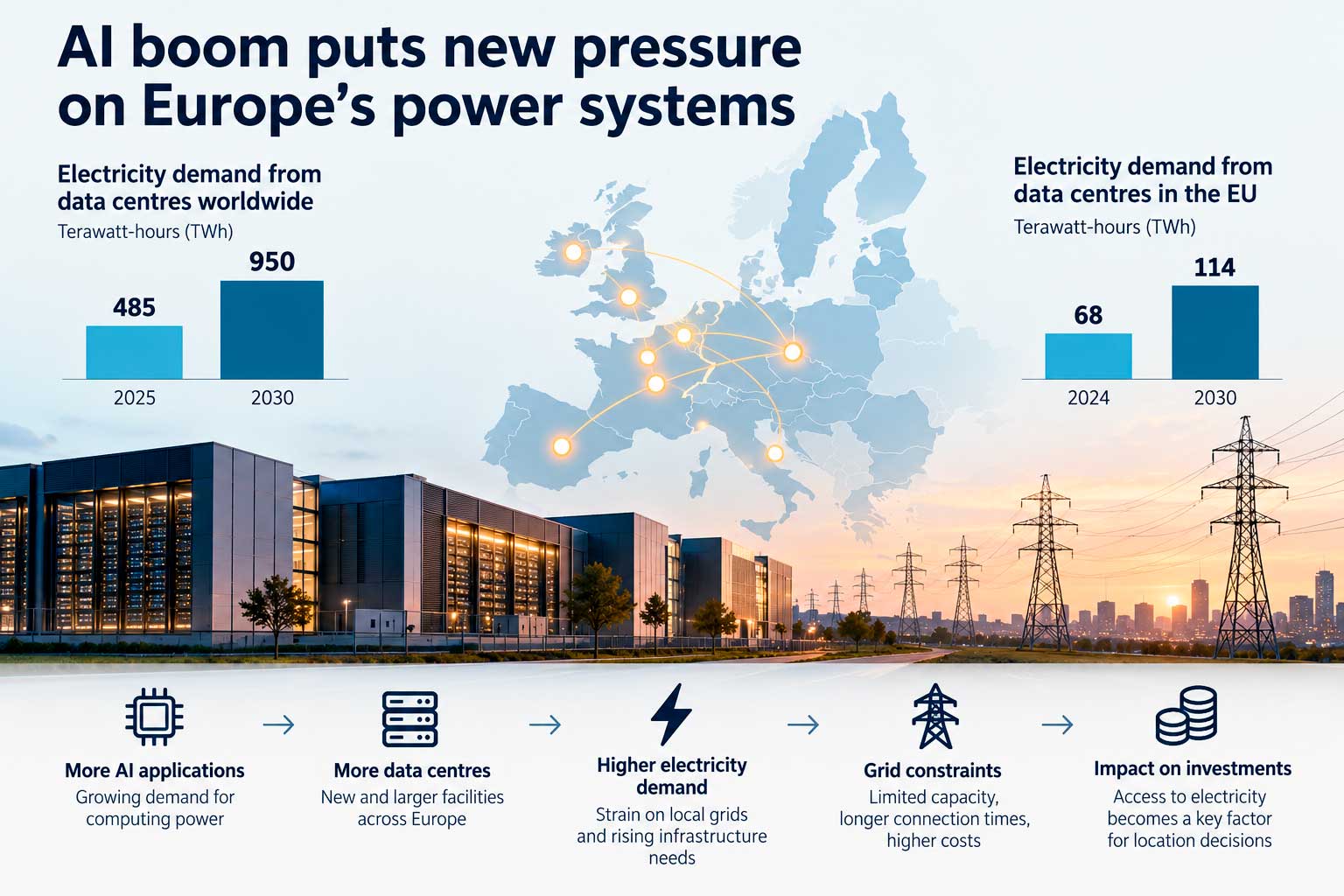
The growing electricity demand from data centres is putting increasing pressure on Europe’s power grids and shaping decisions on where to locate new facilities and invest. AI-generated infographic.
The Race for the Most Competitive Locations
Ireland illustrates just how far this trend has progressed. Having attracted major international technology companies over many years, it has become one of Europe’s leading data centre hubs. According to Ireland’s Central Statistics Office, data centres consumed around 7.7 terawatt-hours of electricity in 2025, accounting for 23 per cent of all metered electricity use. Households, by comparison, accounted for 28 per cent. In 2015, data centres had represented just 5 per cent.
That growth has consequences. New grid connections for data centres in the greater Dublin area were heavily restricted for years. Ireland’s energy regulator has since developed new rules that place additional requirements on the electricity supply arrangements of large facilities.
The Netherlands has also imposed restrictions on the development of particularly large data centres. Germany faces similar pressures, especially around Frankfurt, where operators have gathered to take advantage of excellent connectivity. National electricity supply is not necessarily the limiting factor. At the local level, however, there may simply be too few power lines and substations to connect another large facility.
Other parts of Europe could benefit. France has extensive nuclear generation capacity, while Spain has substantial wind and solar resources. Finland and Sweden offer cooler climates that can reduce the energy needed for cooling. Even so, favourable conditions for generating electricity do not guarantee a timely grid connection.
Iceland presents an especially interesting case. Almost all of its electricity comes from hydropower and geothermal energy, making it an attractive location for energy-intensive digital services. Yet the OECD warns in its economic survey of Iceland that parts of the grid are already operating close to their limits. Building new generation and transmission infrastructure takes time, while other industries are also seeking more power.
The OECD also describes a notable shift in priorities. In 2024, some Icelandic energy suppliers chose not to renew electricity contracts with cryptocurrency mining operators as they explored opportunities in artificial intelligence. The example raises a broader economic question. Which businesses and industries generate the greatest value from a limited supply of electricity?
The map of European data centre investment could therefore change. Regions with spare grid capacity, secure long-term electricity supplies and competitive prices may attract projects that would previously have gone to established technology hubs. Not every computing task can be moved, however. Training large AI models can sometimes take place far from end users, whereas many applications need low latency and therefore computing facilities closer to the people using them.
Who Pays for the Infrastructure Behind the AI Boom?
Choosing a location is only part of the economic challenge. Just as important is who pays for the infrastructure that new data centres require.
Large facilities may call for additional high-voltage lines, substations or power generation capacity. The costs often arise long before a data centre is fully operational. Grid operators must therefore decide today how much capacity will be needed several years from now, even though future demand is difficult to predict.
The IEA examines precisely this issue in its report Powering Artificial Intelligence, published on 14 October 2026. Its analysis covers regulations and corporate strategies across 34 countries and jurisdictions, together representing around 90 per cent of global data centre capacity. It warns that the investment surge is putting pressure on local grids and increasing demand for essential electrical equipment.
The financial risks extend well beyond the data centre industry. If grid operators build new lines for major projects that are subsequently delayed or cancelled, substantial costs may remain. Where those investments are recovered through general network charges, households and other businesses may end up paying part of the bill.
The reverse is also possible. Large new electricity users can improve the economics of a power system if they make better use of infrastructure that is already in place but underutilised. Whether data centres push up or reduce costs for other consumers therefore depends heavily on their location and on how costs are allocated.
The IEA recommends making developers bear more of the risks associated with their connection requests. Options include long-term payment commitments, financial guarantees and charges when reserved capacity goes unused. Such measures could protect grid operators from having to cover the costs of infrastructure built for projects that never materialise.
There is another economic consequence. Data centres are competing with other sectors for grid capacity and available electricity. Industrial facilities, heat pumps and electrified transport all need additional connections too. When new lines cannot be built quickly enough, grid operators must determine which projects can connect first. For energy-intensive businesses, a long wait can become a serious competitive disadvantage.
Can Data Centres Become Part of the Solution?
Higher energy costs and difficulties securing grid connections are already prompting operators to rethink how they design their facilities. Rather than relying entirely on the public grid, they are considering on-site generation, battery storage and arrangements that allow them to reduce electricity consumption temporarily.
Ireland now requires certain new data centres to provide or contract for additional firm generation capacity. The aim is to ensure that new facilities contribute to security of supply rather than simply adding to demand. But generating electricity on site is not necessarily a low-carbon solution. Gas-fired plants can provide reliable power, yet they also produce emissions and expose operators to fuel price volatility.
Data centres could also adjust some of their electricity use to match available supply. Certain computing tasks, for example, could be scheduled for periods of strong wind or solar generation. The IEA sees an opportunity to make better use of existing grids and connect new facilities sooner. It also cautions against unrealistic expectations. Many operators sell computing capacity to customers and have little control over when those customers run their applications. Computing resources are expensive, moreover, and interrupting operations may cost far more than the electricity saved.
A project in Finland shows how data centres could also support local energy systems. In May 2026, energy company Fortum commissioned two large heat production facilities in Espoo and Kirkkonummi. In future, they are intended to recover waste heat from nearby Microsoft data centres and use it to heat homes and other buildings.
According to Fortum, once the system is fully developed, recovered heat could meet around 40 per cent of annual district heating demand in an area serving approximately 250,000 customers. Total demand is around two terawatt-hours a year. For now, the facilities mainly produce heat using heat pumps and electric boilers. Waste heat from the data centres is expected to be introduced gradually from 2027. Fortum has invested approximately €225 million in the heat facilities.
The project demonstrates that, under the right conditions, data centres can become part of a regional energy system. That requires suitable district heating networks, enough nearby customers and investment in the necessary equipment. A facility far from major population centres will often have far fewer opportunities to put its waste heat to use.
The European Commission also wants the industry to take greater responsibility. In September 2026, it launched a public consultation on minimum performance standards for data centres, with responses open until 14 December. A legislative proposal is planned for the second quarter of 2027. Alongside electricity use, the initiative addresses water consumption, emissions and more efficient use of energy.
The EU must therefore reconcile two objectives that can increasingly compete for resources. It wants to strengthen Europe’s digital competitiveness while transforming its energy system. Both require substantial investment, capable power grids and long-term planning.
The expansion of artificial intelligence will do more than influence which European countries catch up technologically. It could also redraw the geography of investment and shape where new power plants, transmission lines and district heating networks are built. The central economic question is no longer simply how much electricity Europe’s data centres will need. It is which locations can deliver that power in time, and who will bear the cost.