


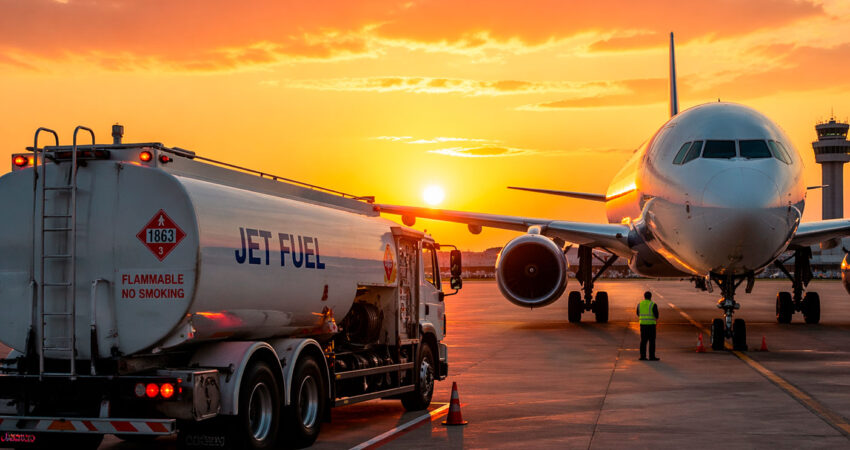
The Strait of Hormuz is far away but a crisis there could directly affect Europe’s airports. In response, the EU has developed an emergency plan for jet fuel and is exploring ways to address a new vulnerability in its supply security. Industry warnings suggest that, if the blockade continues, shortages could arise even before the start of the peak season. Meanwhile, fuel costs on long-haul flights from Europe have already risen by an average of €88 per passenger.
The European Union is preparing for a scenario that, only a few weeks ago, seemed theoretical but which has now become a pressing issue in terms of the stability of Europe’s jet fuel supply under the conditions of persistent disruption around the Strait of Hormuz. Brussels is therefore developing an emergency framework that considers not only the fuel market itself, but also rules for airports, airlines, and crisis management. The EU Commissioner for Sustainable Transport and Tourism Apostolos Tzitzikostas has stated that, while there are currently no immediate supply bottlenecks, a prolonged blockade of the route could have serious consequences. The Commission intends to present new guidelines on issues including airport slots, anti-tankering rules, passenger rights and public service transport links, while also establishing a European monitoring system for jet fuel.
Europe’s air transport sector is structurally vulnerable
The reason for the unease in Brussels is clear: Europe’s aviation sector is more vulnerable than it seems. According to Reuters, the EU imports around 30-40 per cent of its jet fuel, roughly half of which comes from the Middle East. If this supply route were to be disrupted for an extended period or become unpredictable, it would hit European aviation particularly hard – right in the middle of the summer season, when disruption could quickly spread through airports, airlines, freight and tourism. Industry representatives have warned that prolonged disruption to Gulf supply chains could lead to shortages within weeks.
Brussels is opting for control rather than alarmism
That is precisely why the debate in Brussels is considerably more measured than some alarmist headlines might suggest. The focus is not on the danger of an immediate supply collapse, but on how quickly an initially manageable market problem could escalate into an operational crisis. The European Commission is using several approaches simultaneously: greater transparency on available volumes, closer and faster coordination between member states, and – if necessary – coordinated use of existing reserves. According to Reuters, additional jet fuel imports from the United States are also being considered. Meanwhile, the Commission is working to systematically identify which European refineries can supply jet fuel and where extra short-term capacity could be activated.
The core problem lies not only in the origin of the fuel, but also in the system’s structural inertia. Even if the situation in the Gulf were to ease in the short term, this would not immediately relieve Europe. Crude oil and refined products take time to transport by sea, and tanker routes can only be accelerated to a limited extent. Furthermore, many European refineries are already operating close to their capacity limits. This means that the operational resilience of the refineries themselves is a decisive factor in the crisis response. In other words, even a swift diplomatic solution would not immediately mitigate the logistical fallout.
Germany still sees no acute jet fuel shortage
The situation in Germany is tense but stable for now. While the federal government still considers supplies to be secure, the tone in Berlin has become more serious. Chancellor Friedrich Merz has warned that the crisis could have a negative impact on the global economy and lead to political instability far beyond the Near and Middle East. German Economy Minister Katherina Reiche said that there was currently no jet fuel shortage, as refineries were adapting to increased demand. At the same time, the federal government is scrutinising the energy supply more closely. Reuters reported that Germany’s National Security Council met to discuss energy supplies and agreed to create a special committee for them.
However, industry warnings are much sharper: the European airport association ACI Europe believes that a systemic jet fuel shortage in Europe could occur within three weeks if the disruption continues. While there is still no acute bottleneck, the idea that the market could absorb a prolonged disruption without consequences is no longer an illusion.
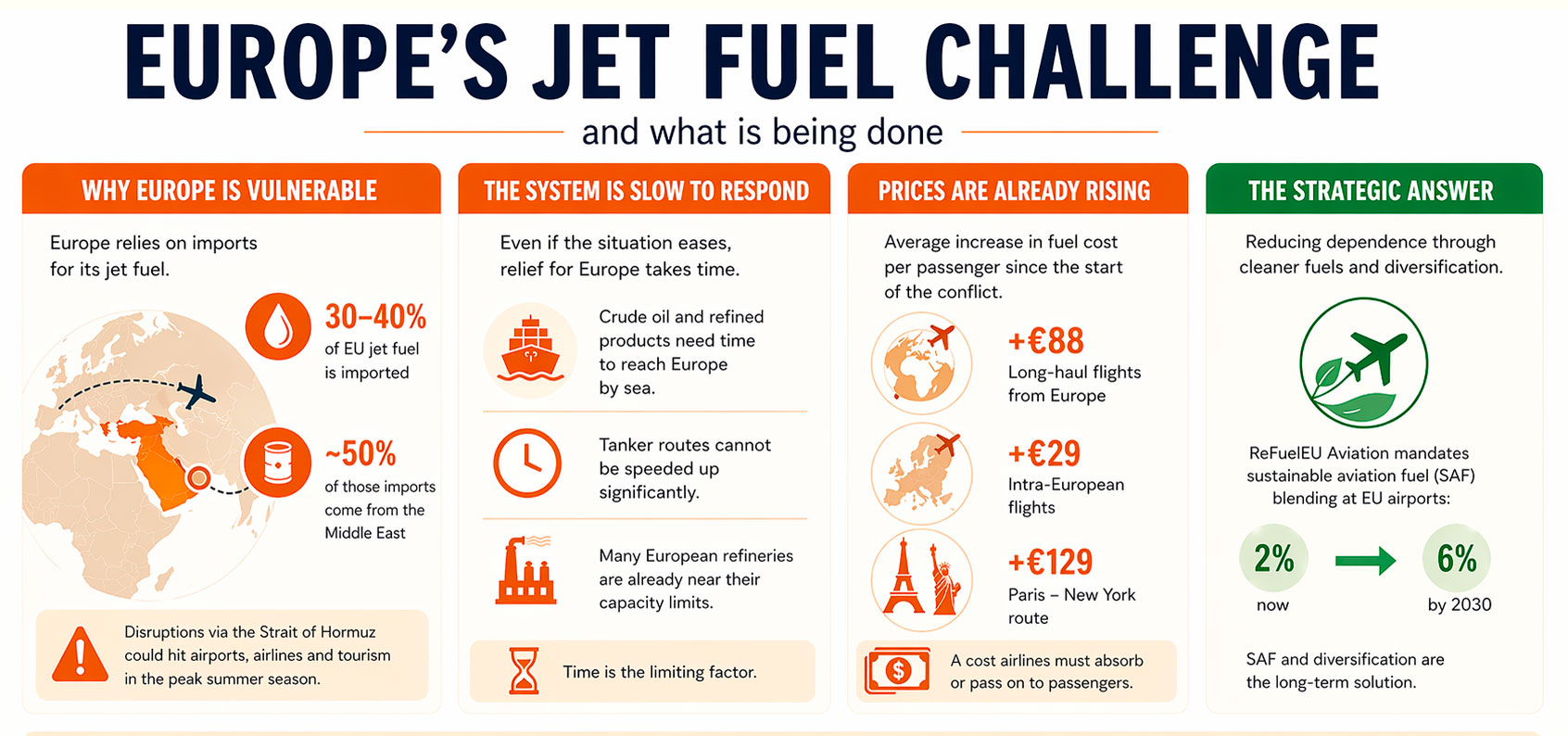
Europe’s Jet Fuel Challenge, Graphic by Energy Europe Editorial Team
Price pressure is already hitting airlines
There is also a second problem that is almost as challenging for airlines as the physical availability of jet fuel: price. A recent analysis by the environmental organisation Transport & Environment (T&E) shows how sharply cost pressures have already risen. According to the analysis, the fuel cost per passenger on long-haul flights from Europe has increased by an average of €88 since the beginning of the conflict, and by €29 on intra-European flights. On some routes, the surcharge is even higher. On the Paris-New York route, for example, it stands at around €129 per passenger. This is no longer an abstract market fluctuation, but a cost factor that airlines must either absorb or pass on to customers.
Diversification remains the EU’s strategic answer
However, Brussels is not just reacting defensively. The Commission is linking crisis management with its long-term strategy of reducing the aviation industry’s reliance on imported fossil jet fuel. According to Reuters, the production of sustainable aviation fuels and synthetic alternatives is set to be accelerated. Nevertheless, this is a medium- to long-term issue and will not provide rapid relief in the coming days. Under the ReFuelEU Aviation rules, EU airports currently have a mandatory blending quota of 2 per cent sustainable aviation fuel, which will rise to 6 per cent by 2030. Therefore, the regulation is not an immediate remedy for an acute Hormuz disruption, but it is part of the strategic response to the system’s underlying vulnerability.
Reserves can buy time, but they cannot solve the problem
The question of reserves is therefore also coming into sharper focus. While member states maintain emergency stocks of oil and oil products, there is no separate European mandatory reserve specifically for jet fuel. According to Reuters, the EU could organise a coordinated release of stocks if the disruption continues. This would stabilise the market in the short term, but it is no substitute for robustly diversifying supply routes. Therefore, what matters is how quickly Europe can source additional volumes from other regions and distribute them across the Union. The fact that Brussels is now preparing guidelines for this demonstrates one thing above all: the Commission no longer considers the risk to be merely theoretical.
Europe’s vulnerability is out in the open
For Europe, the Hormuz crisis is more than a distant geopolitical conflict – it is a stress test for its supply security. A shortage has not yet materialised, but Europe’s dependence on external supply routes has become apparent. Therefore, the answer cannot consist solely of crisis management. In the short term, the EU must coordinate reserves, secure alternative supplies, and prevent bottlenecks within the internal market. In the long term, however, the problem can only be solved through greater diversification, increased refining capacity in Europe, and accelerated development of sustainable aviation fuels. The emergency plan for jet fuel is therefore not just a technical precautionary measure; it is an attempt to address Europe’s greatest air transport weakness at a strategic level.