

'/%3E%3C/svg%3E)
Norway has everything Europe seems to need for a greener energy future: vast hydropower, strong political ties, and direct electricity links to the continent. But behind that promise stand major obstacles – from a weak domestic grid to the lasting pull of oil and gas revenues.
Europe is counting on Norway’s clean power – but the links are not yet in place
Back in 2015, a new meme was spreading through the media: Norway as the EU’s green battery. The country indeed had remarkable potential as an energy supplier of various kinds – both fossil fuels and green energy. During the following decade, two undersea high-voltage cables were commissioned to carry Norway’s green electricity to Europe: the 720-km North Sea Link runs from Norway to the UK, while the 625-km NordLink connects Norway and Germany. Their combined capacity is 2,800 megawatts, enough to power some 5.6 million homes.
But over the past five years, the initiative has not been as prominent. In this article, we shall look at the potential of the “Norwegian model” and see how Europe can benefit from it.
Norway as a model
Interestingly, Norway developed green electricity long before it became a prominent oil and gas producer. Hydropower emerged in the late 19th and early 20th century, while the oil and gas industry did not appear until the 1960s. Oil and gas became export commodities, while domestic energy generation remained predominantly hydro-based. According to IEA, in present-day Norway 89% of total electricity generation comes from hydropower, 9% from wind power, and only 0.9% from natural gas.
Over the decades, Norway has preserved and expanded its green energy capacity and environmental consciousness. The hydro system is so productive that electricity covers nearly half of the country’s total energy consumption – the highest share among all IEA member nations. At the same time, citizens largely prefer green solutions – the country ranks first in the world when it comes to electric vehicles. More than a quoter of cars on Norwegian streets are plug-in electric vehicles, and the share of newly purchased electric cars and hybrids surpasses 90%.
Unlike solar or wind, hydropower is dispatchable. Water is stored behind dams and released on demand. This makes Norway the closest thing Europe has to a giant, rechargeable battery.
This is not an easy model for any country to follow, since much of Norway’s success hinges on its natural resources and historical development. But the country has much to contribute to the energy transition worldwide and certainly in Europe.
“Without hydropower, Norway would be a totally different society,” said Olav Akselsen, former Norwegian Minister of Petroleum and Energy, back in 2001. “One hundred years ago we decided to use our enormous hydropower potential. It has been a great phenomenon.”
The oil paradox
However, another conscious choice has made it difficult for Norway to play the role of a 100% green hero. The government’s 2025 Climate Strategy admits: “Norway is both an active promoter of ambitious international climate co-operation and a significant petroleum exporter.”
The official position is that Norwegian gas replaces coal in Europe, thus cutting CO2 emissions on the continent. But if Europe truly decarbonises, gas demand is going to collapse as well. That would be great for the climate, but quite painful for Norwegian state revenues. So, can Norway commit to being Europe’s battery while maximising fossil fuel income?
The most obvious solution is to use its “petroleum momentum” to kick-start a new, cleaner energy industry. Yet here it gets tricky.
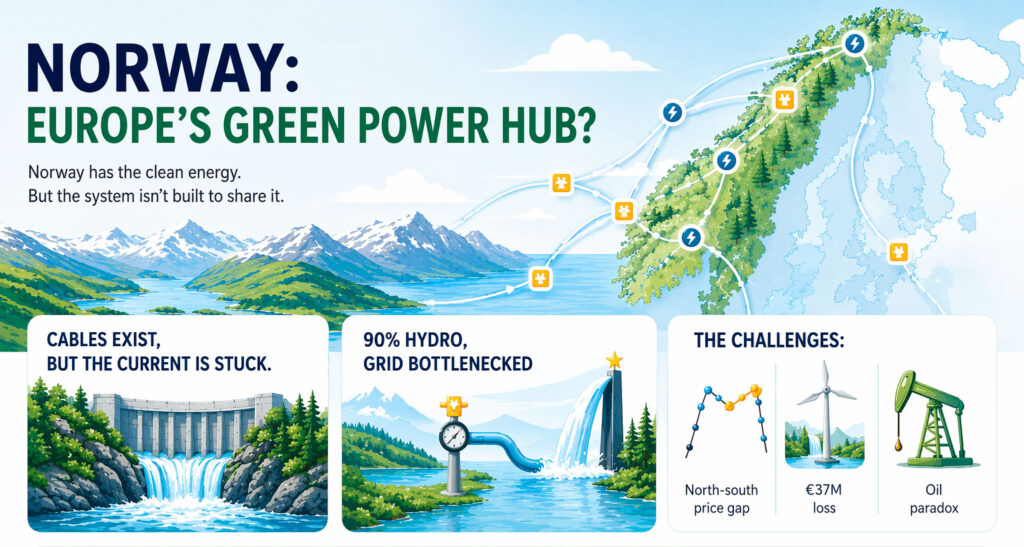
Norway as Europe’s Green Power Hub, Graphic by Energy Europe Editorial Team
The missing link
The low-hanging fruit – exporting hydro-generated electricity to Europe – stumbles when it comes to transmitting it through Norway. The “Norway as a green battery” vision depends on existing interconnectors: subsea cables to Germany, the UK, Denmark, and the Netherlands. But to fill them up, Norway has to move power from its own north to its own south. As the IEA puts it, “Lack of transmission capacity from north to south results in large price differences.”
Most hydropower is in the north. Most people – and the European cables – are in the south. The grid between them is too weak. So weak that in summer 2025, northern Norway had near-zero prices while southern Norwegians paid German-level prices.
SINTEF 2025 roadmap warns that this bottleneck is a critical barrier. Without a grid upgrade costing billions of euros, the battery will only work on paper.
The limits of wind
There are also more modern green energy solutions, such as wind farms, but so far their large-scale development has proved uneconomical. In its 2025 annual results, Statkraft, Europe’s largest renewable energy generator, owned by the Norwegian state, reported a net loss of NOK 413 million (EUR 37 million) due to falling electricity prices, which pushed down the value of wind assets.
This is a market failure, not a technical one. A mild European winter and sluggish industrial demand kept prices low. When prices are low, wind farms – with high upfront costs – become loss-making. But if investors cannot make money from wind in Norway, they will not build more. And without more wind, the battery’s charging capacity remains limited.
So, is Norway going to be Europe’s green battery? The technical answer is yes. Hydropower is there, wind farms are in place, and both can be scaled up further. Even the cables to Europe have already been laid.
A strong partner, an unfinished transition
Norway also remains Europe’s strongest candidate politically. “Norway is our most reliable partner contributing to Europe’s energy security, playing a vital role in our diversification strategy and helping to reduce reliance on Russian oil and gas,” said António Costa, President of the European Council, at a press conference in Oslo on 19 February 2026.
Yet Norway can only become a real backbone of Europe’s green energy transition if it invests billions in its neglected grid – and accepts that the fossil fuel profits which helped build its success cannot define its future forever. Until then, much of that potential will stay untapped, and Europe’s shift away from conventional fuels will remain incomplete.