


Germany’s renewable-energy surge in the first half of 2026 is no longer just a climate story. It is increasingly reshaping the economics, security and operating logic of the country’s power system.
Renewable energy covered 58 percent of Germany’s gross electricity consumption between January and June, according to preliminary calculations by the Centre for Solar Energy and Hydrogen Research Baden-Württemberg (ZSW) and the German Association of Energy and Water Industries (BDEW). This was a new first-half record. Renewable plants generated 152.2 billion kWh of electricity, up from 144.1 billion kWh in the same period of 2025.
Fraunhofer ISE reported a similarly strong result using a different methodology. Renewables accounted for 58.5 percent of Germany’s electricity load and 61.8 percent of net public electricity generation. At the same time, Germany’s net electricity imports fell sharply to 1.3 TWh, compared with 9.6 TWh in the first half of 2025.
The figures suggest that renewable growth is beginning to influence more than Germany’s emissions profile. It is also affecting the country’s exposure to fossil-fuel prices, its electricity trade and the way the power system must be operated.
As ZSW board member Frithjof Staiß noted, a higher share of renewable energy reduces dependence on imported fossil fuels and makes the economy more resilient to energy-price shocks. In the power sector, that effect is becoming increasingly visible. However, it depends on the parallel expansion of grids, storage capacity and flexible demand.
Wind and solar drive the increase
Wind and solar were the main drivers of the increase.
According to BDEW and ZSW, onshore wind generation rose by 7 percent compared with the first half of 2025, while offshore wind generation increased by 28.3 percent. Photovoltaic generation was 3.7 percent higher. Hydropower, by contrast, declined because of lower rainfall.
Fraunhofer ISE recorded offshore wind output rising from 11.4 TWh to 14.6 TWh and onshore wind generation increasing from 48.7 TWh to 52.8 TWh. Solar generation reached a record 43.2 TWh, around 10 percent more than a year earlier.
The difference between the BDEW/ZSW and Fraunhofer figures is methodological rather than contradictory. BDEW and ZSW calculate the renewable share on the basis of gross electricity consumption, while Fraunhofer focuses on electricity load and net public electricity generation. The figures therefore describe different parts of the same expanding renewable-power system.
Solar capacity also continued to grow rapidly. Fraunhofer ISE recorded 2.1 GWp of new rooftop installations of up to 30 kWp in the first half of the year, a further 1.1 GWp in the 30–100 kWp segment and 3.5 GWp of ground-mounted solar capacity.
BDEW put Germany’s total gross photovoltaic additions at 8.3 GW in the first six months of 2026, compared with 7.8 GW a year earlier. Onshore wind additions reached 2.5 GW, while offshore wind additions amounted to 0.9 GW.
BDEW managing director Kerstin Andreae said maintaining this momentum would require faster political decisions and reliable investment conditions. “Investments only flow where reliable rules apply,” she said.
Renewables are changing electricity prices
The first-half results show that renewables are increasingly affecting electricity prices, energy imports and the operation of the power system.
Fraunhofer ISE found that strong renewable generation helped prevent the sharp rise in gas prices during the spring of 2026 from translating fully into wholesale electricity prices. Following the outbreak of the war in Iran, gas prices rose sharply, but electricity prices did not increase to the same extent. Strong renewable generation reduced the extent to which expensive gas-fired power plants determined wholesale electricity prices.
According to Leonhard Gandhi, project manager of Fraunhofer ISE’s Energy-Charts platform, the April exchange electricity price would have been 76 percent higher without the strong contribution from renewable energy. The estimate illustrates the growing influence of wind and solar on wholesale price formation.
At the same time, the figures expose the next challenge for Germany’s energy transition.
High levels of wind and solar production are creating more periods with electricity prices close to zero or below zero. Generation peaks and load curves increasingly demonstrate the need for intraday storage and more flexible electricity consumption.
Germany’s battery-storage capacity increased from 25.4 GWh to 29.3 GWh during the first half of 2026. More large-scale battery storage was commissioned in those six months than during the whole of the previous year. Nevertheless, Fraunhofer ISE says a significant storage gap remains.
Additional storage could absorb surplus electricity during periods of high solar and wind production and release it when generation falls. This would help shift renewable power from periods of abundant supply to hours of lower generation and reduce extreme differences in wholesale prices.
The economic value of renewables will therefore increasingly depend on timing and location. Cheap electricity is most valuable when it can be delivered where industry and households need it, or shifted through storage and flexible demand to the hours when renewable generation is lower.
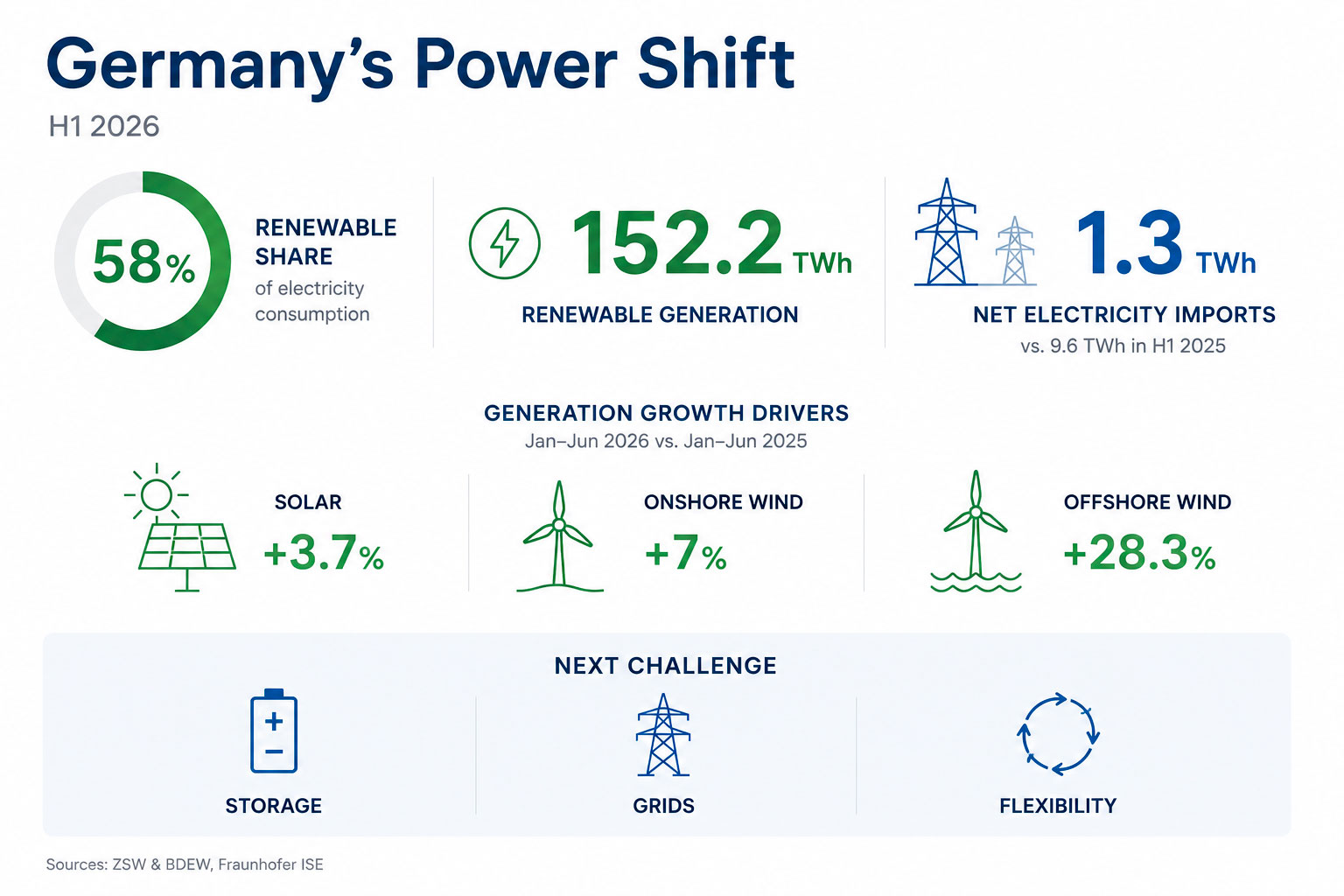
Germany’s Energy Transition in H1 2026. Graphic by the Energy Europe Editorial Team.
The transition extends beyond electricity
The challenge is not limited to the power sector.
Germany’s Federal Environment Agency (UBA) reported in July that renewable energy use had also increased in heating and transport during the first half of 2026. At the same time, the agency warned that progress in electricity generation should not obscure the slower transformation of other sectors.
UBA President Dirk Messner described the figures as encouraging but called for faster deployment of electric cars and heat pumps. He also stressed that the electricity system needs more large-scale battery storage to become sufficiently flexible.
This broader perspective is important. Electricity generation from wind and solar is expanding rapidly, but decarbonising heating and transport also requires changes to vehicles, buildings, infrastructure, consumer behaviour and industrial processes.
A successful energy transition will therefore depend on stronger links between the sectors. Surplus renewable electricity can power heat pumps, electric vehicles and industrial processes, but only if the necessary networks, market incentives and flexibility mechanisms are in place.
The next challenge is system integration
The figures suggest that Germany’s energy debate is gradually moving from one central question, how quickly renewable capacity can be built, to another: how efficiently a power system dominated by variable renewable generation can use the electricity it produces.
Solar is likely to remain an important source of new capacity, while battery storage, grid expansion and flexible consumption will become increasingly important measures of progress. The first half of 2026 already demonstrated why: Germany recorded high renewable generation, sharply lower net electricity imports, more periods of very low or negative electricity prices and rapid growth in storage capacity at the same time.
For industry, this creates both opportunities and challenges. A larger supply of renewable electricity can reduce exposure to fossil-fuel price shocks and improve energy security. But electricity must also be available in the right quantity, at the right location and at the right time.
This will make flexibility an increasingly important industrial and political issue. Companies able to shift demand, use on-site storage or align production with periods of abundant renewable electricity may gain a competitive advantage. Those facing inflexible consumption and congested grid connections could experience higher costs despite lower average wholesale prices.
Looking towards 2027, the decisive question will therefore not be simply how much renewable electricity Germany can generate. It will be how effectively that electricity can be integrated into a stable, flexible and economically competitive power system.
The central issue of the next phase of Germany’s Energiewende is no longer only the expansion of renewable generation. It is the design of the system that allows renewable electricity to deliver its full value.