


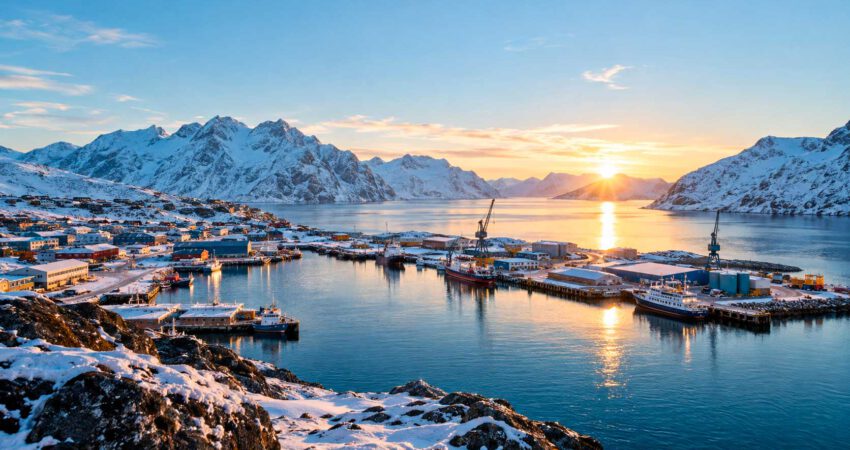
The Arctic is becoming a test case for Europe’s energy policy. The region has substantial oil and gas potential, as well as critical raw materials and renewable energy resources for the energy transition. At the European Arctic Summit in Rovaniemi, it became clear that Europe wants not only to strengthen its security in the far north, but also to forge new energy and raw materials partnerships – particularly with Greenland.
The Arctic is moving up Europe’s energy policy agenda. It is unlikely to replace Russian pipeline gas supplies – which have fallen sharply since 2022 – in the short term, given the challenges of development, infrastructure and environmental regulation. In the long term, however, the region could play a decisive role in securing Europe’s access to energy, critical raw materials and the industrial value chains needed for the energy transition.
At the European Arctic Summit in Rovaniemi on 13–14 September 2026, this connection was articulated with unusual clarity. “The importance of the region goes beyond military security: this is about economic security, critical minerals, energy, infrastructure and logistics, trade routes, security of supply, climate change and sustainable development,” said Finland’s Prime Minister Petteri Orpo.
This raises a question of energy policy: can Europe build up the resources, networks and industrial partnerships it needs in the far north to strengthen its economic independence – without turning the Arctic into a new fossil fuel province?
The answer will help determine how resilient the European energy transition will be. After all, wind turbines, electricity grids, electrolysers, batteries and data centres do not just require energy. They also depend on critical raw materials and a stable, increasingly electrified infrastructure.
On 16 September 2026, European Commission President Ursula von der Leyen made it clear just how urgent the need for action has become. She stated that Europe is more than 80 per cent dependent on China for many critical raw materials, and as much as 90 per cent for some rare earths. “Not only our industry depends on this, but also our independence and security,” said von der Leyen in her State of the Union address.
The Arctic is therefore not merely an energy region for Europe in the traditional sense. It could also provide part of the material basis for the European energy system of the future.
VAST RESOURCES, EXTREME CONDITIONS
However, the Arctic is not a uniform economic area. The Arctic Council comprises eight states: Canada, the Kingdom of Denmark (including Greenland and the Faroe Islands), Finland, Iceland, Norway, Russia, Sweden and the United States. Around four million people live in the Arctic, approximately 500,000 of whom belong to Indigenous peoples.
This low population density is of considerable significance for energy policy. New mines, power stations or industrial facilities cannot rely on the same infrastructure as projects in Central Europe. Roads, ports, electricity supplies and communication networks must, in some cases, first be built or significantly expanded. This drives up costs and explains why even large deposits of raw materials are not automatically economically viable to exploit.
At the same time, climate change is altering conditions. A study published in 2022 in Communications Earth & Environment concluded that, between 1979 and 2021, the Arctic warmed nearly four times as fast as the globe as a whole.
This so-called Arctic amplification does not necessarily make economic development easier. Less sea ice may lengthen shipping seasons in some areas, but thawing permafrost, coastal erosion, extreme weather and a lack of infrastructure simultaneously make the construction, operation and maintenance of many facilities more difficult and expensive.
Climate change is thus, paradoxically, making the Arctic more accessible in some respects while at the same time making it more difficult to develop. New economic opportunities are emerging in a region where the natural conditions for long-term investment are changing particularly rapidly.
ARCTIC OIL AND GAS: BIG POTENTIAL, BIG RISKS
Fossil resources are not disappearing from the equation. According to a 2008 assessment by the U.S. Geological Survey, the Arctic could harbour around 13 per cent of the world’s undiscovered, technically recoverable oil and around 30 per cent of its undiscovered, technically recoverable natural gas. Around 84 per cent of the estimated resources were expected to occur offshore.
However, the assessment describes geological potential, not proven, economically recoverable reserves. Whether a deposit can actually be developed depends on costs, infrastructure, energy prices, political decisions and environmental regulations.
This is precisely where the contradiction in energy policy lies. Europe wants to reduce its dependence on fossil fuels and, at the same time, has had to tap into new energy sources and supply routes following the sharp decline in Russian pipeline gas supplies. The Arctic therefore appears, at first glance, to be an obvious option: vast fossil fuel resources, potential new transport corridors and, at the same time, access to raw materials for the energy transition.
However, a European Arctic strategy that relies primarily on additional oil and gas production would be difficult to reconcile with the EU’s long-term climate targets. Added to this is the economic risk posed by investments running into the billions, which would be dependent on correspondingly high demand for fossil fuels for decades to come.
The strategic importance of the Arctic for Europe therefore increasingly lies in a different combination: renewable energy, critical raw materials, networks, transport routes, digital infrastructure and industrial processing.
Natural gas can continue to play a role here, particularly in supporting the reliability of power systems and supplying energy and feedstock for certain industrial processes. However, not every technically recoverable resource is necessarily worth developing from a strategic perspective. The decisive factors are development costs, the contribution to security of supply and compatibility with Europe’s long-term decarbonisation pathway.
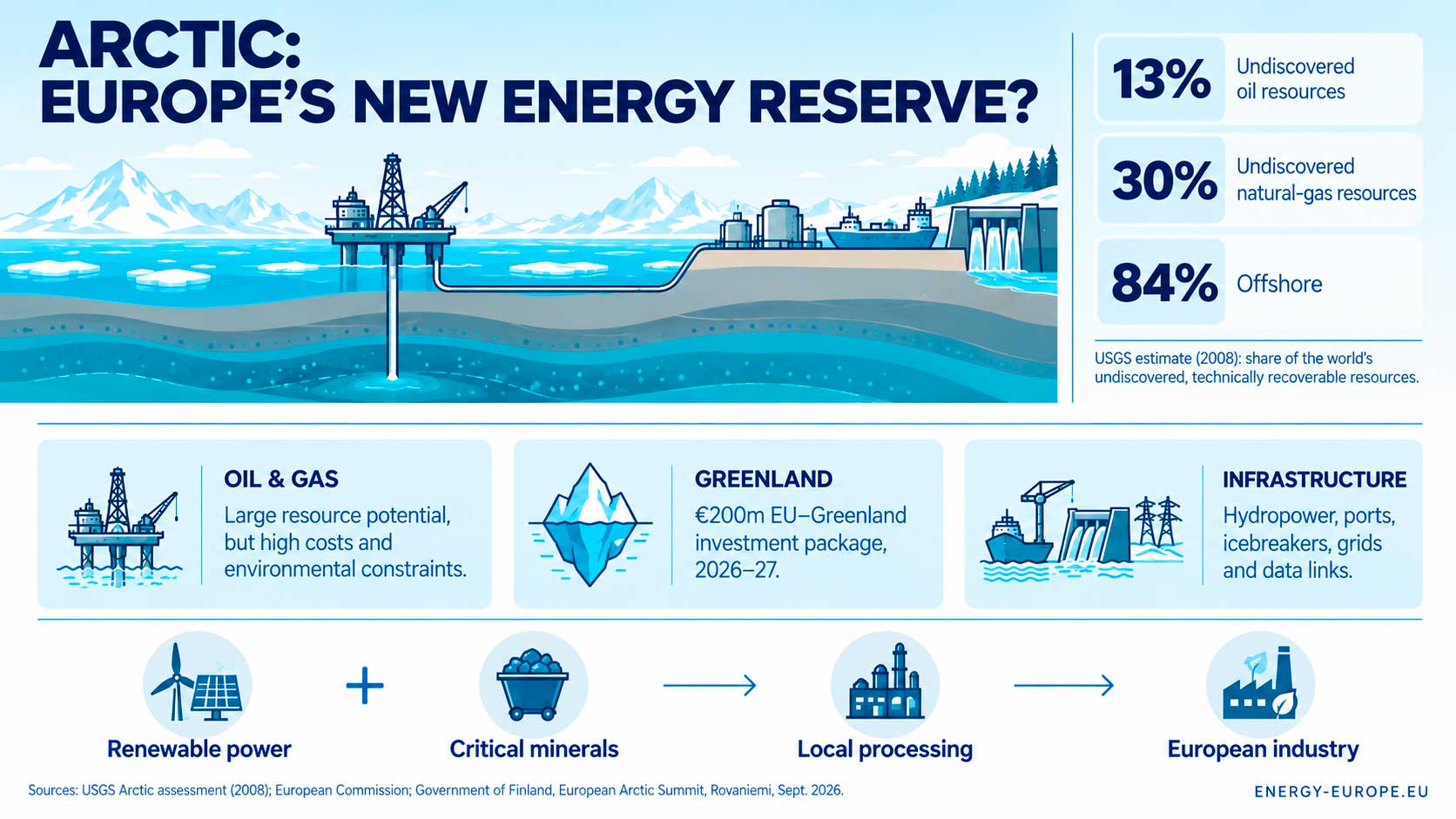
Arctic energy and Europe’s strategy. Graphic: Energy Europe Editorial Team.
GREENLAND: EUROPE’S ENERGY AND MINERALS PARTNER
This new approach is particularly evident in Greenland. On 7 September 2026, the European Commission announced a Global Gateway partnership package worth €200 million, to be invested in and with Greenland in 2026 and 2027.
“Greenland can count on the EU,” said Commission President Ursula von der Leyen during her visit to Nuuk. The package would create “new opportunities and a strong and engaged EU in both Greenland and the Arctic”. Greenland is “a strategic ally and a trusted friend”.
The package’s priorities highlight what matters most to Europe in the far north today: connectivity, sustainable energy and critical raw materials. In addition, there will be investment in areas including education, fisheries, tourism, housing and small businesses.
The scale of Greenland’s raw-material potential is particularly striking. According to the European Commission, Greenland has deposits of 25 of the 34 raw materials that the EU has classified as critical for the green and digital transitions. These include materials needed for batteries, electricity grids, electric motors and numerous industrial applications.
These resources are part of a European raw materials strategy with specific targets. The Critical Raw Materials Act sets non-binding benchmarks for EU capacity by 2030: extraction should cover at least 10 per cent of the EU’s annual consumption of strategic raw materials, processing at least 40 per cent and recycling at least 25 per cent. No single third country should supply more than 65 per cent of the EU’s annual consumption of any strategic raw material at any relevant stage of processing.
Although Greenland is not part of the EU, it can help diversify supplies. One example is molybdenum, used in high-strength and heat-resistant steel alloys, among other applications. The Malmbjerg project in East Greenland could help diversify Europe’s molybdenum supply in the long term.
The package therefore goes beyond traditional raw materials policy. Satellite communications and undersea cables are intended to improve digital connectivity, renewable energy to strengthen local energy supplies, and investment in critical raw materials to support local value creation.
This link is particularly evident in the energy sector. The EU will support a programme led by Greenland’s national energy utility, Nukissiorfiit, to modernise and decarbonise energy supplies in remote settlements through hybrid renewable energy systems. At the same time, the EU and Greenland are exploring support for the expansion of the Buksefjord hydropower plant to meet growing electricity demand in Nuuk.
This is more significant for energy policy than it might initially appear. A reliable electricity supply with the lowest possible CO₂ emissions is a prerequisite for digital infrastructure, local raw materials processing and other energy-intensive industrial projects. The strategic value of Greenland’s renewable energy resources may therefore lie less in direct electricity exports to Europe than in supporting local industrial value creation.
The EU is thus seeking to establish a different model of raw materials partnership. The focus should not be solely on extraction and export. Energy supply, infrastructure, skills, investment and processing should be planned together.
The Amitsoq graphite project illustrates the potential for more integrated value chains between Greenland and Europe. For Europe, a deposit’s strategic value increases significantly when extraction, energy supply, processing and offtake can be linked over the long term.
INFRASTRUCTURE: THE ARCTIC’S MISSING LINK
However, the Arctic’s greatest bottlenecks often lie not underground, but above ground. Anyone wishing to extract raw materials, generate energy or build industrial capacity needs electricity, ports, roads, ships, data connections and reliable logistics.
In the far north, meeting these requirements is costly and technically challenging. Long distances, low population density and extreme climatic conditions significantly increase project costs.
That is why infrastructure also played a central role at the Rovaniemi summit. Orpo called for concrete European projects in the north, including critical infrastructure, cross-border transport links, the extraction and processing of critical minerals, and satellite launch capabilities.
Icebreakers also form part of this equation. “Icebreaking capabilities are also a strategic resource,” Orpo explained in Rovaniemi. He said Europe should explore the possibility of joint ownership of icebreakers.
This is a logical step for Europe’s energy and raw materials strategy. Without ports, ships, power supplies and transport routes, even large deposits may not be economically viable.
The real challenge, therefore, does not lie in identifying individual deposits. Europe would need to develop entire value chains – from energy and transport through extraction and processing to industrial consumers.
EUROPE’S ARCTIC ENERGY BALANCING ACT
This is complicated by the political situation. Cooperation with Russia within the Arctic Council has been significantly curtailed since the Russian invasion of Ukraine.
Technical cooperation has been gradually resumed in specific areas and at project level. In February 2024, the eight Arctic states agreed to gradually resume official working group meetings in virtual form. This has enabled scientific cooperation, as well as the Council’s projects and initiatives, to move forward again. However, high-level political cooperation remains severely restricted.
For Europe, this increases the importance of cooperation with Greenland, Denmark, Finland, Sweden, Norway, Iceland and Canada. Energy, raw materials, research, infrastructure and environmental standards can hardly be developed in isolation from one another in the Arctic.
At the same time, a European strategy must not treat the region’s inhabitants merely as a factor in investment decisions. Around 500,000 of the Arctic’s roughly four million inhabitants belong to Indigenous peoples. Raw materials, energy and infrastructure projects directly affect local environments and livelihoods. Public acceptance therefore also depends on the extent to which local communities are involved in decision-making and share in the economic benefits.
The case of oil and gas in particular illustrates why a broader approach is necessary. Fossil resources make the region attractive from an energy policy perspective, but they should not become the sole yardstick for European Arctic policy. New dependencies on an extremely sensitive and costly extraction area would repeat many of the problems that Europe is currently trying to overcome.
Europe’s most important energy reserve in the far north may not, in the end, be the oil or gas beneath the seabed. Of greater strategic value would be a reliable supply of renewable electricity, stable networks and transport routes, as well as supply chains for those raw materials without which the European energy transition cannot function.
The Arctic thus becomes a test case for European energy and industrial policy. If Europe succeeds in combining hydropower, digital connectivity, critical raw materials, processing and local value creation, the far north can contribute to a more resilient energy supply for Europe. If it fails, the region will remain, above all, an area of enormous resource potential – but also of high costs, environmental risks and political tensions.