

'/%3E%3C/svg%3E)

The G7 has agreed to coordinate the release of 100 million barrels of oil and fuel stocks through the International Energy Agency over four months, taking account of earlier commitments. It has not specified how much of that total represents newly pledged supply. US President Donald Trump has since said he will not authorise a diesel export ban. The immediate risk of a US diesel export ban has eased, but Europe’s diesel concerns remain: much will depend on how much finished diesel reaches the market, how quickly the releases take effect and whether tight global supplies begin to ease.
The agreement followed several days of mounting pressure from Washington. On 1 October 2026, Reuters reported that the US administration had called on Germany and France to release additional diesel reserves, with a potential US export ban remaining on the table. One source put the US request to the EU at 120 million barrels over six months.
Earlier on 2 October, European governments discussed a French proposal to release 50 million barrels of diesel from emergency stocks, potentially accompanied by 50 million barrels of crude oil from IEA members. That was a negotiating proposal, not the final structure of the agreement. Later that day, the G7 agreed on a coordinated release through the IEA of 100 million barrels, beginning immediately and spread over four months. The statement calls for a substantial diesel release to be frontloaded within the first 20 days, but does not set a final 50-million-barrel diesel/50-million-barrel crude split.
Europe still needs US supplies
The US has become an important supplier of diesel to Europe. According to S&P Global Commodities at Sea data, the US was on track to ship around 360,000 barrels of diesel per day to Europe in the third quarter of 2026. With Trump having ruled out an export ban, those flows no longer face the immediate threat of disruption that was under discussion at the beginning of October. Europe nevertheless remains exposed to changes in global supply because replacement barrels are limited.
The debate is taking place against the backdrop of an already strained market. The European Commission described supply as stable at the end of September, while highlighting high diesel and kerosene prices. Commercial stocks at the Amsterdam-Rotterdam-Antwerp hub were below their five-year average, while European refineries were operating at near-maximum capacity.
Data from the International Energy Agency illustrate how limited the alternatives are. Net exports of diesel and gasoil from Gulf states averaged around 390,000 barrels per day in August – just over a quarter of pre-war levels. Taken together, net diesel and gasoil exports from the Gulf states and Russia were around 1.6 million barrels per day below February levels.
This is also relevant for the EU because, as a result of European sanctions, Russian diesel is no longer a regular direct source of supply for the bloc. If Russian or Middle Eastern volumes are unavailable on the global market, competition for alternative supplies intensifies.
Focus on Germany
As a major European diesel market, Germany is exposed to changes in regional prices. It also holds a significant share of the EU’s strategic diesel and gasoil stocks. According to the latest Eurostat data available for this analysis, covering May 2025, Germany held 5.6 million tonnes of strategic diesel and gasoil stocks, while France held 8.2 million tonnes. Together, the two countries accounted for around 35 per cent of the EU’s stocks in this category. The Eurostat data analysed by Reuters therefore provide a snapshot for May 2025, not of stock levels in October 2026.
The G7 decision brings strategic stocks to the centre of the immediate market response. Germany has substantial reserves, but the G7 statement does not specify how much Germany will release, or whether its contribution will consist of finished diesel, crude oil or other products.
Speaking before Trump ruled out the export ban, an employee of a major German energy company who works on petroleum-market issues said a US export ban would initially lead primarily to higher procurement costs in Europe. He did not expect an immediate nationwide diesel shortage. He spoke to Energy Brief on condition of anonymity because he is not authorised to comment publicly on behalf of his company. His assessment does not represent the company’s official position.
“Even if the United States were to impose an export ban, it would not be a disaster for the German economy. A three-month export ban would certainly be noticeable, but it would hardly constitute a major economic shock. The sectors most severely affected would be freight transport, agriculture, construction and companies with high diesel consumption. Higher logistics costs would gradually be reflected in the prices of other goods as well. From today’s perspective, however, a nationwide fuel shortage is not to be expected.”
Before the G7 agreement was reached, the expert described European coordination as a key factor in the decision then facing Berlin. In his view, any additional release should at that stage have been assessed jointly against the actual supply risk, commercial stock levels and the availability of alternatives to US supplies.
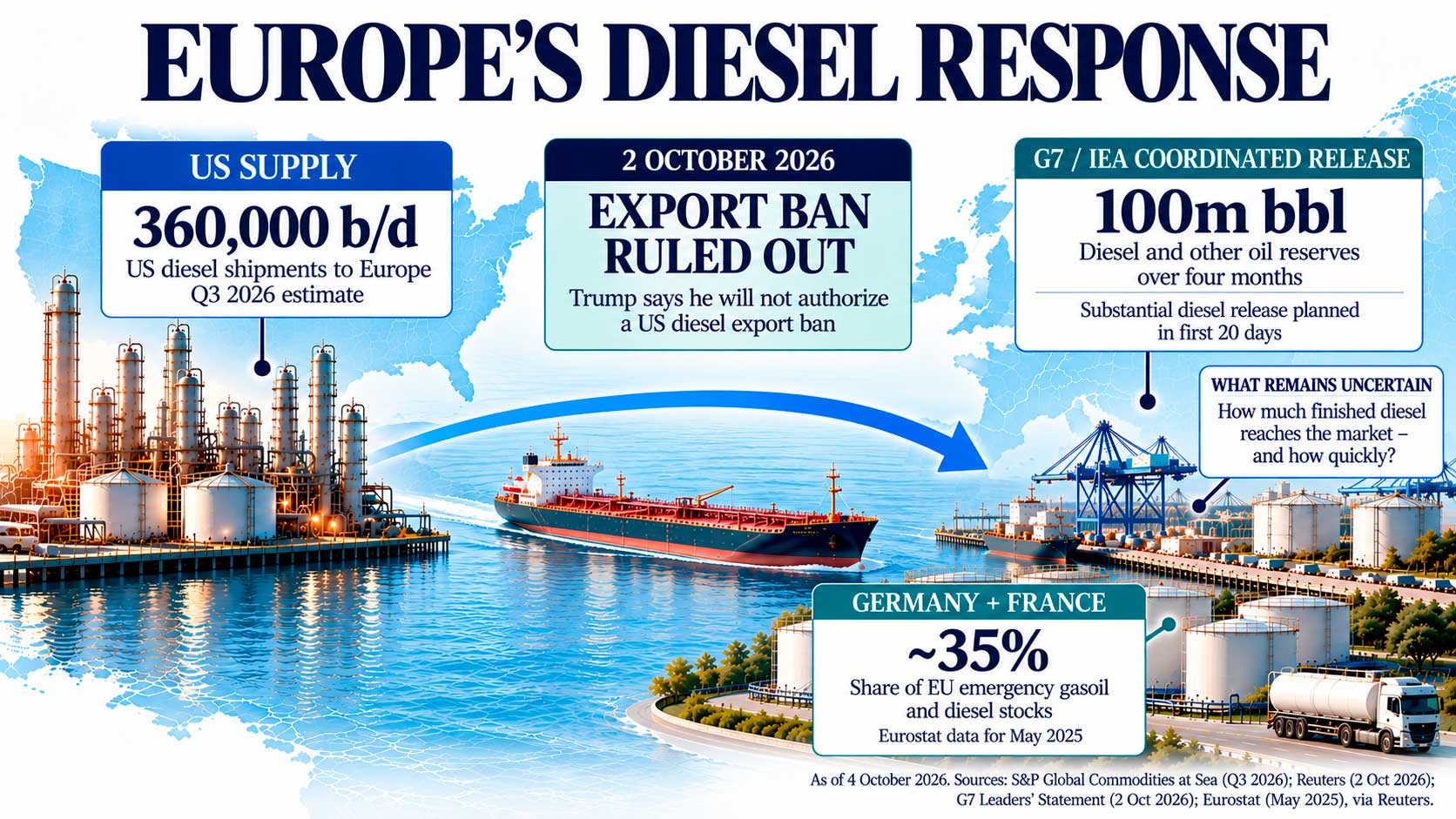
US imports, strategic reserves and measures to ease short-term supply pressure. Graphic: Energy Europe Editorial Team.
How an export ban could have affected prices
Before Trump ruled out an export ban, Goldman Sachs modelled what such a measure could mean for fuel markets. The scenario remains useful for explaining why European governments opposed the idea, but it is no longer the immediate policy scenario facing the market.
According to the Goldman Sachs analysis reported by S&P Global Energy, a complete export ban could initially push down average US diesel prices by around 25 US cents per gallon each week – equivalent to about four per cent of the US diesel price at the time of the analysis – while sufficient storage capacity remained available.
For Europe, the analysts modelled an increase in wholesale prices of around $3 per barrel, or about two per cent. Releases from European strategic diesel reserves could offset roughly half of this potential increase, according to the analysts.
The model calculation is not a forecast for German pump prices. In particular, the initial weekly US effect cannot simply be extrapolated over several months. Storage capacity, refinery output, replacement supplies and reserve releases alter market conditions.
For Germany, higher diesel prices can spill over into other parts of the economy through transport and production costs. However, no reliable quantitative forecast for economic growth or inflation can be derived from this model.
G7 agrees coordinated reserve release
Beyond the reserve release outlined above, the G7 agreement contains several measures aimed at increasing and safeguarding the supply of refined fuels.
The G7 also said members would refrain from export restrictions on energy and energy products between G7 countries and called on other producers to avoid bans that could worsen market tensions. The IEA is to monitor implementation and market effects and provide a follow-up report before the end of the first 20 days. The statement leaves open the possibility of additional diesel releases if necessary.
The G7 also agreed to coordinate refinery maintenance and temporarily increase refinery utilisation where feasible, while seeking additional refined-product output from other countries. Those measures are intended to support the availability of finished fuels alongside the emergency stock release.
Earlier on 2 October, the Energy Union Task Force – Security had brought together senior representatives of EU Member States and the Commission to discuss diesel-market developments and possible measures. The later G7 agreement moved the talks beyond the earlier French proposal but did not specify a final split between diesel and crude oil.
According to Reuters reporting on the talks, European participants had also discussed linking further reserve releases to a US commitment not to impose a unilateral export ban. Trump’s subsequent statement that he would not authorise such a ban removed that immediate point of contention.
What can Europe’s reserves deliver?
Under the EU Oil Stockpiling Directive, Member States must maintain stocks equivalent to at least 90 days of average daily net imports or 61 days of average daily domestic consumption. The higher figure applies.
This requirement relates to oil stocks as a whole and does not mean that every country holds enough finished diesel to cover 90 days of normal consumption. The required stocks may consist of crude oil and petroleum products. The G7 decision refers to a coordinated 100-million-barrel release overall, with a substantial diesel component frontloaded in the first 20 days; it does not specify a final split between diesel and crude oil.
In the event of significant disruptions to oil supplies, a coordinated response can be organised through the International Energy Agency. Its emergency response system is designed to mitigate the economic impact of sudden supply disruptions, including through stock releases and demand-side measures. It is not designed as a tool for long-term supply management.
The distinction between existing and new commitments is already visible. On 5 October, Japan said it had no plans for a further release of crude oil from its national reserves at this stage, noting that it had released oil earlier. Japan did not withdraw from the G7 agreement. Its statement nevertheless underlines why the amount of newly available fuel under the coordinated release remains to be clarified.
For Europe, the release therefore involves a trade-off: it can bring additional volumes onto the market, but drawing down emergency stocks reduces the buffer against further disruptions. How much finished diesel becomes available, and when, will be clearer as the IEA monitors implementation and reports back within 20 days.
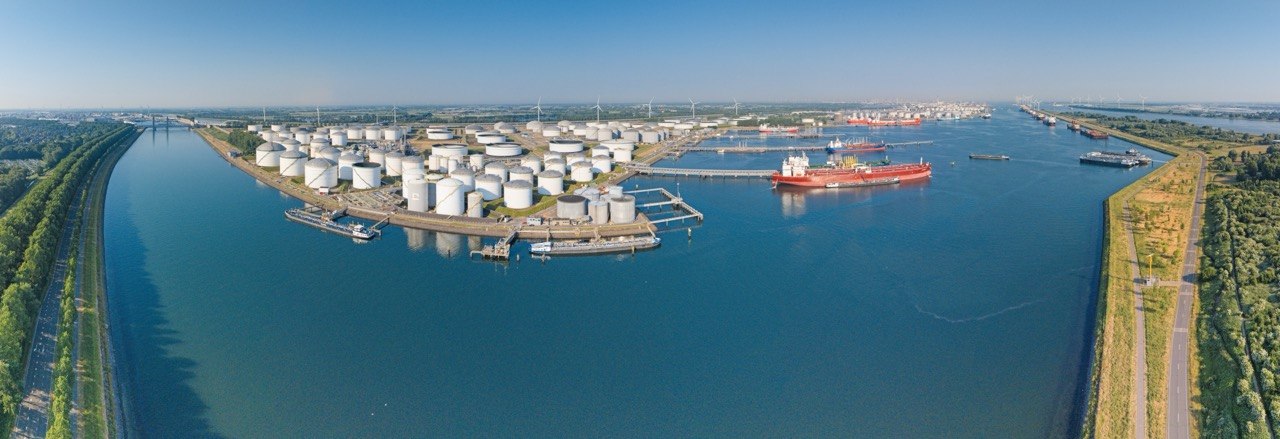
Photo: Adobe Stock #613476442
Why the export-ban scenario mattered for the US
Although Trump has now ruled out the ban, the Goldman Sachs scenario also illustrates why an export restriction could have created problems inside the United States. If foreign buyers disappeared, additional diesel volumes would have to be sold domestically or stored. As storage approached capacity limits, falling refinery margins could prompt refiners to reduce output.
The consequences modelled by Goldman Sachs illustrate this trade-off. Initially, US diesel prices could fall. However, once diesel storage was full, the analysts estimated that US retail gasoline prices could rise by around 30 US cents per gallon as refiners reduced production. Goldman Sachs had described potential restrictions as a “very plausible scenario, though not our base case”.
As quoted by S&P Global Energy, the Goldman Sachs analysts explained the mechanism: “Therefore, downward pressure on diesel production can mean downward pressure on gasoline production, i.e. upward price pressure on gasoline.”
What happens next
The immediate political dispute has eased: the G7 has agreed on a coordinated reserve release and Trump has ruled out a US diesel export ban. The focus now shifts from the threat of lost US supply to the implementation and effectiveness of the reserve release.
Europe is not without options. It continues to receive US diesel, has strategic reserves and refining capacity of its own, and can coordinate measures through the EU, G7 and IEA. At the same time, the global market remains tight and replacement supplies from other regions are limited.
Germany occupies a particular position because it is both a major diesel market and one of the EU countries with large strategic diesel and gasoil stocks. How much Germany contributes to the coordinated release, and in what form, will matter for the balance between immediate market relief and maintaining an emergency buffer.
Trump’s decision not to authorise a diesel export ban has removed the immediate threat to European supplies, but it does not eliminate the underlying geopolitical risk. A renewed escalation in the Middle East, particularly one that further disrupts flows through the Strait of Hormuz, could again put governments under pressure to protect domestic fuel markets. The IEA says refined-product flows from the Gulf remain severely constrained. The G7 has committed its members to refrain from export restrictions on energy and energy products between G7 countries. That makes a renewed US ban politically more difficult, but it does not remove the broader risk of future policy changes if the supply crisis worsens.
The next test will be implementation: how quickly substantial diesel volumes reach the market, how prices and commercial stocks respond, and whether the IEA’s first follow-up assessment points to a need for further releases. The diesel dispute has therefore shifted from a confrontation over export restrictions to a test of how effectively international emergency stocks can stabilise a tight market.