

'/%3E%3C/svg%3E)
Europe’s energy transition is no longer just about building wind turbines and solar farms. The challenge now is to connect electricity, heat and storage – and to decide who owns the infrastructure and who benefits from it. Feldheim found practical answers to these questions remarkably early.
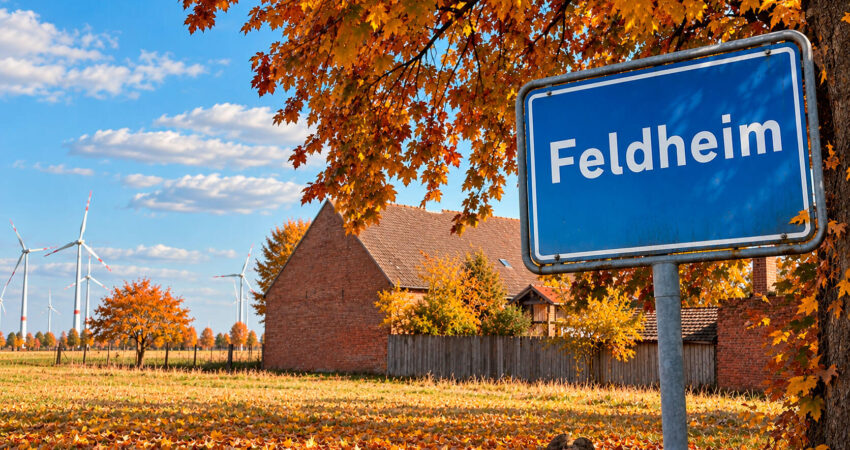
Around 80 kilometres south-west of Berlin lies a village of just under 130 people. Feldheim is so small that a single modern wind turbine could, in theory, generate more electricity than the entire village needs. In reality, 52 wind turbines now stand around this small Brandenburg community.
But some of Feldheim’s most unusual infrastructure lies underground. The village has its own electricity and heat networks. It also has a biogas plant, a wood-chip heating system, a power-to-heat system and a large battery storage facility. Since 2010, Feldheim has been able to meet its electricity and heat demand through dedicated local networks and locally generated renewable energy. At the same time, the village remains connected to the public grid.
What looked like an extraordinary experiment in 2010 has now been working for well over a decade. And Feldheim is becoming relevant again. Renewable electricity has become part of everyday life in Germany and across Europe, but the energy transition is increasingly confronting the very questions Feldheim addressed early on: How can electricity and heat be connected? How can energy be used close to where it is generated? And what role can citizens play if they are not simply customers of an energy supplier, but participants in their local energy system?
It all began with four wind turbines
Feldheim’s energy story began in 1993. Michael Raschemann, then a student, came to the village with an idea: to build wind turbines there. The mayor, the local agricultural co-operative and the municipal council backed the project. Two years later, the first four turbines began operating.
What started as a relatively small project gradually developed into an entire local energy system.
Today, the Feldheim wind farm has 52 turbines. According to Energiequelle, they generate around 200 million kilowatt-hours of electricity a year. Local consumption accounts for only about 0.5 per cent of that annual output. The rest is fed into the public grid. In purely mathematical terms, the wind farm produces enough electricity each year to match the consumption of around 40,000 households.
That is why the term “energy self-sufficient village”, often used to describe Feldheim, needs some explanation. The village is not an energy island cut off from the outside world. It remains connected to the public grid and generates far more electricity than it consumes. What makes Feldheim unusual is that its electricity and heat demand can be met locally through dedicated networks.
Biogas links agriculture, electricity and heat
Agriculture plays a central role in the system. Feldheim has had a biogas plant since 2008. According to the Neue Energien Forum Feldheim, it processes around 4,900 cubic metres of slurry, 7,900 tonnes of maize and 620 tonnes of grain meal from local agriculture each year.
The resulting biogas is used in a combined heat and power plant. It generates around four million kilowatt-hours of electricity annually, most of which is fed into the public grid.
But the heat produced alongside the electricity is at least as important. Instead of being released unused, it supplies the village’s heat network. According to Energiequelle, this replaces around 180,000 litres of heating oil every year.
On particularly cold days, when the biogas plant cannot provide enough heat, a wood-chip heating system can step in. For short-term peaks in heat demand, Feldheim also has a power-to-heat system that can use electricity from the wind farm to heat water for the local heat network.
Another component was added in 2015: a lithium-ion battery with a power rating of 10 megawatts and a storage capacity of 10.7 megawatt-hours. According to the Neue Energien Forum Feldheim, its main role is to provide balancing services for the wider power grid. In other words, its primary purpose is not to store the village’s wind power during the day and supply it back to residents at night.
Feldheim is therefore better understood not simply as a village with an unusually large wind farm, but as a small energy system in which several technologies work together.
Germany has caught up on electricity – but not on heat
A look at Germany’s energy transition shows just how unusual Feldheim was in the early 2010s.
In 2000, renewables accounted for just 6.3 per cent of Germany’s gross electricity consumption. By 2025, the figure had risen to 55.1 per cent. According to the annual figures published in March 2026 by the Working Group on Renewable Energy Statistics at the German Environment Agency (UBA), Germany generated 290.2 billion kilowatt-hours of renewable electricity. Wind alone provided 133.9 billion kilowatt-hours – more than all of Germany’s lignite and hard-coal power plants combined.
When it comes to electricity, what once made Feldheim so unusual has increasingly become mainstream.
But electricity is only part of the energy system. In other sectors, the transition is much less advanced. While renewables supplied 55.1 per cent of gross electricity consumption in 2025, their share was 19 per cent in heating and 8 per cent in transport. Across all sectors, renewables accounted for 23.8 per cent of Germany’s gross final energy consumption.
The German Environment Agency therefore argues that much greater attention will have to be paid to heating and transport if Germany is to meet its energy and climate targets.
This is where Feldheim still looks surprisingly modern. The village did not simply focus on generating as much renewable electricity as possible. It connected electricity generation with heat supply, using local agriculture and energy infrastructure to bring the different parts of the system together.
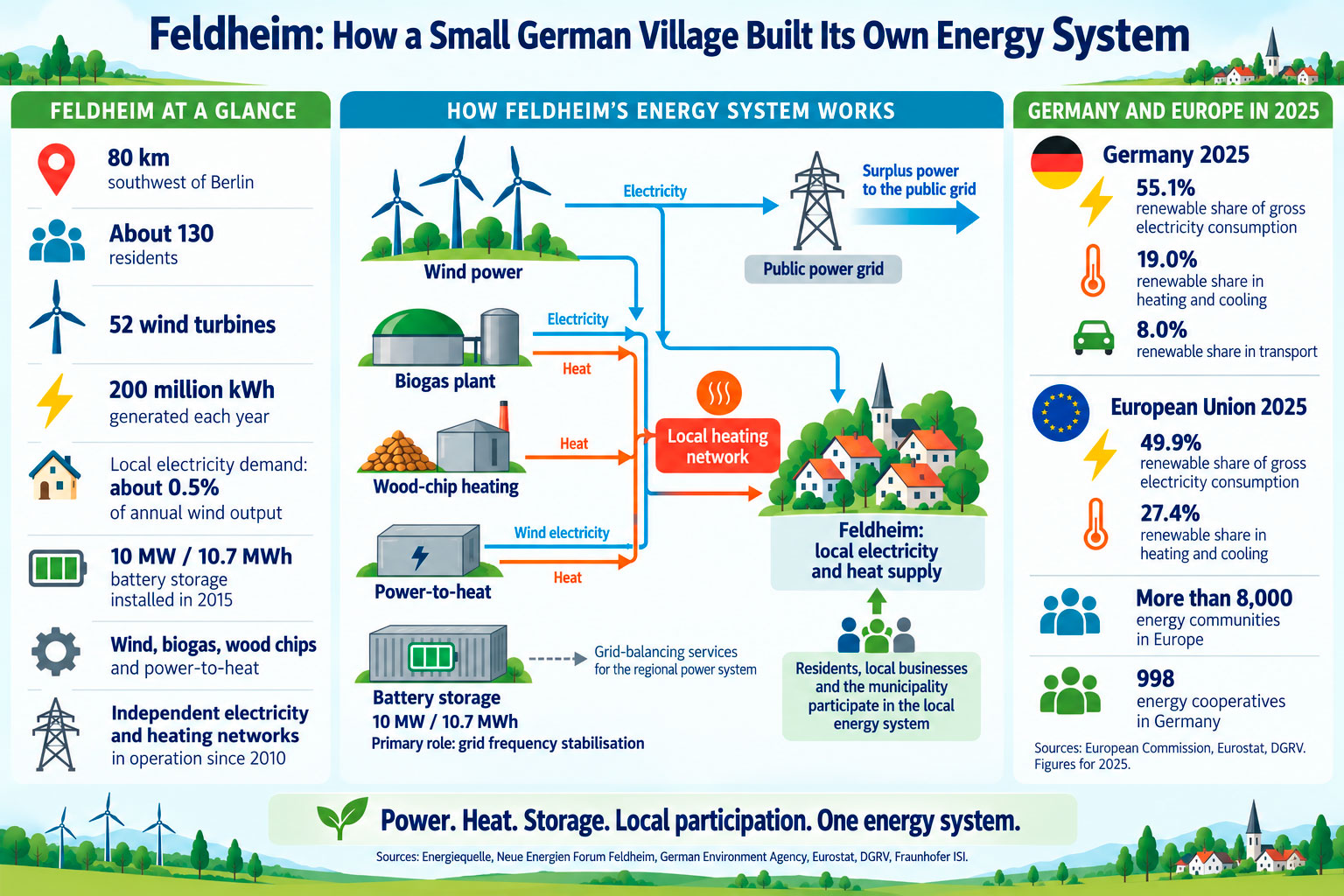
Feldheim: The Energy Transition at a Glance. Graphic by the Energy Europe Editorial Team.
Thousands of local heat networks could be possible
In 2026, the Fraunhofer Institute for Systems and Innovation Research ISI examined how widely similar models could potentially be used.
An analysis published on 19 May 2026 examined the potential for community heat networks in Germany, based on projected building heat demand up to 2050. The underlying research was carried out by Fraunhofer ISI for the German Cooperative and Raiffeisen Confederation (DGRV).
Settlements with medium heat densities are particularly interesting. In such areas, conventional large-scale heat networks may not always be economically attractive, while smaller, community-organised solutions could work.
Fraunhofer ISI estimates the demand-side potential for community heat networks at between 38.3 and 44.3 terawatt-hours a year. The calculation explicitly assumes that only 20 per cent of potential projects in the identified areas would actually be implemented and that 70 per cent of households within those projects would connect to the network.
The DGRV concludes that if 20 per cent of the technical potential were realised, around 8,000 community-based heat networks could be created in Germany.
Technology alone, however, will not be enough.
“For co-operative heat networks to realise their full potential, they need reliable framework conditions and targeted support,” says Jan Holthaus, a member of the DGRV’s Executive Board.
Fraunhofer ISI also points to practical barriers. Heat networks are long-term, capital-intensive infrastructure projects. Alongside technical requirements, financing, municipal heat planning, permitting and households’ willingness to connect all play a decisive role.
This also helps explain why Feldheim, despite its long-running success, cannot simply be replicated thousands of times.
When citizens become part of the energy system
Feldheim brought together an unusual combination: suitable land for wind energy, an agricultural co-operative, a project developer, a supportive municipality and committed local residents. A dedicated organisation was created for the local energy supply, involving residents, businesses and the town of Treuenbrietzen.
The basic idea has since spread far beyond Feldheim.
According to the DGRV’s 2025 annual survey of energy co-operatives, Germany had 998 energy co-operatives with around 220,000 members. Together, they had invested approximately €3.6 billion in renewable energy and generated around eight terawatt-hours of electricity.
Their activities show that community energy is no longer just about jointly financed rooftop solar. Some 80 per cent of the energy co-operatives surveyed install and operate solar power systems, while 25 per cent generate electricity from wind. Twenty-eight per cent operate heat networks, 20 per cent are involved in electricity storage and 22 per cent in electric mobility.
For the DGRV, the value of such projects goes beyond the additional kilowatt-hours they generate. Its annual survey says that local people benefit economically and, as members, have an active say – helping to build “acceptance and trust”.
For a community, it makes a difference whether residents simply see a wind farm on the horizon or whether some of the economic benefits remain in the area. Likewise, there is a difference between people simply accepting decisions about new energy infrastructure and having a role in those decisions.
Feldheim made that connection early.
Nevertheless, Feldheim remains an exception
The nationwide figures also show how difficult such models can be to put into practice. According to the DGRV annual survey, 40 per cent of energy co-operatives supply electricity themselves – for example within individual buildings, through dedicated supply contracts or via electricity trading. The association argues that inadequate or overly complicated rules for energy sharing make more flexible local solutions harder to develop.
A dedicated local electricity grid like Feldheim’s therefore remains unusual.
Nor can every village simply copy the Brandenburg model when it comes to heat. Suitable sites for wind turbines are not available everywhere. Not every municipality has an agricultural co-operative or access to the feedstocks required for a biogas plant. And building a dedicated electricity or heat network is far more demanding, both financially and organisationally, than installing individual solar systems.
Feldheim’s real significance therefore lies not in providing a technical blueprint. More important is the principle behind it: energy is generated locally, different technologies are connected, and residents and other local stakeholders become part of the system.
Energy communities gain ground across Europe
What began early in Feldheim has since become a European issue.
According to provisional Eurostat data published in July 2026, renewables accounted for 49.9 per cent of the European Union’s gross electricity consumption in 2025. In 2004, the figure had been just 15.9 per cent. Austria reached 90.8 per cent, Sweden 89.2 per cent and Denmark 77.7 per cent.
A second Eurostat analysis gives a slightly lower figure: 47.3 per cent of the electricity generated within the EU in 2025 came from renewable sources.
There is no contradiction between the two figures. They measure different things. The 49.9 per cent figure refers to the share of renewables in gross electricity consumption under the EU’s renewable-energy accounting system. The 47.3 per cent figure refers to the composition of the electricity actually generated within the EU.
The gap between electricity and heat can also be seen at European level. Renewables accounted for a 27.4 per cent share of energy used for heating and cooling in 2025. Meanwhile, electricity as a whole still represents only around 23 per cent of the EU’s final energy consumption.
The European Commission therefore sees greater electrification of heating, transport and industry as a crucial next step.
More than 8,000 energy communities
At the same time, another question is becoming increasingly important: who produces and owns that energy?
According to the European Commission’s Citizens Energy Package, more than 8,000 energy communities were estimated to be active in Europe by the end of 2025. The Commission uses a broad definition here that extends beyond the EU’s narrower legal categories.
With the Citizens Energy Package and the subsequent Energy Communities Action Plan, the Commission aims to give such models greater support. The Action Plan focuses on five areas: effective enabling frameworks, access to finance, awareness-raising and capacity-building, social inclusion and public participation, and digital innovation and integration into the energy system.
The target is ambitious. The Commission estimates that renewable capacity installed by energy communities could reach up to 90 gigawatts by 2030.
By 2030, more than 16 million European households and around 630,000 small and medium-sized businesses could be producing their own renewable energy. For individual households generating and consuming their own solar electricity, the Commission estimates potential annual savings of €260–550. For communities combining wind and solar power, the figure could be €440–930 a year, depending on the assumptions used.
A model that once seemed extraordinary in places such as Feldheim has thus become a distinct area of European energy policy.
Renewable energy in citizens’ hands
For REScoop.eu, the European federation of energy communities, the issue goes beyond climate protection.
Responding to the Citizens Energy Package, REScoop.eu Vice-President Ilonka Marselis said: “Bringing renewable energy and renovations under citizen ownership is our best bet to protect Europe’s independence, democracies, and local economies.”
REScoop.eu represents the interests of energy communities, so the statement should be understood as the federation’s policy position. But it also illustrates how much the debate has broadened. The question is no longer simply how to generate as many renewable kilowatt-hours as possible. Increasingly, it is also about who owns the infrastructure, who gets a say in decisions and where the economic benefits end up.
The European Commission now makes a similar case for the economic and social benefits of greater citizen participation. Self-generation and energy sharing can give consumers greater autonomy and improve access to more affordable and stable energy prices.
From experiment to a European issue
When Feldheim’s first four wind turbines were built in 1995, renewable electricity was still a marginal part of Germany’s energy system. When the village established its own electricity and heat networks in 2010, locally supplied renewable energy was still highly unusual.
By 2025, renewables were supplying more than half of Germany’s gross electricity consumption. Across the European Union, the figure was almost half. Germany now has almost 1,000 energy co-operatives, while more than 8,000 energy communities are active across Europe.
Feldheim’s significance has changed as a result.
What makes the village particularly relevant today is no longer simply the fact that a small community can meet its energy needs with renewables. More remarkable is how early Feldheim brought together several questions that Germany and Europe are now grappling with: How can renewable electricity also be used for heating? What role can storage and local networks play? How can agriculture and energy production work together? And how can local people become more than neighbours of new energy infrastructure – participating in it and sharing in its economic benefits?
Feldheim does not offer a one-size-fits-all answer. The circumstances of this small Brandenburg village are too specific for that. But since 2010, it has shown that electricity, heat, storage, agriculture, businesses, local government and residents can be brought together as parts of a single local energy system.
What began more than 30 years ago with four wind turbines has become an early example of a debate now taking place across Europe – not only about how energy should be generated, but also about where, by whom and for whom.