

'/%3E%3C/svg%3E)
The crisis in the Strait of Hormuz is accelerating a fundamental shift in Middle East oil infrastructure. From Iraq and Syria to Saudi Arabia and the UAE, producers are developing alternative export routes that could reduce their dependence on one of the world’s most critical energy chokepoints.
Before the war, more than 20 million barrels of crude oil and petroleum products passed through the Strait of Hormuz every day – equivalent to roughly one-fifth of global oil consumption. But following US and Israeli strikes on Iran, traffic along one of the world’s main energy routes fell sharply. In the second quarter of 2026, an average of just 4.9 million barrels per day passed through the Strait of Hormuz, compared with 21.6 million in the fourth quarter of 2025. After a partial resumption of supplies in July, traffic slowed again in August: on 10 August, just six vessels passed through the strait, compared with 130-140 per day before the war.
Several months of restricted shipping have turned long-standing dependence on the Strait of Hormuz into an immediate economic threat for the region’s oil-producing countries. Projects discussed for years as contingency options are now being accelerated. Iraq has begun work on the Basra-Haditha pipeline and is studying options for extending export routes towards the Mediterranean and Red Seas; Chevron has joined preliminary studies of several potential Iraqi export corridors; the UAE has accelerated construction of a second pipeline to Fujairah; and Saudi Arabia is considering increasing the capacity of its pipeline to the Red Sea while also discussing the possibility of connecting neighbouring states to the system.
The International Energy Agency has directly linked these developments to a shift in governments’ attitudes towards infrastructure risk.
“The current energy crisis, stemming from the effective closure of the Strait of Hormuz, is changing risk perceptions and bolstering moves towards greater diversification,” the IEA said.
New routes will not be able to fully replace the Strait of Hormuz in the foreseeable future, as the volumes that passed through the strait before the war significantly exceed existing alternative capacity. However, the 2026 crisis has already accelerated the development of a more diversified export system, under which a larger proportion of oil from the Persian Gulf could eventually reach the Mediterranean, Red Sea and Arabian Sea without passing through a single maritime corridor.
IRAQ IS LAYING THE FOUNDATIONS FOR SEVERAL NEW ROUTES
Iraq was among the countries hardest hit by the disruption around the Strait of Hormuz. Before the war, the bulk of its oil exports passed through southern terminals in the Persian Gulf. When traffic through the strait virtually ground to a halt, the country was unable to reroute comparable volumes quickly. As a result, production fell in May from 4.3 million to less than 1.5 million barrels per day.
Baghdad aims to reduce this dependence through several export corridors rather than a single backup pipeline. In May, Iraq began work on the Basra-Haditha oil pipeline, which is approximately 700 kilometres long and has a design capacity of 2.5 million barrels per day. Around $1.5 billion has already been allocated to the project, although the pace of construction will depend on future budget funding.
In July, the government took the next step and authorised the state-owned Basra Oil Company to enter into preliminary agreements with a consortium comprising the US firm Chevron, TI Capital and the Qatari company UCC. The companies are to carry out a technical and financial comparison of several options, officially identified as the Basra-Haditha-Kirkuk-Ceyhan and Basra-Haditha-Baniyas routes.
THE SYRIAN ROUTE WOULD REQUIRE A NEW PIPELINE SYSTEM
One of the most ambitious options under consideration is a new Iraqi export route to Syria’s Mediterranean coast. Although it would broadly follow the corridor of the former Kirkuk-Baniyas pipeline, the project is no longer expected to consist primarily of restoring the old infrastructure.
The original pipeline linked northern Iraq with Syria’s Mediterranean coast but has been largely out of operation since sustaining damage during the 2003 US-led invasion of Iraq. More recent technical assessments indicate that the existing infrastructure is so damaged and outdated that an almost entirely new pipeline system would be required.
According to Reuters, sources involved in the project estimate that such a system could take around four years to build and cost at least $15 billion. The proposed network would connect southern and northern Iraqi oil fields through Haditha to the Syrian port of Baniyas.
The US supports renewed oil infrastructure links between Iraq and Syria. In July, the State Department said Washington was facilitating efforts by the two countries to restore cross-border oil connectivity and expected American companies to participate.
The Syrian authorities directly link renewed interest in their infrastructure to the crisis surrounding the Strait of Hormuz.
Yousef Qiblawy, Chief Executive Officer of the Syrian Petroleum Company: “It’s already become a hub. The war in the Gulf and the situation in the Strait of Hormuz give us a chance and an opportunity.”
THE TURKISH ROUTE REMAINS IN PLACE
A future Syrian route could reduce Iraq’s dependence not only on the Strait of Hormuz but also on Turkey. However, it would be premature to speak of a weakening of the route to Ceyhan at this stage: Ankara and Baghdad are simultaneously seeking to maintain and expand the existing oil pipeline between the two countries.
On 1 August, Turkey and Iraq signed a new one-year agreement on its operation following the expiry of the previous intergovernmental treaty. The agreement provides for the transport of 750,000 barrels per day, while the pipeline itself is technically capable of handling up to 1.5 million barrels. Currently, however, only around 170,000 barrels per day are flowing through it.
Ankara wants to increase the pipeline’s use substantially and is discussing a new long-term agreement. Turkey is also interested in extending the system towards southern Iraqi oil fields.
As a result, two potential Mediterranean export routes are gradually taking shape for Iraq: one through Turkey to Ceyhan and another through Syria to Baniyas. In the longer term, both could potentially gain access to oil from the south of the country.
There have so far been no official statements from the Turkish authorities opposing the restoration of an Iraqi-Syrian route, so it would be incorrect to describe the situation as a direct political confrontation between Ankara and the Syrian project. However, a greater number of export options would strengthen Iraq’s negotiating position – the less the country depends on a single transit route, the more leverage it has when discussing tariffs, transit conditions and investment.
UAE SPEEDS UP SECOND PIPE TO FUJAIRAH
Unlike Iraq, the United Arab Emirates began developing a full-scale bypass around the Strait of Hormuz long before the current crisis. As a result, the country is better prepared than many of its neighbours for prolonged restrictions on shipping.
The existing Abu Dhabi Crude Oil Pipeline, also known as the Habshan-Fujairah pipeline, connects Abu Dhabi’s oil fields with Fujairah on the coast of the Gulf of Oman. It is capable of transporting up to 1.8 million barrels of oil per day directly to the port, which lies outside the Strait of Hormuz.
This infrastructure has enabled the UAE to continue a significant proportion of its oil exports without routing crude through Hormuz. Following the outbreak of the war, Abu Dhabi accelerated the next phase of its export diversification strategy.
The West-East Pipeline, currently under construction, is intended to double export capacity via Fujairah. In May, ADNOC chief Sultan Ahmed Al Jaber said the project was approximately half completed, with operations scheduled to begin in 2027.
According to Al Jaber, the current crisis will continue to affect oil logistics even after hostilities cease.
Sultan Ahmed Al Jaber, Managing Director and Group CEO of ADNOC: “Even if this conflict ends tomorrow, it will take at least four months to get back to 80 per cent of pre-conflict flows, and full flows will not return before the first or even second quarter of 2027.”
SAUDI ARABIA WANTS TO EXPAND THE EAST-WEST PIPELINE
The largest operational bypass of the Strait of Hormuz belongs to Saudi Arabia, which built the East-West pipeline in the early 1980s during the Iran-Iraq War. The system links eastern oil fields with the port of Yanbu on the Red Sea.
Today, it can transport up to 7 million barrels per day. Around 2 million barrels per day supply refineries on Saudi Arabia’s western coast, while roughly 5 million barrels per day are available for export.
Following the de facto closure of the Strait of Hormuz, this alternative route became one of the country’s main export arteries as Saudi Arabia redirected a significant proportion of its crude to Yanbu. Before the Houthi blockade intensified in July, shipments from Yanbu had risen to around 4 million barrels per day – roughly four times more than a year earlier.
Riyadh is now considering increasing the system’s capacity by a further 1-2 million barrels per day, although it has not yet been decided whether the existing pipeline would be upgraded or an additional line built.
“It would take years, cost billions of dollars and require changes to Saudi crude’s pricing mechanism,” a source familiar with the project discussions told Reuters.
The Red Sea route does not, however, eliminate geopolitical risk. Saudi energy infrastructure and shipping on the western side of the country have themselves faced attacks and threats during the conflict. That underlines a broader limitation of diversification: bypassing Hormuz can shift exposure towards other pipelines, terminals and maritime corridors rather than removing it entirely.
The expanded Saudi system could also serve neighbouring exporters. Riyadh is already holding preliminary talks with other Gulf states, and Kuwait has publicly confirmed its interest.
Sheikh Nawaf Saud Al-Sabah, Chief Executive Officer of Kuwait Petroleum Corporation: “We are in discussions with our brothers in Saudi Arabia and the Emirates to look at how to expand the pipeline system they have to accommodate Kuwaiti oil.”
For Kuwait, Bahrain and Qatar, the issue is particularly acute because they do not have their own major export routes that fully bypass the Strait of Hormuz.
Qatar mainly exports LNG, making the creation of an alternative significantly more technically challenging. Nevertheless, Doha is considering potential alternatives, including routes via Saudi Arabia.
Zaid Belbagi, managing partner at London-based consultancy Hardcastle Advisory: “The recent talks about new pipeline corridors involving Saudi Arabia, Kuwait and Qatar reflect a broader strategic reality. The conflict has focused minds regionally on the perils of relying solely on Hormuz.”
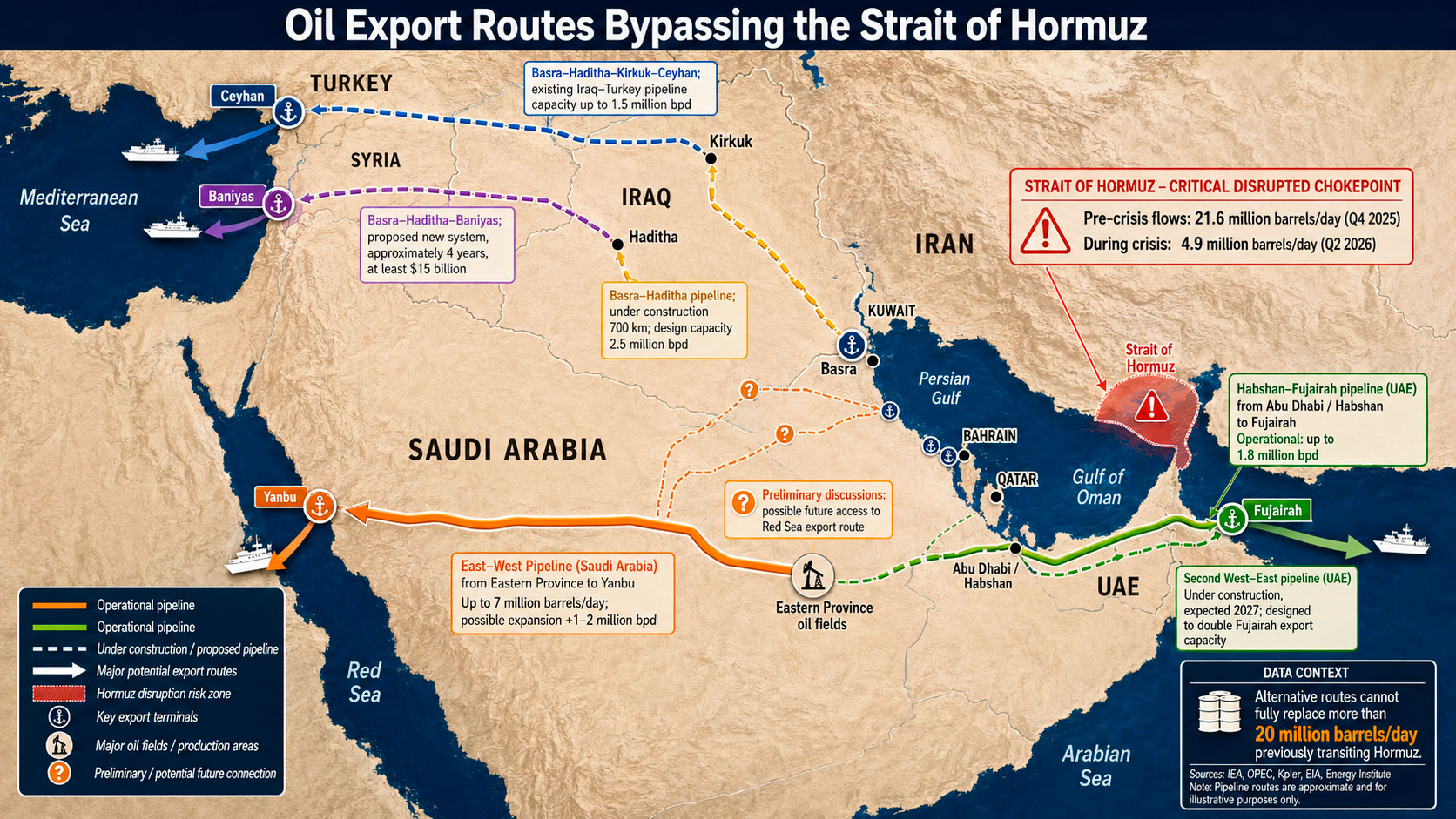
Routes Around Hormuz. Graphic by the Energy Europe Editorial Team.
FROM A SINGLE ROUTE TO A NETWORK
Iran’s ability to disrupt shipping through the Strait of Hormuz remains one of its most consequential sources of leverage over regional and global energy flows. While the development of overland export routes may reduce the significance of that leverage, it cannot eliminate it entirely in the foreseeable future.
Even the most ambitious projects currently under discussion would not allow the entire volume of oil that previously passed through the strait to be rerouted in the coming years. The crisis has also demonstrated that pipelines, export terminals and alternative maritime routes can themselves become military targets.
The main constraint on these alternatives is time. Expanding the Saudi system will take several years. New Iraqi routes range from projects already under construction to preliminary studies. Syrian infrastructure would require extensive reconstruction, major financing and security guarantees. For Qatar, the task is even more complicated because of the country’s dependence on LNG, for which no straightforward pipeline substitute exists.
The unprecedented situation surrounding the Strait of Hormuz has altered the key baseline assumption behind such projects – the likelihood of a prolonged disruption to shipping. A scenario that until early 2026 was largely treated as an extreme contingency – and one that did not always justify the construction of expensive backup infrastructure – has now become a reality.
If even a fraction of the current projects are implemented, the region’s energy landscape could become significantly less dependent on a single narrow maritime corridor over the next decade. The Strait of Hormuz will retain immense importance for global oil and gas trade. But Iraq could gain greater access to the Mediterranean and potentially the Red Sea, the UAE could expand exports through Fujairah, Saudi Arabia could increase volumes through Yanbu, and neighbouring states could eventually gain access to some of these systems.
This may become one of the most enduring consequences of the 2026 crisis: the use of the Persian Gulf’s geographical vulnerability as a source of strategic pressure is simultaneously encouraging neighbouring states to invest billions of dollars in ensuring that this vulnerability is no longer absolute.