


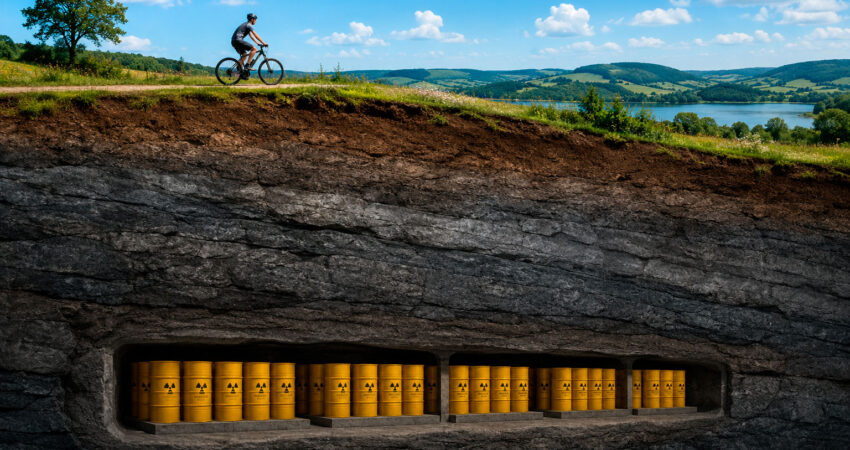
Europe is expanding its nuclear capacity, but its radioactive legacy remains unresolved. With the world’s first deep geological repository for spent nuclear fuel only now approaching operation, the conflict between risks measured in millennia and politics shaped by electoral cycles is becoming increasingly visible. At its core, nuclear waste is not merely a technical challenge – it is a test of trust, governance and responsibility across generations.
There is no easy way to talk about nuclear energy – or nuclear waste – in Europe. On the one hand, the technology can contribute to greater energy independence by reducing the continent’s reliance on imported fossil fuels and providing a stable source of low-carbon electricity. On the other, public fears surrounding radioactivity remain deeply entrenched.
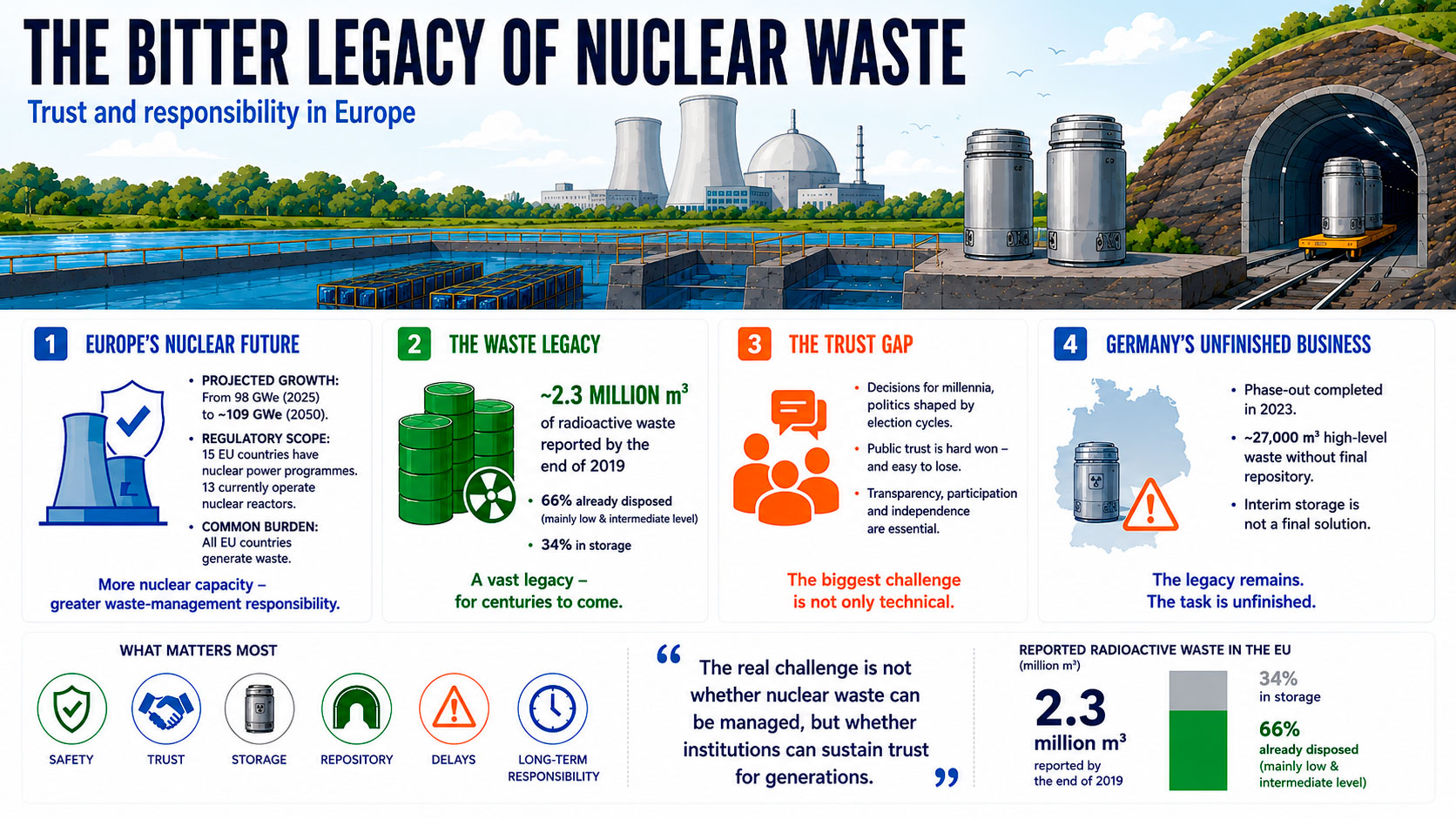
Nonetheless, nuclear generating capacity across the EU is projected to grow from 98 GWe in 2025 to around 109 GWe by 2050, according to the European Commission’s Nuclear Illustrative Programme, published in June 2025. Against this backdrop, the unresolved question of nuclear waste disposal is no longer peripheral. It is becoming central to the credibility of Europe’s nuclear ambitions.
Nuclear Power Returns – but the Waste Remains
The perception of nuclear power as a “necessary evil” has found its way into European policymaking. In 2022, the European Commission adopted the Complementary Climate Delegated Act, which included specific nuclear activities in the EU taxonomy as transitional activities, subject to strict technical and environmental conditions.
The act did not declare nuclear energy sustainable without qualification. Nor did it resolve the long-standing political dispute over its place in Europe’s energy mix. Yet its very existence signalled an institutional shift towards accepting nuclear power as part of the transition to climate neutrality – and, consequently, a more urgent need to deal convincingly with the waste it leaves behind.
Within the EU, 15 member states have nuclear power programmes and account for approximately 99.5% of the Union’s radioactive waste inventory by volume. Thirteen currently operate nuclear reactors. Yet every EU country generates radioactive waste in some form, primarily low- and very-low-level waste produced by hospitals, industrial facilities and research institutions.
The issue therefore extends well beyond the countries that generate electricity from nuclear power. Nuclear waste is not exclusively an energy problem. It is a shared and permanent consequence of modern medicine, science and industry.
Trust Cannot Be Legislated
In Europe, where decision-making depends on negotiation, institutional continuity and compromise, nuclear waste management is particularly difficult. Repository projects extend far beyond electoral cycles and are therefore highly vulnerable to shifts in political priorities.
As Kalev Kallemets, CEO of Estonia-based Fermi Energia and a former member of parliament, observed in an interview on nuclear waste policy: “The politicians don’t have the vision for 15 years. Their planning period is limited to the next elections – which is kind of natural.”
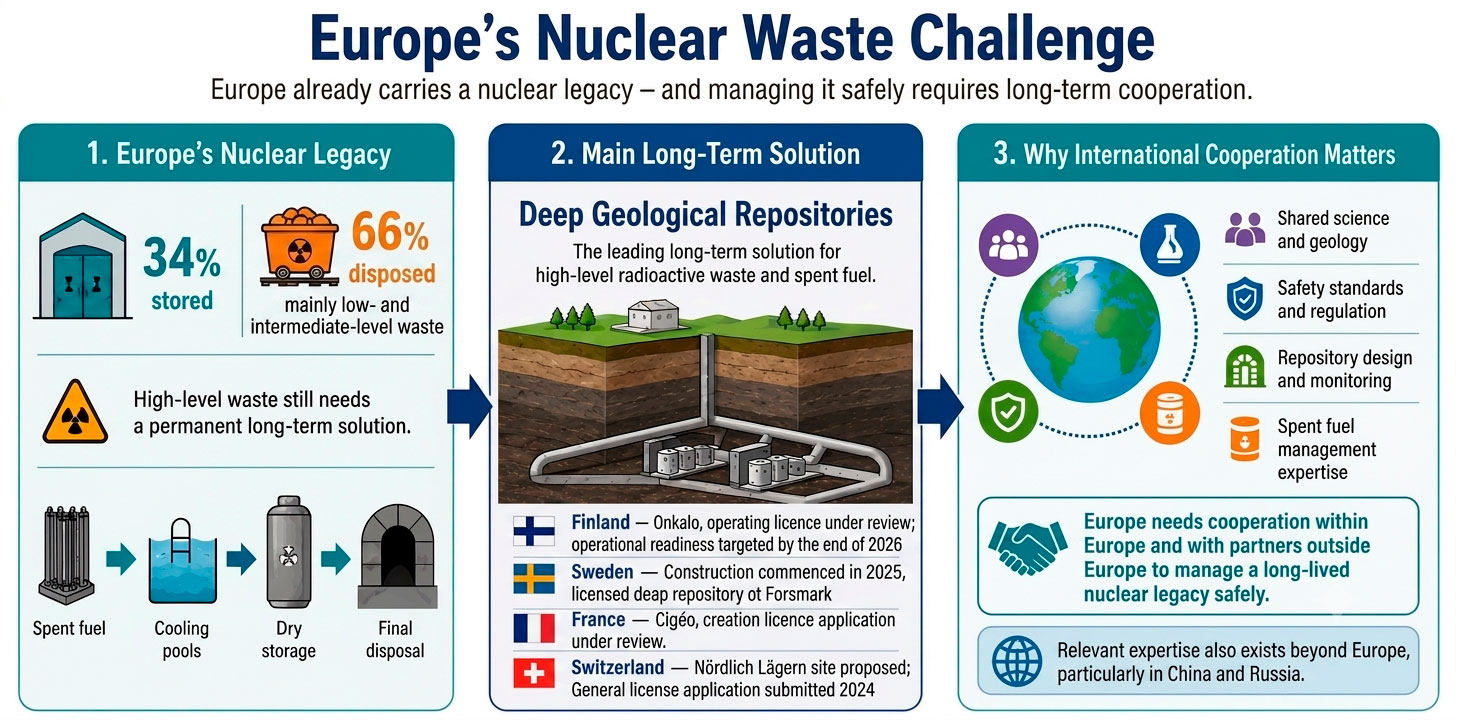
The difficulty exists regardless of whether a country continues to operate nuclear power plants. France, Europe’s largest nuclear power producer, is advancing the licensing process for the Cigéo deep geological repository in the Meuse/Haute-Marne region. In Sweden, construction of the spent-fuel repository at Forsmark formally began in January 2025. Switzerland’s waste management organisation, Nagra, submitted its general licence application for a repository at Nördlich Lägern in November 2024, and the proposal is now undergoing regulatory and political review.
These projects share a common thread. They depend not only on robust geology and engineering, but also on the painstaking accumulation of what is often called a social licence – public acceptance built over decades and capable of surviving changes of government.
Trust, unlike a construction permit, cannot simply be legislated into existence. It must be earned slowly, yet it can be lost almost overnight.
The Nuclear Trust Gap. Graphic by the Energy Europe Editorial Team
Germany’s Unfinished Business: Exit Does Not Equal Resolution
Perhaps no country illustrates the institutional dimension of nuclear waste more clearly than Germany. The country completed its nuclear phase-out in April 2023, following a long-running political process accelerated by the Fukushima accident in 2011.
Yet shutting down the last reactors did not erase the accumulated legacy. It merely separated the waste problem from the production of electricity.
Germany must find a permanent repository for approximately 27,000 cubic metres of high-level radioactive waste. The final volume will depend partly on the containers and geological formation chosen, but the material will include spent nuclear fuel and vitrified residues returned from reprocessing abroad.
At present, this waste is held in transport and storage containers at 16 interim storage facilities. These sites are technically robust, but they require constant monitoring, maintenance and security. They represent the best available working solution for the present – but they were never designed to become permanent monuments to political indecision.
A final repository is intended to work differently. Rather than depending indefinitely on human supervision, maintenance and functioning institutions, it should provide passive safety through a system of engineered barriers and stable geological formations.
Germany’s site-selection process involves two central institutions. The Federal Company for Radioactive Waste Disposal, BGE, conducts the search and assesses potentially suitable areas. The Federal Office for the Safety of Nuclear Waste Management, BASE, supervises the process and is responsible for public participation. Together, they must ensure that the search remains transparent, scientifically credible and socially legitimate.
In a statement to the Bundestag’s Environment Committee, BASE stressed that the credibility of the process depends on transparency, institutional independence and broad societal participation.
The geology must be stable, but so must the institutions responsible for evaluating it. At the same time, local and regional communities must be given a genuine role in a decision whose consequences will extend far beyond the lives of everyone involved in making it.
Meanwhile, the clock is ticking. The operating licences of several interim storage facilities are expected to expire before a permanent repository can become operational. Germany will therefore have to develop a legal and technical framework for extended interim storage – prolonging arrangements that were originally presented as temporary.
The high-level repository is only one part of the country’s nuclear legacy. Germany must also retrieve approximately 47,000 cubic metres of low- and intermediate-level radioactive waste from the unstable Asse II mine, decommission the former Morsleben repository and dismantle its remaining nuclear infrastructure.
In the public imagination, this legacy is increasingly associated with cost, institutional failure and long-term risk. The bitter pill can no longer be sweetened by promises of cheap electricity, technological optimism or future energy independence. What remains is the less glamorous work of paying for, dismantling and safeguarding the consequences of earlier decisions.
Europe’s Growing Radioactive Legacy
Germany’s challenges are by no means unique. According to the European Commission’s third report on the implementation of the Radioactive Waste Directive, EU member states had accumulated approximately 2.3 million cubic metres of radioactive waste by the end of 2019. The reported inventory had grown by around 5% compared with the previous three-year reporting period.
This total includes waste from nuclear electricity generation, but also radioactive material originating in medicine, scientific research, industry, construction and the dismantling of nuclear facilities.
Around 34% of the reported waste was in storage, while 66% had been disposed of. At first glance, this may appear reassuring. The terminology, however, requires context.
Most of the material already disposed of belongs to very-low-, low- or intermediate-level categories for which surface or near-surface disposal solutions exist in several countries. “Disposed” does not mean that Europe has already solved the challenge of high-level waste or spent nuclear fuel.
The real gap lies between the vast radioactive legacy already produced and the absence of an operating final repository for the most hazardous and long-lived material.
From Interim Storage to Geological Disposal
No deep geological repository for spent nuclear fuel or high-level radioactive waste is yet in full commercial operation anywhere in the world.
After being removed from a reactor, spent nuclear fuel is generally stored in water-filled pools. The water removes residual heat and shields workers and the surrounding environment from radiation. After several years, once the fuel has cooled sufficiently, it may be transferred to dry-storage containers designed to remain secure for decades.
These systems can provide effective protection, but they are not passive solutions for hundreds of thousands of years. They require continued institutional control, physical security, monitoring and eventual replacement or transfer.
Some countries reprocess spent fuel to recover uranium and plutonium for possible reuse. France remains the principal European country operating commercial reprocessing facilities, while Russia and China also maintain significant fuel-cycle capabilities.
Reprocessing, however, is technologically complex and expensive. It does not make the waste disappear. Highly radioactive residues remain and must ultimately be isolated from people and the environment.
After decades of research, a broad scientific and regulatory consensus has emerged: deep geological disposal represents the most viable long-term solution for spent nuclear fuel and high-level radioactive waste.
A repository of this kind places the material hundreds of metres underground and surrounds it with several mutually reinforcing barriers. These may include durable containers, swelling clay and stable host rock. The central idea is that safety should not depend forever on future governments, functioning electricity systems or continuous human intervention.
Onkalo and the Long Road to a Final Repository
Finland’s Onkalo repository at Olkiluoto is the most advanced project of its kind. Construction has largely been completed, and Posiva has carried out trial operations using non-radioactive test material. The operating licence, however, remains under regulatory review. Posiva aims to achieve operational readiness by the end of 2026, although the precise date on which final disposal will begin has not yet been confirmed.
When the project received its construction licence in 2015, Janne Mokka, then President and CEO of Posiva, captured its wider significance: “This pioneering project is important not only for Finland, but also on a global scale.”
Sweden is following closely. Construction of the Forsmark repository began in January 2025, with disposal expected to start in the 2030s. France and Switzerland are also advancing major repository projects, while Germany remains at an earlier stage of site selection.
The new era may indeed be dawning, but much more slowly than the nuclear industry once expected. Deep geological disposal is no longer only a theoretical solution. At the same time, it has not yet become an operational reality for high-level waste anywhere in the world.
The Lost Dimension of International Cooperation
Radioactive waste management would appear to be a natural field for international cooperation. Countries face the same fundamental questions involving geology, fuel conditioning, container materials, radiation safety and the preservation of knowledge over periods longer than recorded human history.
Waste volumes do not respect political blocs, and the laws of geology and chemistry apply universally. Yet decisions about repositories remain overwhelmingly national, while the technical expertise needed to design them is scattered across borders.
International organisations such as the International Atomic Energy Agency and the OECD Nuclear Energy Agency provide frameworks for sharing research and regulatory experience. Nevertheless, the current geopolitical environment has narrowed the space for deeper cooperation, particularly between Europe and Russia.
Russia possesses one of the world’s most comprehensive nuclear fuel-cycle systems, including significant reprocessing capabilities and long-running research into geological disposal. Rosatom’s Proryv, or Breakthrough, project represents a major scientific and industrial effort to develop a closed nuclear fuel cycle.
In a different geopolitical environment – one defined by trust, effective international safeguards and verifiable regulatory standards – this expertise could contribute to broader knowledge-sharing, particularly in areas such as fuel conditioning, reactor technologies and geological assessment.
Today, however, Russia’s war against Ukraine, strategic dependence and profound questions of institutional trust have severely restricted the scope for such cooperation. This is not merely a diplomatic loss. It also carries a long-term scientific and technological cost.
At the same time, cooperation cannot be justified by technical expertise alone. Nuclear waste management requires confidence not only in scientific data, but also in the institutions that produce it, the regulators that verify it and the governments expected to honour commitments over decades.
The contradiction is difficult to escape. The hazard is universal, while the trust required to manage it is political.
Europe has produced a vast radioactive legacy, yet still has no operating final repository for spent nuclear fuel or high-level waste. The gap between the two is filled with institutional promises, interim casks and the unglamorous work of building trust.
Europe’s Long-Term Nuclear Challenge. Graphic by the Energy Europe Editorial Team
A Responsibility Beyond the Next Election
Europe is no longer deciding whether it must deal with nuclear waste. It is deciding how much uncertainty, cost and political risk it is prepared to carry into the future.
The absence of operating repositories is not simply a technical gap, nor can it be described only as a governance failure. It also reflects the extraordinary scientific, regulatory and societal demands involved in making decisions whose consequences extend over hundreds of thousands of years.
Yet the distinction offers only limited comfort. Every additional year of delay prolongs dependence on interim systems that were never intended to serve indefinitely. It also shifts responsibility from the generation that benefited from nuclear power to generations that had no part in choosing it.
Nuclear waste is therefore not merely the bitter legacy of past energy decisions. It is an ongoing stress test for Europe’s capacity to align long-term responsibility with political systems organised around short electoral cycles.
The outcome will shape not only the credibility of nuclear energy, but also the broader ability of European institutions to act beyond the horizon of the next election. And to keep promises made to generations that cannot yet hold them to account.