


Nuclear energy is back on Europe’s political agenda. After years of closures, disputes and a dominant focus on renewables, a growing bloc of EU leaders now sees nuclear power not as a technology of the past, but as a cornerstone of future energy security. Its main selling point: stable, low-carbon electricity that does not depend on the weather and can provide industry with a steady power supply.
A turning point at the Paris summit
The most decisive signal came in March 2026 at the Nuclear Energy Summit in Paris. European Commission President Ursula von der Leyen said Europe’s decision to scale back nuclear power had been a mistake. She noted that in 1990, nuclear generated about one-third of Europe’s electricity, while the share is now closer to 15%. She used the figure as a political and historical comparison, even though the current EU share has been higher in recent years, at around 22%.
“This reduction in the share of nuclear was a choice. I believe that it was a strategic mistake for Europe to turn its back on a reliable, affordable source of low-emissions power,” von der Leyen said.
She argued that Europe’s dependence on expensive, volatile fossil fuel imports puts the EU at a disadvantage compared with other regions. The European Union therefore needs its own low-carbon energy sources – both renewables and nuclear. The Commission also said it would consider an additional €200 million in guarantees until 2028 to support the first commercial units of innovative nuclear technologies, including small modular reactors.
France bets on nuclear sovereignty
France remains Europe’s strongest pro-nuclear advocate. For Paris, nuclear is both a climate tool and a strategic asset for energy independence. French reactors have for decades supplied the bulk of the country’s electricity and remain central to its energy model.
At the summit, France and a group of other countries issued a joint statement declaring nuclear energy “a strategic asset” for meeting rising demand, cutting greenhouse gas emissions, strengthening energy security and supporting long-term sustainable development. The statement describes nuclear as “a safe, secure, reliable, baseload and dispatchable source of electricity generation” that can complement other low- and zero-emission sources.
A separate statement on nuclear financing was signed by France, Belgium, Finland, Italy, the Netherlands, Poland, Romania, Slovakia, Slovenia and other countries. It calls for “adequate, predictable and diversified financing for nuclear energy projects,” through public funding, international financial institutions, export credit agencies, private investors and innovative instruments.
A nuclear alliance inside the EU
France is no longer alone. In March 2026, pro-nuclear EU countries acted within the framework of the Nuclear Alliance, an initiative launched by France in 2023. Participating countries include France, Sweden, Italy, Poland, the Netherlands, Belgium, Czechia, Finland, Romania, Slovakia and Slovenia.
These countries promote nuclear power as part of Europe’s strategy for decarbonization, competitiveness and energy security. Their core argument: nuclear can complement solar and wind by providing stable low-carbon electricity regardless of weather conditions.
Europe is not returning to nuclear unanimously. But the political balance has shifted: nuclear supporters are no longer an exception, but an organized bloc demanding that nuclear power be fully considered in EU climate and industrial policy.
Sweden, Italy and Belgium change course
Sweden has made one of the most visible shifts. After years of debate over reducing the role of nuclear power, the government is now planning new reactors. New state aid for nuclear investment is limited to around 5,000 MW – roughly four large reactors. The Swedish government says nuclear plays an important role in fossil-free electricity generation in the EU and that Stockholm is working with other countries in the Nuclear Alliance.
Italy, which abandoned nuclear power after referendums in 1987 and 2011, is preparing a possible return. In 2025, Giorgia Meloni’s government approved a plan to open the way for new nuclear technologies, especially small and advanced modular reactors. Meloni presented the move as a way to provide “clean, safe and low-cost energy” and strengthen Italy’s energy security.
Belgium, which had planned a full nuclear phase-out, reversed course in 2025. Parliament repealed the 2003 “Nuclear Exit Act,” removing the legal basis for the phase-out and the ban on new nuclear capacity. The move does not mean reactors will appear overnight, but it opens a path that was previously closed.
Why nuclear is attractive again
The return of nuclear energy is not driven only by climate policy. After the 2022 energy crisis, Europe re-evaluated energy independence. Cheap Russian gas is no longer seen as a reliable foundation for the European economy, while LNG imports expose EU countries to global competition and price swings.
Electricity demand is also rising sharply. The electrification of transport, industry and heating, together with the growth of data centers and artificial intelligence, requires stable power. For energy-intensive industries, cheap and predictable electricity is a matter of competitiveness.
Supporters argue that without nuclear, Europe risks building an energy system too dependent on weather, imports and expensive backup capacity. Opponents say new plants take too long to build, cost too much, and leave the radioactive waste problem unresolved.
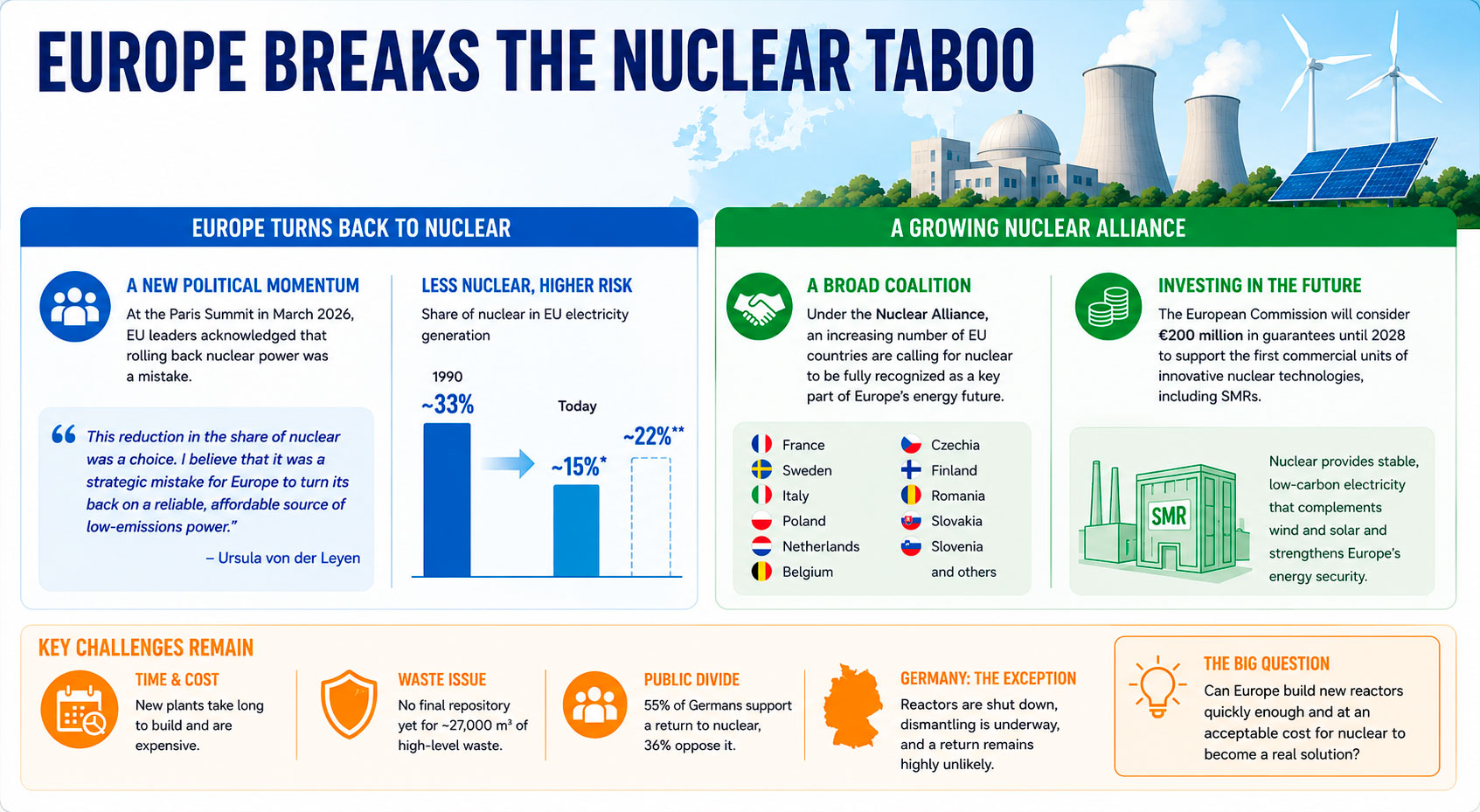
NPP Comeback in Europe. Graphic by the Energy Europe Editorial Team
Germany remains the main exception
Germany is the clearest exception. Even as more EU countries back a nuclear revival, Berlin does not plan to return to nuclear power.
Germany’s nuclear era formally ended on 15 April 2023, when the last three reactors – Isar 2, Emsland and Neckarwestheim 2 – were permanently shut down and entered decommissioning. Dismantling has already begun at some sites. In October 2025, cooling towers at the former Gundremmingen plant in Bavaria were demolished, a symbolic sign that Germany is not preserving old infrastructure for a possible return.
Restarting reactors would require a political reversal, new licensing, rebuilt personnel capacity, fuel procurement, a halt to dismantling and major investment. The German nuclear association KernD has estimated restart costs at €1-3 billion per reactor. For six potentially suitable units, that would mean roughly €6-18 billion, with no guarantee of staying within those timelines and budgets.
Even politicians who criticize the phase-out, including Chancellor Friedrich Merz, have not proposed a real reversal. Merz has called Germany’s nuclear exit a serious strategic mistake, but the government has not announced plans to restore conventional nuclear power plants.
The unresolved waste problem
Radioactive waste remains a key barrier. Germany has not selected a final repository for the high-level radioactive waste accumulated over decades. The volume is about 27,000 cubic meters of high-level waste. According to the Gesellschaft für Anlagen- und Reaktorsicherheit (GRS), Germany is searching for a repository for this amount, with material needing safe isolation for up to one million years.
The Federal Company for Radioactive Waste Disposal (BGE) says high-level waste accounts for only around 5% of Germany’s total radioactive waste by volume, but for about 99% of its radioactivity.
Public opinion is contradictory. A Verivox/Innofact survey in spring 2025 found that 55% of respondents would support a return to nuclear energy, 36% were against it and 9% were undecided. But support for nuclear in the abstract does not mean acceptance of a repository near one’s home. Previous site searches failed, and the current process is a long scientific and public effort involving citizens.
At the EU level, Germany is less active than before in blocking other countries from treating nuclear as part of a low-carbon future. Inside Germany, however, a return to nuclear generation remains highly unlikely: plants are shut down, dismantling has started, restarts would cost billions, and the waste issue is unresolved.
Nuclear is back, but still disputed
Europe is not returning to nuclear power unanimously. Austria, Luxembourg, some German politicians and environmental organizations still see nuclear as too expensive and too risky, citing high costs, long construction times, waste and safety concerns.
Yet the political climate has changed. Once seen as a technology of the past, nuclear is now increasingly described as an instrument of energy independence, climate policy and industrial competitiveness.
The main question is no longer whether nuclear will return to Europe’s agenda – it already has. The real question is whether Europe can build new reactors quickly enough and at an acceptable cost for nuclear to become a real solution, rather than just a political slogan.