


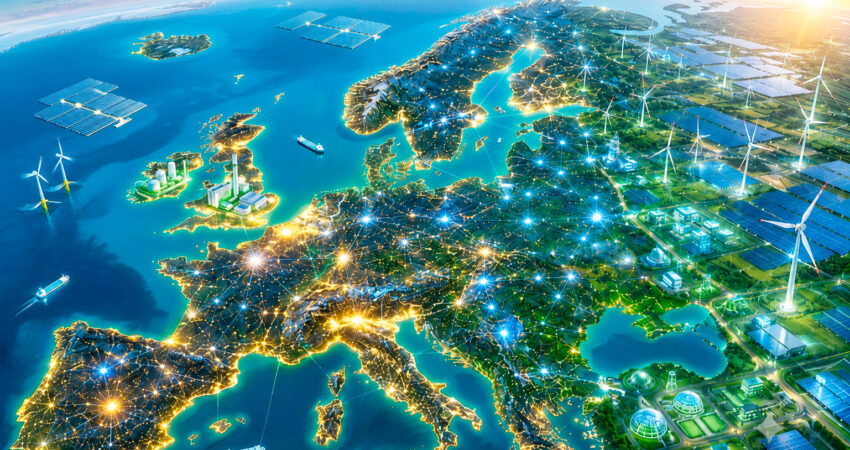
Europe is being urged to become the first “electro-continent,” with a 50% electrification goal for 2040. The Commission wants to raise electricity’s share of final energy consumption from roughly 23% today to 50%, while renewables already supply 47.5% of the EU’s gross electricity consumption. Hitting that goal will still require cheaper power, major grid upgrades, and a much faster industrial transition than Brussels has achieved so far.
In mid-2026, the EU is rolling out a new Electrification Action Plan designed to guide the bloc’s economy away from fossil fuel dependence once and for all. The benchmarks are ambitious. The Commission’s official target is for electricity to make up 32% of final energy consumption by 2030, up from roughly 23% in 2020. In its 2025 10th State of the Energy Union report, the Commission says electricity’s share of final energy consumption should reach 50% by 2040 – not yet a formal target, but one that could become one.
In this article, we examine whether these ambitions are feasible, how Brussels plans to support the transition, and what it means for the European economy.
A Strategic Wake-Up Call
In recent years, increasingly volatile international relations have repeatedly hit Europe’s energy markets – from Russia’s aggression against Ukraine in 2022 to the US confrontation with Tehran in 2026.
Add to this Brussels’ ambition to lead on climate action, and the conclusion becomes clear: Europe needs to become the “world’s first electro-continent,” as EU Commissioner for Energy and Housing Dan Jørgensen put it in early June at the Power Summit of Eurelectric, the European electricity industry federation, in Helsinki.
The message is not that diversification of energy sources alone is enough. Europe should rely more on its own production, prioritising electricity generated from renewables over fossil fuels. The wake-up call stage is over. It is now time to connect the dots across Europe’s energy-security puzzle.
Why Electrification Matters
Over the past decades, the EU power sector has decarbonised rapidly, but the rest of the economy has lagged behind. In 2024, renewables accounted for 47.5% of gross electricity consumption in the EU, up from 28.6% in 2014. Yet electricity still covers only around 23% of final energy demand.
That means renewable electricity production is growing, but the systems needed to deliver it to consumers reliably, conveniently, and at scale are still not fully in place.
The Commission’s current policy direction increasingly prioritises direct electrification wherever possible. The principle of “electrification first” – not yet legally recognised, but increasingly embedded in policy – would complement the “energy efficiency first” principle and give EU energy policy a more coherent framework.
The idea is simple: if a process can run directly on clean electricity, why subsidise less efficient alternatives? Hydrogen, synthetic fuels, and bioenergy will still be needed, but mainly for sectors that are difficult to electrify.
The Price Signal Problem
Eurelectric argues that in 2023 electricity was taxed about 1.4 times more heavily than gas per unit of energy. That price signal pushes households and firms away from the EU’s vision of a more sustainable future.
A simple example: a heat pump may be three to five times more efficient than a gas boiler, but if electricity is taxed too heavily, the economics become blurred. Heating and cooling account for about 50% of all EU energy consumption, and more than 70% still comes from fossil fuels, mostly natural gas.
Brussels appears to understand this. A draft proposal reported by Reuters would require electricity to be taxed below natural gas, aiming to make electric cars, heat pumps, and industrial electrification more competitive. It would also encourage consumers to shift demand to cheaper hours and set a target for half of electricity customers to have smart meters by 2030.
The exact changes, however, are still to be negotiated, as taxation has always been a sensitive issue for national governments.
Rewiring the Grid
Financial incentives are only one pillar of the solution. Another is energy transport and distribution. The grid must expand and digitalise at an unprecedented rate.
Experts estimate that more than 40% of Europe’s distribution grids are over 40 years old and need modernisation, which will cost hundreds of billions of euros. In Eurelectric’s Grids for Speed report, Leonhard Birnbaum, CEO of E.ON and President of Eurelectric, estimates that roughly €584 billion will be needed for the electricity grid by 2030. “The physical grid expansion must be paired with immediate digitalisation because a grid that is not smart cannot host the massive number of electric vehicles and heat pumps we are targeting,” he says.
The task is massive and requires coordinated action from multiple stakeholders. Construction will be carried out by a mix of privately owned, state-owned, and municipal companies – transmission system operators and distribution system operators – and financed overwhelmingly by private capital.
That said, the primary barrier is not a lack of actors, or even money, but rather the regulatory frameworks at national level. While the EU provides a strategic framework, national rules still determine how the grid is run and how much it costs.
Adapting the legal framework takes time and careful coordination, especially because grids must operate across national borders.
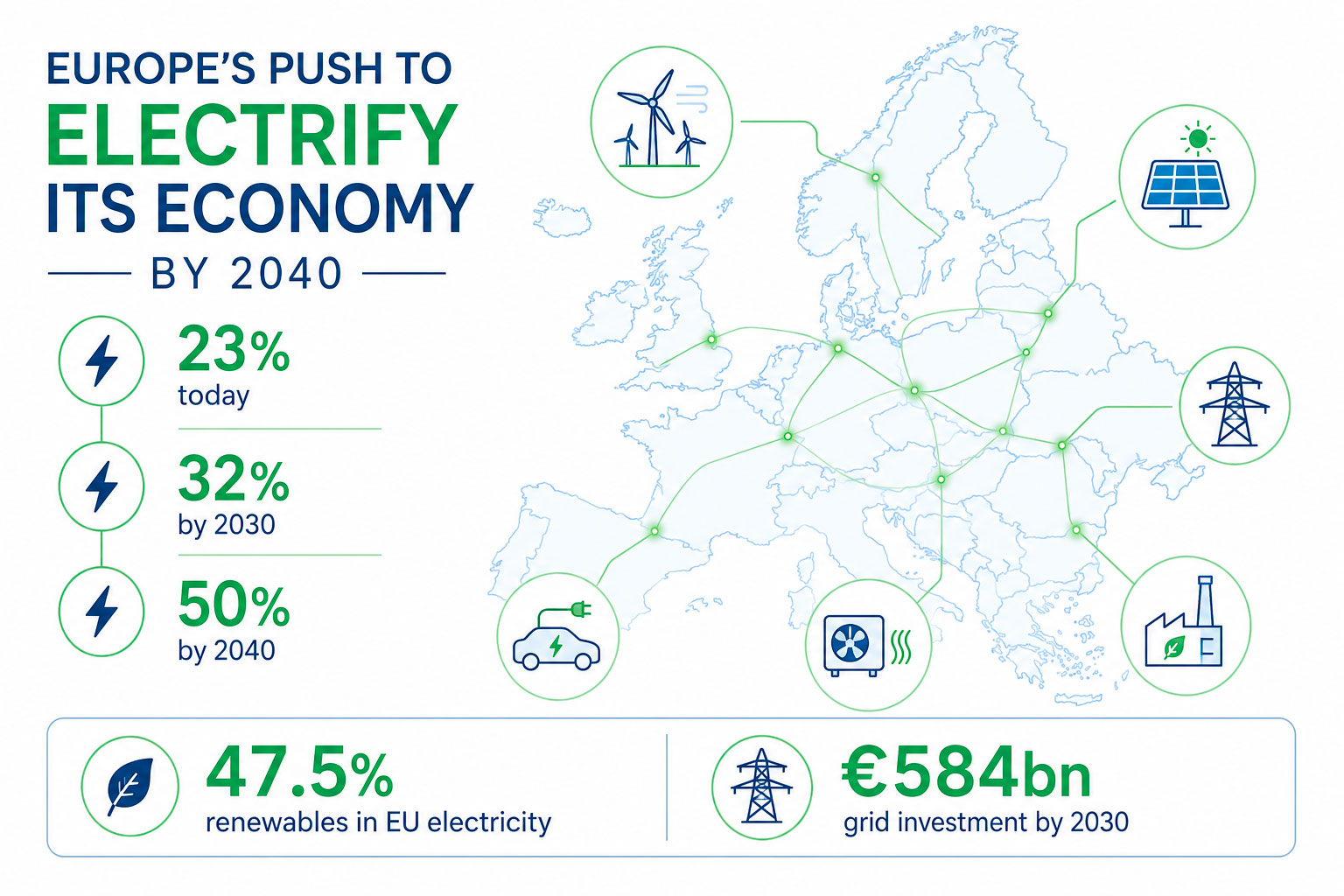
Can the EU become the first “electro-continent” by 2040? Graphic by Energy Europe Editorial Team.
Industry Is the Toughest Test
The most significant changes will need to happen in energy-intensive sectors.
Transport is a good example. Urban mobility is already moving toward decarbonisation thanks to relatively short distances and more developed infrastructure. Long-distance trucking is more difficult because it requires high-power charging along corridors, grid connections at logistics hubs, and harmonised standards across borders.
The Alternative Fuels Infrastructure Regulation points in this direction: by 2030, heavy-duty vehicle charging stations should be available every 60 km on the core TEN-T network and every 100 km on the comprehensive TEN-T network. But industry warns that infrastructure is still lagging behind demand. The European Automobile Manufacturers’ Association, ACEA, estimated that the EU had more than 630,000 public charging points in 2023. The Commission’s 2030 target would require about 3.5 million, while ACEA itself argued that actual demand could require 8.8 million.
Industry presents a similar challenge. As of 2024, fossil fuels accounted for almost half of industrial final energy consumption in the EU – and usually for good reason.
In glass production, for example, electrification would require replacing most currently used furnaces. Eurostat data shows that the manufacture of glass and glass products used natural gas for 71.9% of its final energy consumption in 2024.
Steel is at a different stage. Electric arc furnaces are already central to lower-carbon steelmaking, especially where scrap is available. Primary steel, however, still faces much tougher technological and cost barriers.
Even if the EU balances taxes between electricity and fossil fuels, the hardest part is replacing existing equipment. That makes completion within one and a half decades highly uncertain. The transition plan may be feasible on paper, but the timeline for industrial transformation is “terrifyingly tight,” Simone Tagliapietra, Senior Fellow at Bruegel, said at the 2025 Cleantech Conference in Brussels.
All in all, electricity-driven solutions will only work if electricity prices are both low and highly stable. That is not the reality today, given grid constraints, limited storage, and insufficient infrastructure. Technological and regulatory progress will have to build on those foundations.