

'/%3E%3C/svg%3E)
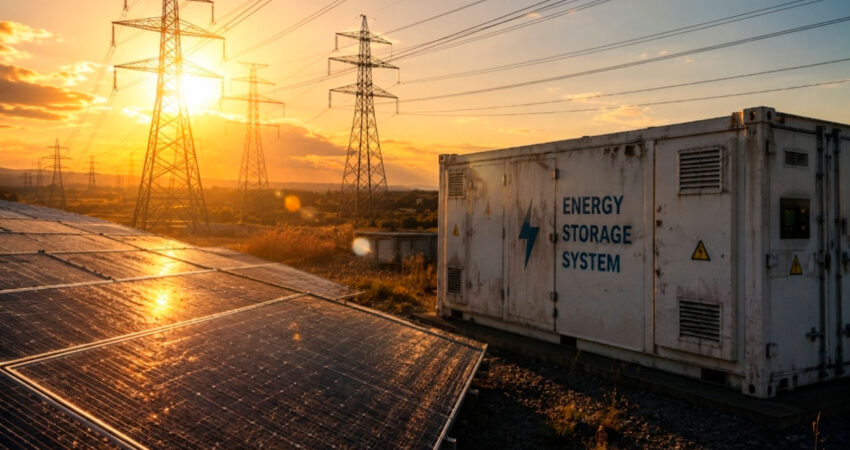
The European energy transition has entered a new, challenging phase. For a long time, one question took centre stage: how quickly can coal, oil and gas be replaced by renewable energy? Now, a second, more complex problem is coming to the fore. Europe is producing ever more electricity from wind and solar power – but not always when it is needed, and not always where the grid can absorb it.
A turning point in the energy mix
In 2025, wind and solar energy together accounted for 30 per cent of electricity generation in the EU, surpassing fossil fuels for the first time; fossil fuels together accounted for 29 per cent. At the same time, it is becoming increasingly common for clean electricity to be available but not fully usable by the system. Wind turbines are curtailed, solar output is reduced, and electricity prices on the exchange occasionally fall below zero.
Curtailment means that technically feasible electricity generation is not fed into the grid for network or market-related reasons. This happens when regional power lines are overloaded, demand is low at that moment, or there is a lack of flexible consumers and storage. At such times, there is no shortage of electricity, but a surplus – albeit at the wrong time and in the wrong place.
This problem is growing with the success of renewable energy. Wind and solar plants have very low operating costs. When the wind blows or the sun shines, large amounts of electricity enter the market at the same time. In principle, this is desirable, as every kilowatt-hour from renewable sources can displace fossil fuel generation. However, electricity systems must remain in balance at all times. If the necessary flexibility is lacking, the system responds with exports, storage, consumption shifts – or indeed curtailment. The International Energy Agency describes such situations as phases of oversupply, in which electricity supply can exceed demand on the grid and grid operators must intervene to keep the system in balance.
Negative prices: No cause for celebration
This imbalance is particularly evident in negative electricity prices. They arise when high and inflexible supply meets low demand at the same time, often during periods with high wind or PV feed-in and low consumption. Germany’s Federal Network Agency explains this mechanism in detail on its electricity market data portal SMARD.
Negative prices may sound attractive to consumers. In reality, however, they are not a sign of free abundance, but an indication of a lack of flexibility. The electricity is only cheap because it cannot be sufficiently used, stored or transported at that particular moment. The IEA describes such periods of oversupply as a systemic challenge in markets with high shares of wind and solar power.
Who pays the bill?
The costs do not disappear simply because the wholesale price is negative. If a renewable energy plant is curtailed, potentially usable energy is lost. At the same time, operators receive compensation – depending on national regulations. Added to this are redispatch costs: interventions in which grid operators instruct power plants to adjust their output to avoid grid congestion. Ultimately, these costs are usually borne by consumers, businesses or taxpayers – directly via grid charges, indirectly via the electricity price, or through government support mechanisms. The IEA has accordingly warned of the growing economic consequences of curtailment.
When generation and consumption diverge
The problem becomes particularly acute where generation and consumption are geographically far apart. Wind power is often generated in coastal regions or at sea, while major consumption centres are located inland. Solar power peaks at midday, when private households consume less than in the evening. Industrial plants, in turn, do not automatically operate when electricity is abundant. This gives rise to a new key challenge: the electricity system must not only become cleaner, but also more flexible in terms of both location and time.
Germany’s grid dilemma: from transmission to distribution networks
Germany is a prime example of this dilemma. A great deal of wind power is generated in the north and at sea, while the major industrial consumption centres are located in the south and west. At the same time, solar PV is expanding rapidly, particularly on rooftops and in solar parks, which are predominantly connected to distribution networks. As a result, the problem is increasingly shifting from the large transmission grids to the lower voltage levels.
This is clearly reflected in the redispatch figures: according to Germany’s Federal Network Agency, a total of 15,549 gigawatt-hours of generation were curtailed in 2025 as part of redispatch measures – an increase of around seven per cent compared to 2024. Of this, 9,379 gigawatt-hours, or 60 per cent, were attributable to renewable energy. At the same time, the number of hours with negative wholesale prices rose significantly: negative prices occurred in 573 out of 8,760 hours in 2025, compared with 457 out of 8,784 hours in the previous year. Germany therefore illustrates the next stage of the challenge. It is no longer just about transmission from north to south, but about the intelligent integration of millions of decentralised solar installations into distribution networks, storage facilities, flexible tariffs and controllable consumers.
Grid expansion alone is not enough
New power lines remain indispensable, but are often slowed by planning, approval and construction procedures that take years or even decades. Meanwhile, renewable generation is growing faster than many grids can be modernised. The IEA describes the problem as a bottleneck in connecting generation, demand and storage. Europe therefore runs the risk of entering a costly transitional phase in which a growing proportion of clean energy is wasted.
The end of baseload logic
This development fundamentally challenges existing concepts of the electricity system. For decades, the idea of baseload dominated: large power plants ran as continuously as possible, while flexible units covered the peaks. In a system with a high share of wind and solar power, this logic shifts fundamentally. What matters is no longer which plants can supply continuous power reliably, but which can adjust their output quickly and economically.
Nuclear energy in a flexible system
In this context, the debate on nuclear energy is taking a new direction. Nuclear power plants generate low-carbon electricity and contribute to security of supply. Technically, some plants are capable of load following. Nevertheless, they are economically dependent on high utilisation rates because their fixed costs are immense. Frequent ramping down and ramping up does not fit their business model. If a country has a lot of nuclear power and, at the same time, a lot of renewable generation on the grid, a real conflict of objectives arises. Do you curtail wind and solar plants, or do you throttle large nuclear units? The answer is not only technical, but also economic and political.
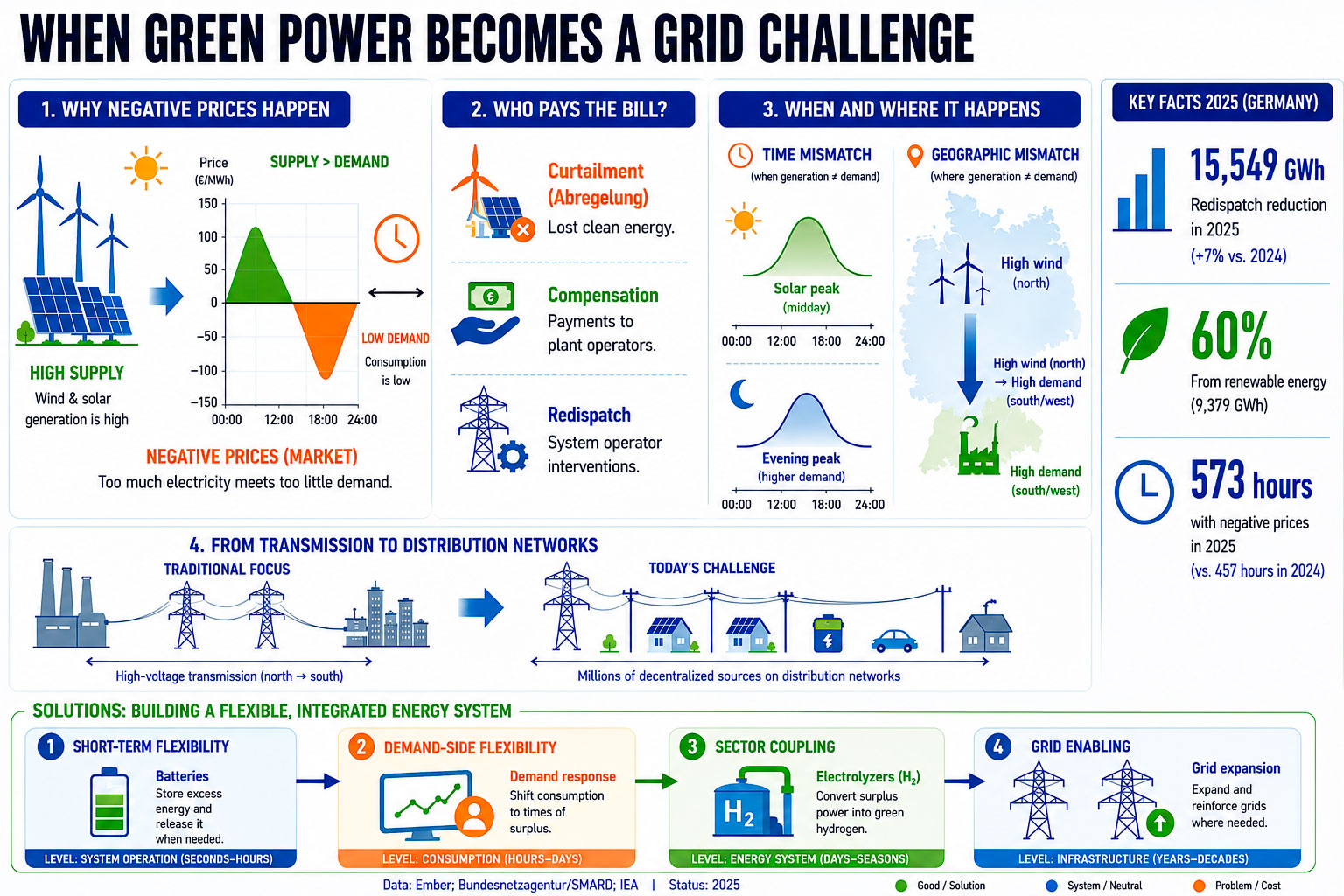
Why abundant green power can strain the grid. Grafik vom Energy Europe-Redaktionsteam.
Rethinking combined heat and power
The role of combined heat and power is similarly complex. CHP plants are considered efficient because they supply both electricity and usable heat simultaneously, thereby making an important contribution to district heating networks and industry. Yet CHP plants too need to be integrated into a more flexible electricity system. If a CHP plant operates in heat-led mode, it produces electricity when heat is needed, not necessarily when the grid requires additional feed-in. On cold, windy days, this can actually increase the strain on the system. The solution lies in combining CHP plants with heat storage systems, large-scale heat pumps, power-to-heat plants and more flexible operating concepts.
Flexibility as the key: technologies working together
The answer does not lie in any single technology. Battery storage can help in the short term by shifting solar peaks into the evening. Long-duration storage can help bridge prolonged periods of low wind and solar output. At least as important is flexible demand: industrial plants that shift their production times; electrolysers that produce hydrogen during periods of surplus; data centres with load-variable IT; electric cars that charge when electricity is abundant; and heat pumps and thermal storage systems that link the electricity and heating sectors more closely.
The IEA now describes demand flexibility as an essential component of modern electricity systems. The European Network of Transmission System Operators for Electricity, ENTSO-E, also no longer views flexibility as an additional option, but as a core task. It states that flexibility from renewable energy must become a cornerstone of the decarbonised European electricity system in order to ensure grid stability, improve integration and limit costs for consumers.
Market design and social balance
Electricity tariffs and market design are also becoming increasingly important. As long as many consumers are barely aware of when electricity is expensive or cheap on the exchange, a large proportion of demand remains inelastic. Dynamic tariffs can create strong incentives to shift consumption during periods of high renewable generation. However, such models must be designed with social safeguards so that households without flexible appliances or on low incomes do not become the losers of this shift towards flexibility.
Conclusion: Utilisation rather than curtailment
Curtailment is not an argument against renewable energy. It demonstrates that wind and solar energy have advanced to the point of exposing the system’s outdated structures. The first phase of the energy transition involved building up clean generation capacity. The second phase requires intelligent interaction between grids, storage, flexible power plants, flexible heat supply, flexible demand and a market design that does not waste surplus but makes it usable.
Europe is thus facing an efficiency problem with considerable political sensitivity. If clean electricity is curtailed with increasing frequency while consumers complain about high energy costs, acceptance of the energy transition suffers. Success is measured not only by how many gigawatts of wind and solar capacity are installed, but by how much of that energy actually reaches the right place at the right time and is used.
More on this topic: Beyond renewables: building europe’s storage backbone