


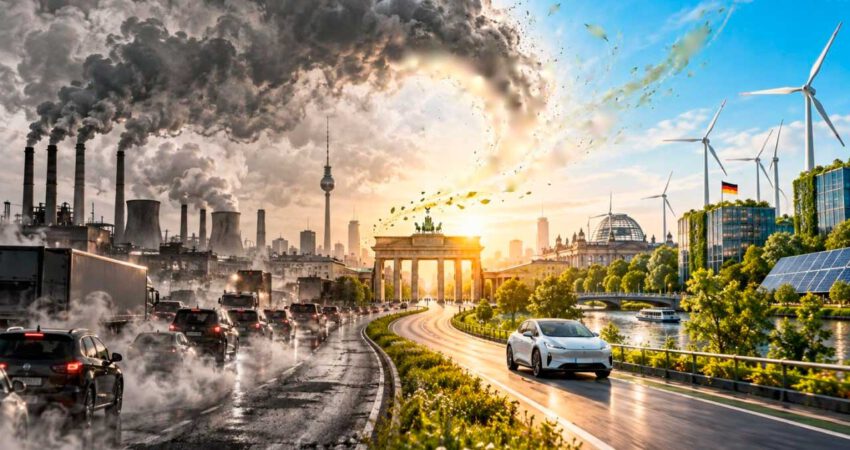
Germany’s route to climate neutrality promises greater energy security, but requires trillions of euros in investment. The challenge is to finance the transformation without pricing households out of it or weakening the industries expected to deliver it.
Germany presented its roadmap for transitioning away from fossil fuels at the United Nations in New York on 23 September 2026. It brings existing policies together around the statutory goal of climate neutrality by 2045, with electrification central to replacing oil, gas and coal in transport, buildings and industry.
The roadmap incorporates the Climate Action Programme 2026. The government estimates that its 67 measures will reduce gas consumption by almost seven billion cubic metres and petrol consumption by around four billion litres by 2030. These are expected policy effects, rather than savings already achieved.
The direction is clear. The economic outcome depends on whether cleaner equipment, reliable infrastructure and affordable power arrive together. A factory cannot decarbonise on the strength of a target alone, and a household cannot buy a heat pump with projected national savings.
Energy security has an investment bill
According to the Federal Environment Ministry, Germany imported approximately 98% of its petroleum and 95% of its natural gas in 2024. The roadmap puts net fossil-fuel imports at about €76 billion that year. Reducing that dependence would limit exposure to volatile fuel markets and redirect spending towards domestic infrastructure and production.
The case for renewables as a security strategy has a wider European counterpart. Bas Eickhout, the Dutch MEP and co-president of the Greens/EFA group in the European Parliament, and fellow co-president Terry Reintke called for “a strong green industry that can compete with China and the US” in a February 2026 letter to EU leaders. Their argument links industrial investment with European autonomy and security.
That connection matters for Germany: importing fuel year after year leaves consumers exposed to decisions elsewhere. Investing in renewable generation changes that exposure, although equipment and raw-material supply chains create vulnerabilities of their own.
The €76 billion is therefore an import bill, not a guaranteed annual saving. Replacement power plants, networks and equipment must be financed, and their operating costs matter. The transition’s economic value will depend on the lifetime cost and reliability of the new system, rather than the disappearance of one line in the trade accounts.
The targets and the projected shortfall
Germany’s legal milestones are emissions reductions of at least 65% by 2030 and 88% by 2040 against 1990 levels, followed by net zero in 2045. Climate neutrality allows residual emissions to be balanced by removals, but it does not make extensive fossil-fuel use compatible with the target by default.
The Federal Environment Agency’s 2026 projections show a 62.6% reduction by 2030, leaving an annual gap of about 30 million tonnes of CO₂-equivalent. They project roughly 80% by 2040 and 212.5 million tonnes of gross annual emissions remaining in 2045, before land-use emissions and removals. These projections reflect policies sufficiently defined by October 2025, rather than a full assessment of the September 2026 roadmap.
The Council of Experts on Climate Change challenged the projections’ narrow compliance with the cumulative 2021 to 2030 emissions budget. Its May 2026 assessment instead estimated an overshoot of 60 million to 100 million tonnes of CO₂-equivalent, citing underestimated emissions, especially in energy and buildings. The annual 2030 gap and the cumulative budget shortfall measure different things.
The distinction matters politically. A distant neutrality pledge cannot substitute for credible reductions this decade. Postponing investment may ease immediate spending pressures, but risks compressing the remaining work into a shorter, more expensive period.
Electricity is ahead of heating and transport
The transition is advancing unevenly. UBA’s energy statistics show that renewables supplied 55.1% of gross electricity consumption in 2025, compared with 23.8% of gross final energy consumption overall. Their shares were only 19% in heating and cooling and 8% in transport. Germany’s 2030 electricity target is at least 80% renewables.
A greener electricity mix is essential, but the harder task is replacing equipment that still burns fossil fuels. Cars, boilers and industrial installations have long operating lives. Investment decisions made now can either reduce future dependence or prolong it.
Electrification can also reduce the energy needed to deliver the same service. Comparing the price of a kilowatt-hour of electricity with a kilowatt-hour of gas or petrol misses that efficiency advantage. The relevant comparison for consumers is the cost of heating a home or travelling a kilometre, including equipment and finance.
Networks must connect that new demand to generation. Klaus Müller, president of the Federal Network Agency, said in its June 2026 statement that accelerating expansion remained necessary to make the system fit for the future. He also stressed the need to “keep a handle on costs”. Both requirements deserve equal attention.
The Monitoring Report 2025, published by the agency and the Federal Cartel Office, records distribution operators’ estimated expansion needs of approximately €110 billion by 2033 and €207 billion by 2045. These figures exclude pure replacement investment and dismantling costs. They concern distribution networks, rather than the entire electricity system.
Network spending ultimately feeds into regulated charges and financing arrangements. Households and businesses can therefore pay through their bills even when operators make the initial investment. Planning must avoid both bottlenecks that obstruct electrification and unnecessary capacity that burdens consumers. Grid estimates also overlap with broader transition studies and should not simply be added to them.
What KfW’s €65 billion actually means
KfW’s analysis of 12 October 2026 estimates around €6 trillion in climate-related investment from 2025 to 2045, averaging about €290 billion annually. This is spending on assets, including vehicles and infrastructure, rather than the net economic cost of climate action.
The historical comparison is roughly €110 billion a year invested in climate protection during 2018 to 2023. Raising that gross investment to €290 billion implies an increase of about €180 billion annually.
KfW then compares cleaner technologies with conventional fossil alternatives. On that basis, required annual net investment is around €145 billion, against an estimated €80 billion already being invested annually on the same basis. The difference is approximately €65 billion a year. It is the further increase in net investment, not the full premium over fossil technologies and not a taxpayer bill.
The underlying Prognos study places about 45% of climate investment in transport, 25% in energy, 22% in buildings and 8% in industry. Around 12% is attributed to the public sector, with the rest assigned to private capital.
An investor’s identity does not settle who bears the cost. Private investment can receive public subsidies; companies may pass costs into prices; public support draws on budgets. Nor do investment estimates capture all operating expenses, financing costs or fuel savings. Judging affordability requires those wider effects, along with the distribution of costs across incomes and sectors.
The timing of payment matters too. An investment can be worthwhile over its lifetime yet unaffordable at the moment of purchase. Loans, guarantees and carefully targeted grants should bridge that gap without obscuring the eventual cost. Policy should make sound investments accessible while keeping their benefits and risks visible to those financing them.
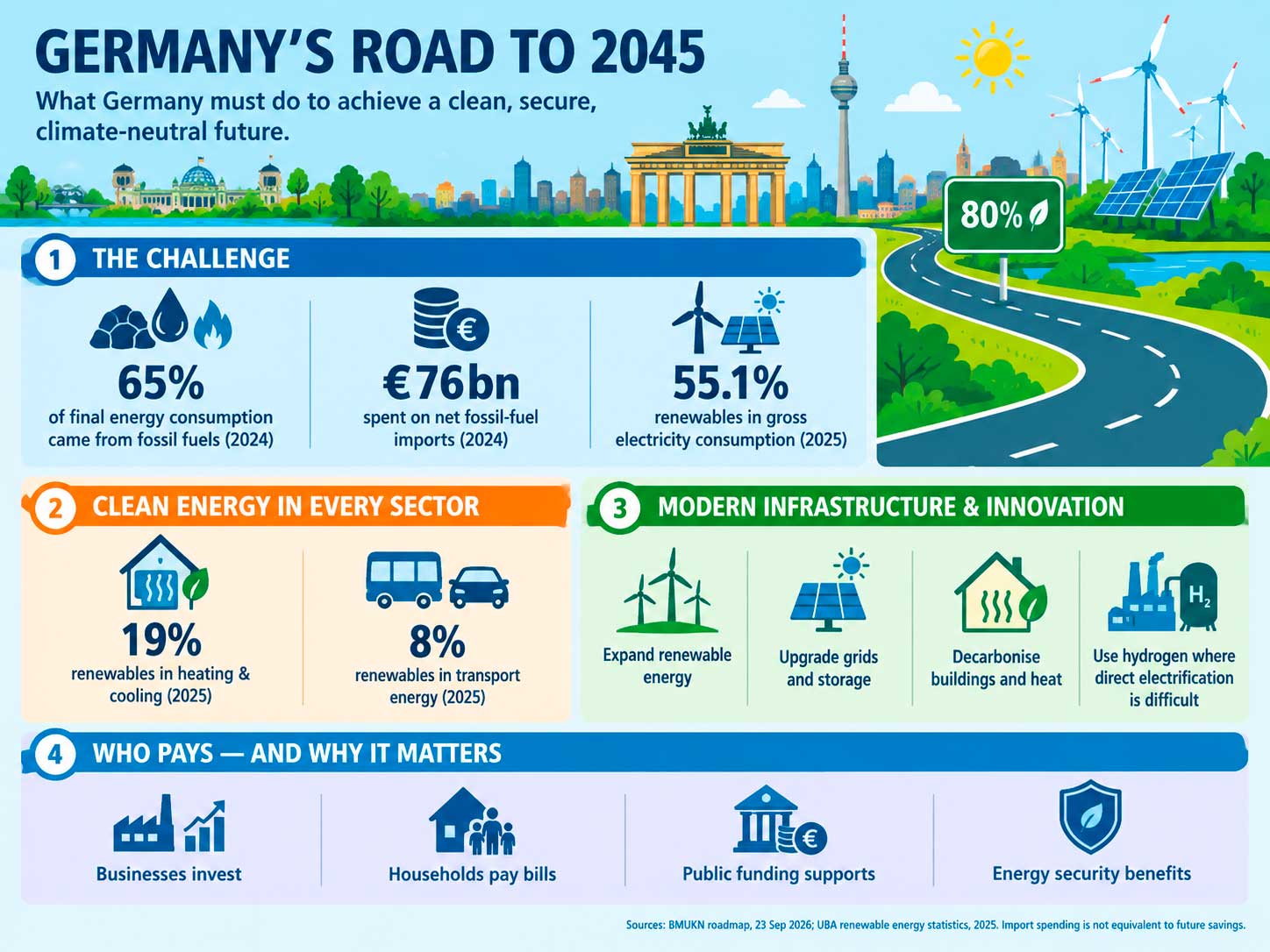
Germany‘s Road to 2045. Graphic: Energy Europe Editorial Team.
Keeping low-carbon industry in Germany
Industrial decarbonisation requires equipment that works commercially as well as technically. For internationally competing manufacturers, the price of dependable electricity and the cost of converting production can decide whether a cleaner plant attracts investment.
The International Energy Agency’s electrification report finds electric technologies already competitive in several industrial applications, including some low- and medium-temperature heat. That supports a practical approach: electrify where it makes sense, while concentrating scarce low-emission hydrogen on applications with fewer alternatives.
Public support should help viable new processes reach scale and reward measurable emissions reductions. Permanent subsidies for inefficient production would shift costs onto taxpayers without resolving competitiveness. Equally, demanding conversion before affordable energy and infrastructure are available risks discouraging investment altogether.
The EU’s Carbon Border Adjustment Mechanism, in its definitive phase since January 2026, addresses carbon leakage by applying carbon pricing to selected imports, including steel, cement and fertilisers. Its limited sectoral coverage means it cannot resolve every competitive pressure facing German manufacturers.
If production moves abroad to more emissions-intensive plants, Germany’s territorial emissions may fall while the global benefit shrinks. Preserving a viable industrial base therefore requires coordination between carbon pricing, infrastructure and targeted support, rather than treating lower domestic emissions as sufficient evidence of success.
The household test
Transport and buildings account for roughly two-thirds of the investment identified by KfW. For families, these costs arrive as individual decisions about cars and heating systems, often before the benefits appear in lower running costs.
The IEA’s heat-pump assessment identifies upfront installation costs, building modifications and access to skilled installers as barriers. Efficiency improvements can reduce heating demand and the strain on local electricity networks. The economics still vary by property, tariffs and financing terms. Homeowners need dependable installation advice; tenants need arrangements that connect investment decisions with the people paying the heating bills.
Support must consequently reach households unable to finance a conversion, even when it would save money over time. Stable rules and clear information are also necessary: uncertainty can delay purchases or encourage another generation of fossil equipment. A subsidy that helps affluent buyers while excluding those with limited borrowing capacity would weaken the transition’s public legitimacy.
Efficiency offers another route to reduce costs. UBA modelling estimates that a combined limit of 120 km/h on motorways and 80 km/h on roads outside built-up areas could save around 2.8 billion litres of fuel, using 2024 traffic as the baseline. This is a modelled policy option, rather than an adopted nationwide rule.
Such measures deserve attention alongside expensive replacements. Reducing energy demand can ease the amount of new supply and infrastructure required. The political difficulty is persuading voters to accept changes whose financial benefits are dispersed across millions of everyday journeys.
Can Germany afford to wait?
Germany’s fossil-fuel exit is a test of economic coordination as much as climate ambition. Its feasibility depends on affordable power, timely infrastructure and support that makes conversion possible for households and businesses.
The roadmap provides direction, but cannot guarantee that investment and implementation will move fast enough, or in the right order. Germany may be able to afford its fossil-fuel exit. The danger is making it more expensive through delay, uncertainty and poor coordination.