


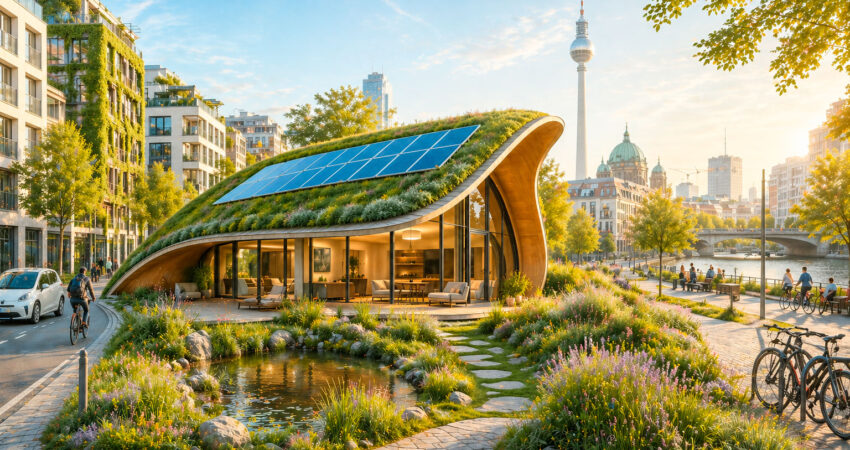
Europe’s energy transition is being shaped not only by wind farms and solar parks, but also by homes, schools and office buildings. Going forward, modern homes are expected to consume less energy, generate their own electricity and store energy, making households less dependent on gas prices. In Germany, the government can subsidise the replacement of heating systems by up to 70%, and Europe’s heat pumps could reduce gas demand for building heating by at least 21 billion cubic metres by 2030.
The energy transition starts with buildings
Europe’s cities face a dual challenge: they must remain affordable while drastically reducing their energy consumption. The solution lies not only in new power stations, wind farms and solar installations, but also in the buildings themselves. In the future, houses should be designed and built to consume as little energy as possible for heating, cooling, ventilation and hot water, and ideally to generate, store or use energy flexibly.
The potential impact is enormous. Buildings account for around 40% of energy consumption and approximately 36% of energy-related greenhouse gas emissions in the EU. The revised EU Energy Performance of Buildings Directive aims to make existing buildings climate-neutral by 2050, with zero-emission buildings required from 2030 onwards. This means that Europe’s energy transition will be determined not only by the electricity market, but also by homes, schools, offices, hospitals and entire neighbourhoods.
How better building envelopes reduce energy consumption
The new generation of buildings starts with the building envelope. Better insulation, modern windows, controlled ventilation with heat recovery and efficient shading can reduce energy demand even before the heating is turned on. High-performance insulation materials, such as aerogels or vacuum insulation panels, can be used where there is limited space for conventional insulation, for example in city centre renovations or on challenging façades. The basic idea is simple: the less energy a building loses, the smaller, cheaper and more efficient the technology behind it can be.
Roofs and façades are becoming power stations
In addition, energy is being produced within the building itself. Rather than simply being bolted onto roofs, photovoltaics are increasingly being integrated into façades, glass surfaces and building components. These BIPV (building-integrated photovoltaics) solutions replace traditional building elements, turning houses into small power stations.
According to the Fraunhofer Institute for Solar Energy Systems, Germany has the technical capacity to install around 1,000 GWp on and around buildings, which is almost nine times the current PV figure of 117 GW. This would theoretically generate enough electricity for around 170 million households – more than sufficient to cover a large share of Germany’s power demand with solar power from buildings.
Smart technology cuts energy demand
Control systems are also becoming increasingly important. Smart sensors, digital meters and AI-supported building technology can adapt heating, cooling, lighting and ventilation according to the weather, electricity prices and actual usage. In office buildings, schools and residential areas, this can lead to significant savings, as energy is no longer consumed on a rigid schedule, but rather where and when it is needed. The house of the future will therefore respond not only to its occupants, but also to the surrounding energy system.
Germany as a test market for the heating transition
In this regard, Germany is an important test market. The Building Energy Act is gradually shifting the focus of new heating systems towards renewable energy sources. Heat pumps play a central role in this transition, as they harness environmental heat from the air, ground or water and are powered by electricity. While the technology is not new, it is becoming increasingly important strategically as it can replace gas and oil heating systems, reduce local emissions, and reduce Europe’s dependence on fossil fuel imports.
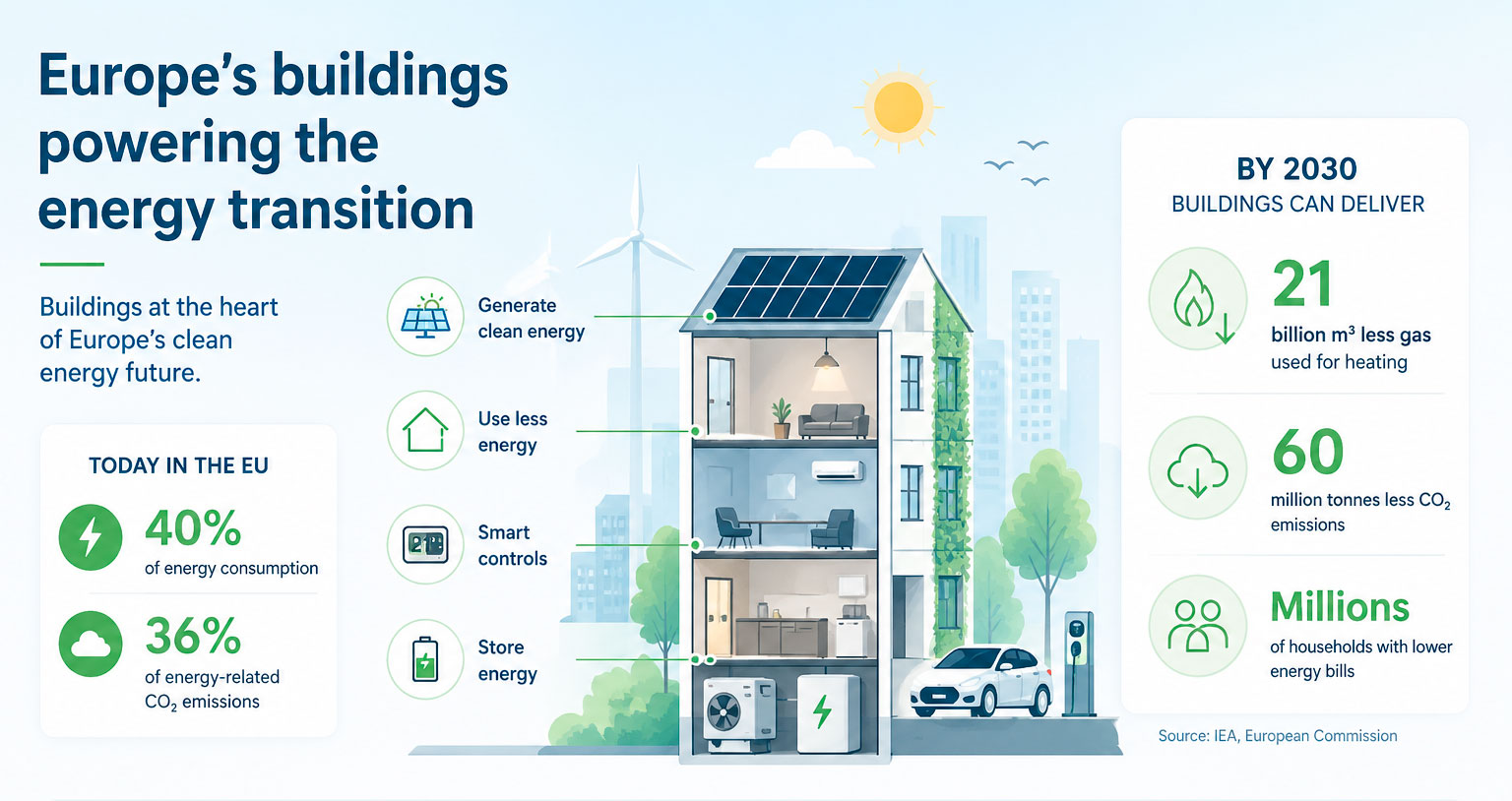
Europe’s buildings powering energy transition, Graphic by Energy Europe Editorial Team
Subsidies shape the economics
For households, however, success depends not only on environmental arguments, but also on costs. In Germany, the government can subsidise up to 70% of the eligible costs of replacing an old heating system. For a detached house, the eligible cost limit for a single dwelling is €30,000; in theory, the grant could therefore amount to as much as €21,000. However, eligibility depends on factors such as ownership status, income, the technology used and the availability of public funds.
The calculation for running costs is more complex. Heat pumps operate most economically in well-insulated buildings, especially where electricity prices are not too high compared with gas prices. Energy experts therefore repeatedly emphasise the importance of monitoring electricity and gas prices: lower electricity costs and higher fossil-fuel heating costs due to CO₂ pricing mean that heat pumps can pay for themselves more quickly in everyday use. For many homeowners, this is not just about climate protection, but also about stabilising heating costs in the long term.
How much households could save
The potential savings are nevertheless significant. Depending on the building’s condition, electricity tariff and heating system age, households can save several hundred euros a year with an efficient heat pump. The switch becomes particularly attractive when high subsidies reduce the initial cost of installation and the household also uses on-site solar power. In that case, the house becomes more economical and less dependent on price spikes in the gas market.
Heat pumps and energy security
The economic impact is also significant. The International Energy Agency recognises heat pumps as both a climate protection technology and a tool for energy security. Its findings suggest that rapid expansion could reduce Europe’s gas demand for building heating by at least 21 billion cubic metres by 2030. This would significantly reduce dependence on imports.
Neighbourhoods are becoming small energy systems
The effect is even greater when individual buildings are connected to form neighbourhoods. This allows solar systems, heat pumps, local heating networks, battery storage and charging points to be controlled together. Rather than generating and consuming energy individually, energy is distributed throughout the neighbourhood, temporarily stored and used at the right time. Large-scale battery storage already demonstrates the importance of storage for an electricity system with a high share of wind and solar power. In residential neighbourhoods, the focus is usually on smaller solutions, but the principle is the same: energy should not be lost, but made available when needed.
Green roofs, light-coloured façades, unpaved surfaces and rainwater storage systems are also part of this new approach. Although they do not generate electricity, they reduce heat in densely built-up neighbourhoods, store water and relieve pressure on sewer systems during heavy rainfall. Cities such as Berlin and Vienna are therefore increasingly adopting “sponge city” concepts, in which buildings, streets and green spaces work together to combat heat and flooding.
From cost burden to energy asset
Experts largely agree that Europe’s buildings are evolving from a passive cost factor into an active energy source. Fraunhofer ISE points to the potential of roofs and façades as energy-generating surfaces. The International Energy Agency considers heat pumps essential for greater energy security. Meanwhile, energy economists emphasise that economic viability hinges on subsidies, electricity prices and the condition of existing buildings.
The house of the future is not an isolated high-tech gadget, but rather an intelligent system component. It consumes less energy, generates its own electricity (with a potential capacity of up to 1,000 GWp in Germany alone), stores energy and can adapt based to weather conditions, electricity prices and actual usage. Europe’s concrete jungle remains, but it now saves, stores and uses energy more intelligently. The winners are the climate, your wallet, and energy security.