

'/%3E%3C/svg%3E)
Extreme heat is exposing a new energy-security risk: demand for cooling rises just as hydro, wind, nuclear and thermal generation come under pressure. Solar helps during the day, but the hardest hours begin after sunset.
This summer, Europe was already longing for autumn. Since late May, successive heatwaves had brought punishing temperatures across the continent. June and July were the warmest such two-month period on record for Western Europe, according to the Copernicus Climate Change Service (C3S), implemented by the European Centre for Medium-Range Weather Forecasts (ECMWF).
Commenting on the June heatwave, ECMWF Strategic Lead for Climate Samantha Burgess warned of “growing risks for people, ecosystems and infrastructure across Europe and beyond”, as reported by Copernicus.
Electricity infrastructure is increasingly part of that risk. Europe’s power system was not designed for summers like these: heat drives up electricity demand for cooling while simultaneously disrupting generation from hydro, wind, nuclear and conventional thermal plants. Solar has offered important relief during daylight hours, but the system’s most difficult hours begin after sunset.
Heat puts pressure on both supply and demand
Extreme heat puts Europe’s electricity system under pressure at both ends. Air conditioning pushes electricity demand higher, while drought, warm rivers, stagnant air and high ambient temperatures can constrain supply.
Europe enters these heatwaves with a considerably cleaner electricity mix than it had only a few years ago. Renewables accounted for 45.5% of EU electricity generation in the first quarter of 2026, up from 42.7% a year earlier. Wind remained the largest renewable source, while solar continued its rapid expansion.
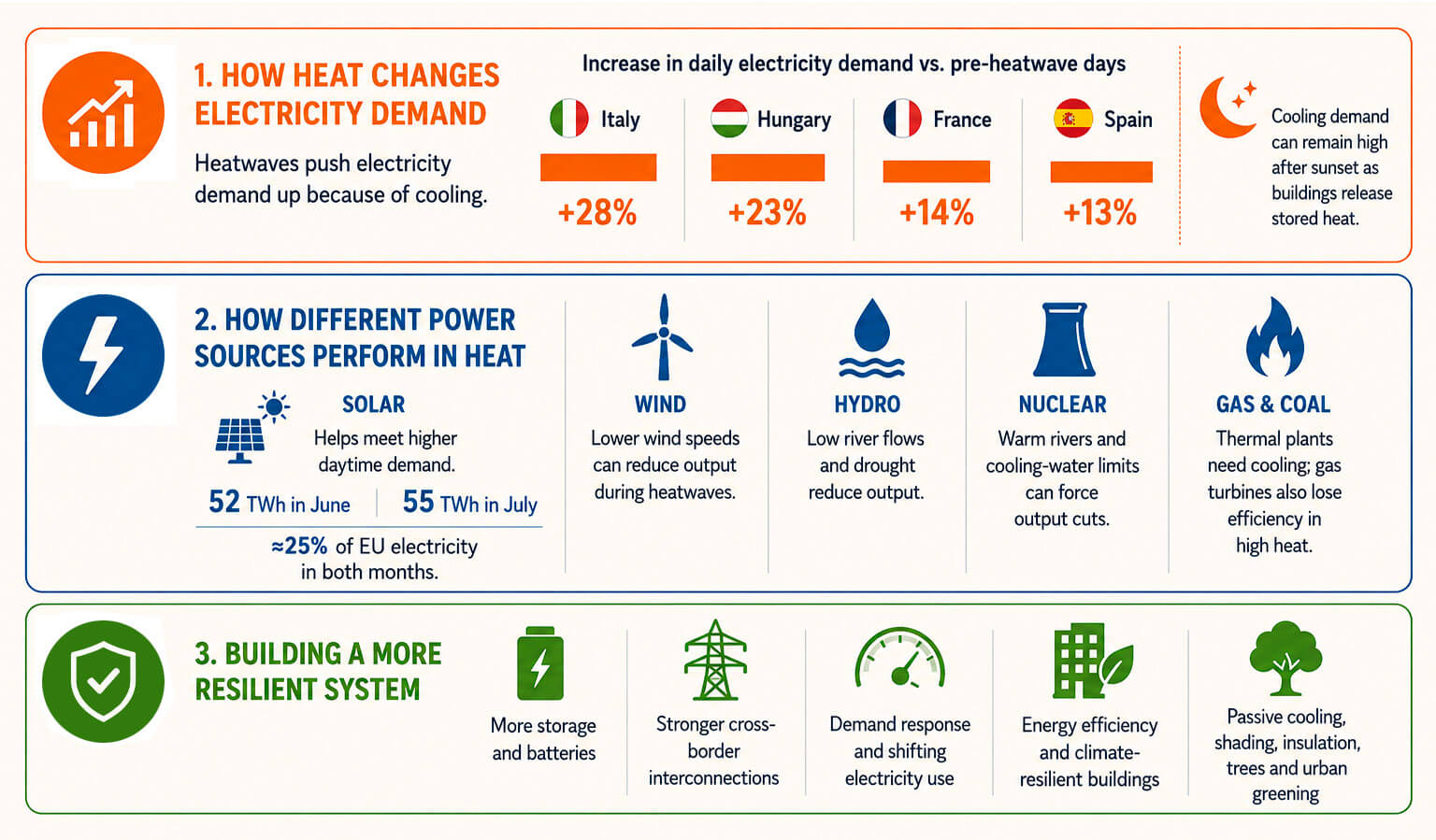
Solar has been the clear daytime winner. During the June and July heatwaves, EU solar generation reached roughly 52 TWh in June and 55 TWh in July, providing around 25% of EU electricity generation in both months. The effect varied by country. On heatwave days, average daily solar generation was 17% higher in France and Hungary than on other days in June and July, 5% higher in Spain and broadly unchanged in Italy, according to Ember’s analysis.
“The surge in solar output helped stabilise grids at a time when other power sources were struggling to deliver,” Ember Senior Energy Analyst Chris Rosslowe observed. Yet solar’s contribution is concentrated in daylight hours. Cooling demand often remains high after sunset, when homes and buildings release heat accumulated during the day.
No power source is protected from extreme heat
Other sources have had a much harder summer. Low river flows reduced hydropower output across the continent. According to Ember’s analysis, seven of the EU’s eight largest hydropower producers generated below their five-year averages in July.
Wind generation can also suffer during heatwaves. Many European heatwaves are associated with persistent high-pressure systems, which can bring stagnant conditions and lower wind speeds. A study focused on Southern Europe found that wind-power output could fall by as much as 30.8% during heatwaves.
Nuclear reactors are not immune either. They require substantial volumes of cooling water, while environmental rules restrict the discharge of excessively warm water into rivers. France, the EU’s largest nuclear-power producer, has become the most visible example. In July, heat and river conditions cut output by 6.3 GW across eight reactors. In mid-August, another heatwave was expected to curtail as much as 9.4 GW across nine reactors.
Conventional thermal plants are affected too. Coal, gas and biomass facilities need cooling, while gas turbines lose efficiency as intake-air temperatures rise. In July, high Mediterranean temperatures also threatened operations at the gas-fired Martigues plant in southern France because seawater used for cooling was approaching permitted temperature limits. The episode underlined that the vulnerability is not specific to nuclear power: any large thermal plant that must reject substantial quantities of waste heat can become sensitive to the temperature and availability of its cooling source.
No generation technology is entirely insulated from extreme heat.
Cooling is becoming a structural challenge for the grid
The core problem is that electricity supply becomes less reliable at the same time as demand rises. During the late-June and July heatwaves, daily electricity demand increased by as much as 28% in Italy, 23% in Hungary, 14% in France and 13% in Spain compared with pre-heatwave days, Ember reports.
This is not merely a problem created by one exceptionally hot summer. Cooling is becoming a structural challenge for electricity systems. According to the International Energy Agency (IEA), global electricity demand for space cooling has risen by around 50% since 2015 to roughly 2,900 TWh – more than the EU’s entire annual electricity consumption – and has accounted for about 14% of global electricity-demand growth over that period.
The IEA also expects EU electricity consumption to increase by around 300 TWh over the five years to 2030, with buildings the main contributor to demand growth. Alongside data centres and heat pumps, rising demand for cooling is expected to account for much of the increase in the buildings sector.
The particular challenge for electricity systems is that cooling demand is highly concentrated. According to the IEA, cooling accounts for around 10% of annual electricity consumption globally but 30% of peak electricity demand. Heatwaves can therefore create a disproportionately large strain during a relatively small number of hours.
They can also have a lasting effect. Extreme heat not only increases the use of existing air conditioners but encourages households and businesses to buy new units, creating additional electricity demand that persists after the heatwave has passed. The IEA estimates that under current policies, global cooling demand could increase by 1,600 TWh by 2035 – roughly equivalent to the current annual electricity consumption of Japan and Korea combined. In a scenario with more frequent and intense heatwaves, another 700 TWh could be added. More than 60% of that additional demand would come from faster adoption of air conditioners rather than simply heavier use of existing equipment.
The hardest hours come after sunset
The critical hours are not always the hottest ones. Solar generation is abundant around midday, but air conditioners continue to run into the evening as buildings release accumulated heat. Solar output then falls rapidly at sunset, leaving batteries, hydroelectricity, imports and gas-fired generation to cover the residual peak.
Europe’s power system under heat stress. Graphic by the Energy Europe Editorial Team.
“Solar is already doing heavy lifting during heatwaves, but the real challenge starts after sundown,” Rosslowe told Euronews.
The mismatch between supply and demand is increasingly visible in power markets. Heatwave-day prices have been substantially higher in several markets. During the heatwave in the second week of August, French day-ahead electricity prices rose 21.8% in a single session to €142.50/MWh, while German prices climbed 22.8% to €138.50/MWh.
Different supply constraints were hitting the two markets simultaneously. French nuclear generation was being constrained by high river temperatures, while German wind output was forecast to fall by around 8.1 GW, roughly 60% below seasonal averages.
The effects did not stop at national borders. France remained a net electricity exporter during the August heatwave, but export volumes fell as nuclear availability declined. That increased the need for coal and gas generation in neighbouring markets such as Germany and Britain.
This is also why interconnection is valuable but cannot eliminate weather risk. Electricity can be moved across Europe, but simultaneous heat, drought and low-wind conditions can affect several interconnected markets at once.
Heat resilience is becoming an investment priority
Europe has so far avoided a systemic electricity shortage. The 2026 Summer Outlook from the European Network of Transmission System Operators for Electricity (ENTSO-E) assessed the overall adequacy situation as favourable, with no systemic risks expected for most of the European power system. Individual countries, however, have already had to activate emergency measures.
Hungary increased imports and appealed to businesses and households to cut electricity consumption as record-low Danube levels constrained generation. The government also urged consumers to reduce demand during stressed periods, including the use of air conditioning and EV charging. Reuters reported that the country had increased imports and called for consumption cuts as the power situation became critical.
Romania similarly called for voluntary reductions in evening demand as record-low Danube levels threatened nuclear generation. The country subsequently declared an energy emergency for August and asked companies and households to reduce consumption voluntarily during peak evening hours.
At EU level, the response is broader. The European Commission is preparing an Integrated Climate Resilience Framework while promoting stronger interconnectors, renewable generation, storage, energy efficiency and more climate-resilient buildings. It has also warned against relying on air conditioning alone as temperatures rise, emphasising passive cooling, greener cities and other measures to reduce cooling needs.
For businesses, the issue is increasingly one of capital investment rather than emergency management. French state-owned utility EDF has earmarked €8.7 billion to adapt its nuclear and hydropower infrastructure to higher temperatures.
The scale of the programme reflects the fact that climate adaptation is no longer theoretical for electricity producers. EDF has already faced repeated heat-related output restrictions this summer, with the August heatwave threatening at its peak to curtail around 15% of France’s nuclear capacity.
That figure illustrates the scale of the adjustment ahead. Heat resilience will require spending not only by generators but also by grid operators, municipalities, property owners and industrial consumers. The central question is whether this investment will be made ahead of the next heatwave or only after a period of strained supply, soaring prices and emergency demand reductions.
Flexibility matters more than a “heat-proof” technology
Summer has shown that no electricity source is fully heat-proof. Solar can cushion daytime demand spikes, but drought can reduce hydropower, stagnant weather can weaken wind output, and high river temperatures can restrict nuclear and other thermal plants.
Europe’s most effective near-term response is therefore flexibility. Storage can move midday solar production into evening hours. Stronger cross-border interconnectors can transfer electricity from regions less affected by a particular weather event. Demand-response programmes can reward households and industry for shifting consumption away from stressed periods.
The value of a diversified system increasingly lies not simply in having different sources of generation, but in being able to move electricity between technologies, hours and regions. A dry summer can weaken hydropower, persistent high pressure can suppress wind generation, and warm rivers can constrain nuclear and thermal plants. Flexibility allows the system to compensate when several of those pressures occur at the same time.
The IEA expects this challenge to grow as electricity takes a larger role across the economy. Global electricity demand is forecast to rise by an average 3.6% a year between 2026 and 2030, while EU consumption is expected to increase by around 300 TWh over the period. The agency argues that grid expansion, system flexibility and more efficient use of existing infrastructure will be critical as variable renewable generation expands.
Building design and urban planning matter just as much. Better insulation, external shading, reflective roofs, natural ventilation, trees and urban greening can reduce the electricity required for cooling in the first place. Cities can also create cool public refuges where residents can safely spend the worst hours of a heatwave, rather than cooling many individual flats simultaneously.
The European Commission argues that passive cooling and other adaptation measures should complement mechanical air conditioning rather than allowing cooling demand to rise unchecked.
In this sense, Europe’s summer stress test is not primarily an argument against any particular technology. It is an argument for designing the electricity system around the possibility that several technologies may come under pressure at the same time.
Adaptation is now part of energy security. Europe cannot respond to extreme heat with more generation capacity alone; it must build a power system – and cities – designed to operate in a hotter climate.