


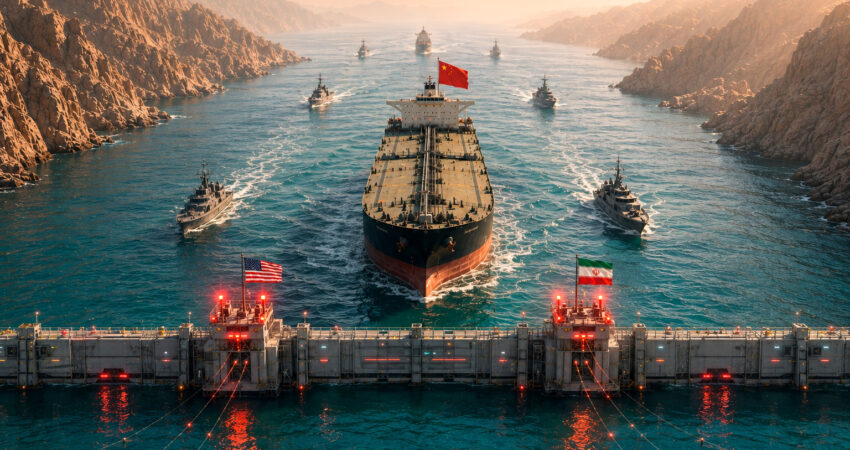
China initially appeared to be among the biggest potential losers from the crisis around the Strait of Hormuz. Yet Beijing’s vast oil reserves, diversified supply network and rapid electrification strategy may allow it to weather the shock far better than many experts expected. As global concerns over energy security intensify, the crisis could ultimately strengthen China’s position in both clean-energy supply chains and the wider geopolitical order.
The escalation around the Strait of Hormuz has caused serious turmoil in global energy markets. The world’s largest economies have all come under pressure, and China initially appeared to be among the most vulnerable. China is the world’s largest importer of crude oil and a major buyer of Iranian oil, accounting for an estimated 80 to 90 per cent of Iran’s oil exports. The military confrontation involving the US, Israel and Iran, attacks on regional energy infrastructure and severe disruptions to shipping through the Strait of Hormuz raised fears that the Chinese economy could become one of the main victims of a new global energy crisis.
However, as the crisis unfolded, it became clear that Beijing was far better prepared for such a scenario than many expected. For more than two decades, China has been building an energy security system designed specifically for major geopolitical shocks. As a result, the current crisis may not weaken China’s position, but strengthen it – both in the energy sector and in the broader global economy and geopolitical arena.
Beijing’s strategy rests on several pillars simultaneously: large-scale diversification of oil supplies, the creation of the world’s largest strategic reserves, the accelerated electrification of the economy and dominance in the production of clean energy technologies. Together, these trends are gradually reducing China’s dependence on global oil markets while simultaneously increasing the world’s dependence on Chinese energy-transition technologies.
CHINA’S DOUBLE INSURANCE
As the world’s largest oil importer, China has long pursued a “double insurance” strategy to safeguard domestic energy supplies. The policy is built around two key elements: diversification of import sources and the accumulation of large-scale strategic and commercial reserves.
Unlike many Asian economies, China avoids dependence on any single supplier. While Japan traditionally purchases around 80 per cent of its oil from Saudi Arabia and the UAE, China spreads its imports across a much broader group of suppliers. No single country accounts for more than 20 per cent of Chinese crude imports.
According to data from China’s General Administration of Customs, around 42 per cent of crude oil imports – approximately 4.9 million barrels per day – come from Saudi Arabia, Iraq, the UAE, Oman, Kuwait and Qatar.
At the same time, China continues to purchase substantial volumes of oil from Russia, Venezuela and Iran, benefiting from discounted supplies made available by Western sanctions.
Following the disruption in the Strait of Hormuz, China quickly compensated for part of the shortfall through alternative suppliers. Official data showed that oil imports from Gulf states fell by 25 per cent in March compared with the previous year. Yet China’s total oil imports declined by only 2.8 per cent, to 11.77 million barrels per day.
“To offset Middle Eastern supply losses, Russia, Africa and Latin America are all potential alternative sources,” said Bi Xinxin, research analyst at energy consultancy Wood Mackenzie.
Oil imports from Russia rose by 13 per cent year-on-year in March. At the same time, China purchased record volumes of Brazilian crude, while supplies from Indonesia increased sharply.
PREPARING FOR ENERGY SHOCKS
The second element of China’s strategy is the world’s largest oil reserve system. According to the US Energy Information Administration, by the end of 2025 China held reserves of almost 1.4 billion barrels of oil. With average imports of around 11.55 million barrels per day, this would be sufficient to cover roughly 120 days of imports.
By comparison, the International Energy Agency requires member states to maintain reserves equivalent to 90 days of net imports. China is not an IEA member, yet significantly exceeds this threshold.
Even before the crisis escalated, Beijing had been increasing oil purchases. In January and February, imports rose by 15.8 per cent year-on-year, creating a surplus of around 1.24 million barrels per day. Even in March, despite weaker demand, China continued replenishing reserves.
Erica Downs, Senior Research Scholar at the Center on Global Energy Policy at Columbia University, said China’s strategic and commercial reserves could likely sustain the country for up to six months even if Middle Eastern supplies were completely disrupted.
“They’ve been planning for a rainy day,” she said.
Another factor supporting China’s resilience is the large volume of Iranian crude stored in floating facilities and customs warehouses in the Chinese ports of Dalian and Zhoushan.
Energy security has long formed part of China’s broader national security strategy. Since becoming a net oil importer in 1996, the country’s dependence on foreign supplies has steadily increased. In response, Beijing has spent decades investing in reserves, pipelines, refining infrastructure and specialist training. China is home to five major petroleum universities, established in the 1950s and 1960s to train experts in exploration, production and petrochemicals.
ELECTRICITY AS A STRATEGIC WEAPON
However, the most important part of China’s long-term strategy is no longer tied directly to oil, but to reducing dependence on it altogether.
For more than two decades, Beijing has systematically shifted the economy towards electricity. Today, electricity accounts for more than 30 per cent of China’s final energy consumption, compared with just over 20 per cent globally.
The transport sector is changing particularly rapidly. More than half of all new cars sold in China are already electric. For Beijing, this is not only climate policy, but also an instrument of national energy security.
According to the International Energy Agency, the spread of electric vehicles has enabled China to avoid an increase in oil demand of around 1.2 million barrels per day since 2019.
Some analysts now believe China’s oil demand could peak even earlier than expected. Rystad Energy estimates that consumption may already reach its peak this year before beginning a gradual decline.
“China’s oil demand is likely to peak this year and decline thereafter,” said Chen Lin, Vice President of Oil and Gas Research at Rystad Energy. “So although the import share will remain high, the situation is unlikely to worsen.”
According to estimates by the Centre for Research on Energy and Clean Air, the volume of oil displaced by electric vehicles in China is already comparable to the country’s crude imports from Saudi Arabia.
At the same time, Beijing is seeking to rely increasingly on domestic electricity production. Coal and renewable energy dominate China’s energy mix, while almost all growth in electricity demand in 2024 was covered by clean generation – primarily solar and wind power.
China is also rapidly expanding nuclear energy. Around half of all nuclear reactors currently under construction worldwide are located in the country.
At the same time, Beijing is becoming a key supplier of energy-transition technologies to the rest of the world. China dominates global supply chains for solar panels, batteries, electric vehicles and large parts of renewable-energy equipment manufacturing.
As concerns over energy security and volatile oil and gas markets intensify, many countries may accelerate electrification and investment in clean energy. This, in turn, increases global dependence on Chinese industrial technologies and manufacturing capacity.
As Anne-Sophie Corbeau, analyst at the Center on Global Energy Policy at Columbia University, notes, “European leaders hesitate to exchange reliance on imported hydrocarbons for dependence on Chinese clean-tech supply chains”.
The clean energy sectors – solar power, batteries and electric vehicles – already accounted for more than 11 per cent of China’s GDP in 2025 and more than a third of economic growth. If China’s clean-energy sector were treated as a separate economy, it would rank among the world’s largest.
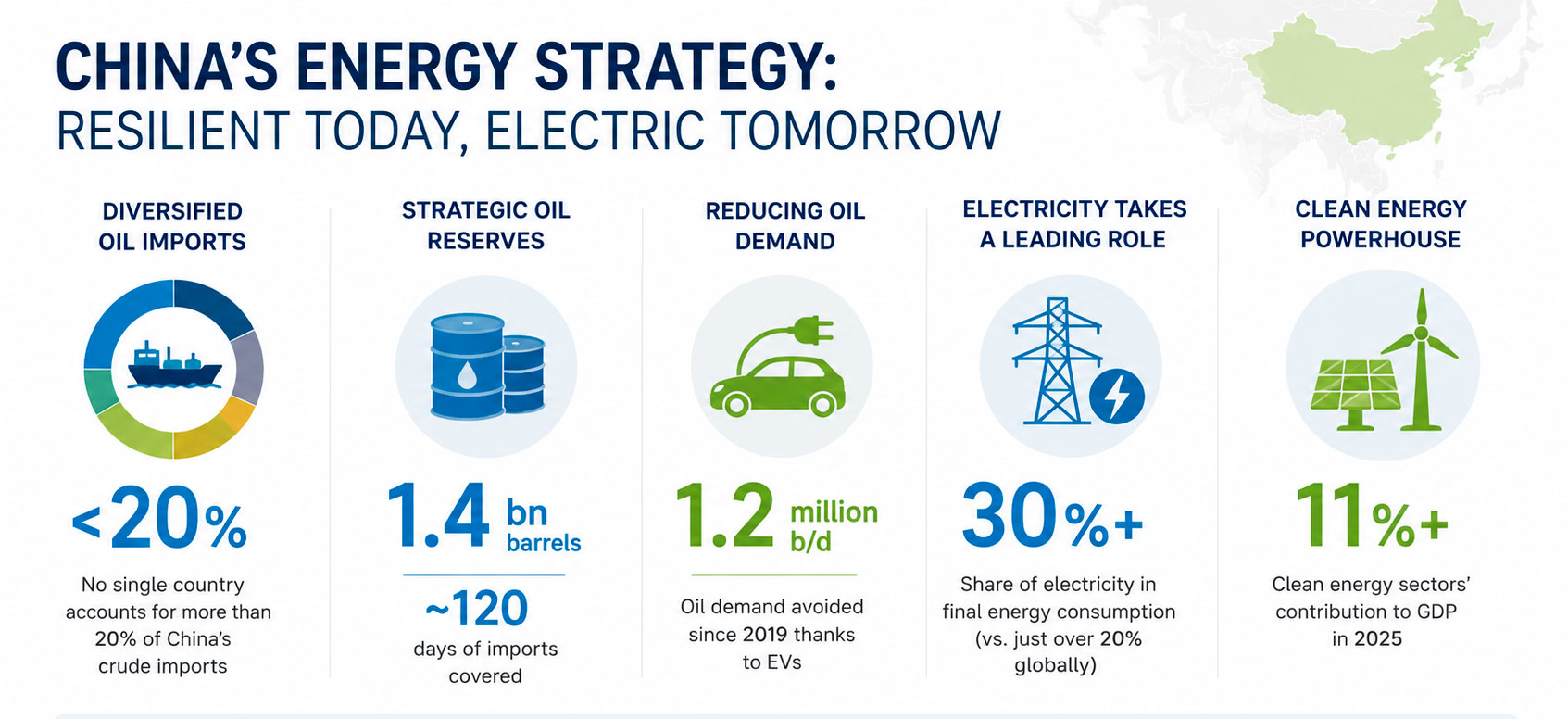
China’s energy-security strategy. Graphic by Energy Europe Editorial Team
THE RISE OF “ELECTRIC STATES”
The crisis around the Strait of Hormuz also carries a broader geopolitical dimension. By escalating tensions without close coordination with allies, Washington risks reinforcing the perception of the United States as a source of global instability. China, by contrast, is attempting to position itself as a more stable economic and trading partner.
Against this backdrop, many countries are beginning to seek a more balanced relationship between Washington and Beijing. Canada’s decision to ease restrictions on certain Chinese electric vehicles, alongside intensifying cooperation between European countries and China in the clean-energy sector, reflects this trend.
As concerns over energy security grow, governments around the world may accelerate investment in electrification, battery storage, power grids and renewable energy infrastructure – sectors where China already holds a dominant position.
As a result, the current crisis could accelerate the transition towards a new model of the global economy in which strategic influence is determined not only by oil and gas production, but also by control over electricity systems, batteries, grid infrastructure and clean-energy technologies.
The immediate shock caused by the Strait of Hormuz crisis highlights China’s continuing dependence on Middle Eastern hydrocarbons. Yet at the same time, it demonstrates how systematically Beijing has prepared for a world in which energy security and geopolitics are increasingly inseparable – through electrification, domestic energy development, massive reserves and dominance of clean-technology supply chains.
Against this backdrop, the talks between Chinese President Xi Jinping and Donald Trump in Beijing on 14-15 May 2026 take on additional significance. Energy security is one of the key issues on the agenda. Washington is reportedly considering ways to encourage Beijing to reduce purchases of Russian oil while increasing imports of American energy resources.
However, China is unlikely to fundamentally alter its position. For years, Beijing has been attempting to reduce its vulnerability to precisely this kind of geopolitical pressure – and to the market disruptions now reshaping the global energy system.
If confidence in global oil and gas supply routes continues to weaken and electrification accelerates worldwide, some analysts argue, the current crisis could become a turning point in the transition to the era of “electric states”.