


On 3 January 2026, as part of Operation ‘Absolute Resolve’, the US military captured Venezuelan President Nicolás Maduro and transported him to the US. Power passed to an interim government led by Delcy Rodríguez, after which Caracas’s oil policy underwent a drastic change.
The United States did not formally take ownership of Venezuela’s oil fields, pipelines or terminals, nor did it acquire a controlling stake in the state-owned oil company Petróleos de Venezuela, S.A. (PDVSA). However, Washington established control over the conditions without which it is virtually impossible to make full use of these assets on the global market.
Through its sanctions and licensing system, Washington exercises substantial influence over which companies can invest in Venezuela’s oil industry, supply equipment and technology, and participate in production, transport and refining through authorised channels. Access to export markets, revenue and new contracts is also shaped by decisions of the US Department of the Treasury.
This system differs from direct external control: Venezuela retains ownership of its mineral resources, whilst Russia and China may still be listed as shareholders in joint ventures. However, the commercial value of these assets is now largely determined by US licences.
The central question, therefore, is not whether Washington controls every Venezuelan oil well. Rather, has US control over exports, finances and access for foreign companies effectively become external management of the sector’s key operations — and to what extent will this control undermine Russia’s and China’s positions in the country?
CONTROL WITHOUT OWNERSHIP
The new system comprises two interlinked elements. The first is the reform of Venezuela’s oil legislation, which has expanded the scope for private companies to assume technical, financial and operational management of projects. The second is the system of US licences that determines exactly who may take advantage of these opportunities.
Licence 48D authorises certain supplies of goods, technology and services from the United States or by US persons. Licence 49B permits negotiations and contingent contracts for new investment, but their performance requires separate OFAC authorisation. These licences exclude specified transactions involving Russian and Chinese parties, including certain entities owned or controlled by, or in joint ventures with, them; they do not themselves cancel those parties’ Venezuelan ownership rights. A separate licence, 50C, authorises specified oil and gas transactions involving Chevron, BP, Eni, Repsol, Shell and Maurel & Prom and their subsidiaries, subject to its conditions and exclusions. Washington is thus creating a selective system of access to authorised business in the sector.
There is an important caveat concerning China. An American company may resell Venezuelan oil to China, provided that the transaction complies with the conditions set by the US Treasury Department’s Office of Foreign Assets Control, better known as OFAC. Consequently, Beijing is not entirely cut off from supplies, but is shifting from the position of an independent operator and privileged buyer to that of a customer within the American licensing system.
Control over covered oil revenues is no less important. Under licences 48D and 50C, monetary payments to blocked persons in transactions authorised by those licences must be made into the Foreign Government Deposit Funds or another account as instructed by the US Treasury, except for payments for local taxes, permits or fees. Licence 50C separately specifies that oil and gas taxes and royalties payable to the Venezuelan government, PDVSA or its majority-owned entities must follow those Treasury-directed arrangements. Licence 49B, which covers negotiations and contingent investment contracts, contains no equivalent payment-routing provision; performance of those contracts requires separate OFAC authorisation. These requirements concern transactions under the relevant licences, rather than all payments to Venezuela. The funds remain Venezuelan property, but their use is subject to US oversight.
Christopher Hodge, chief economist at Natixis and a former US Treasury official, described the arrangement as unprecedented. ‘The fact that now America is controlling all the finances into and out of the country…this seems to be unprecedented to me’, he told Reuters. The report clarified that Washington then controlled only oil sale proceeds, which Hodge noted were Venezuela’s main source of revenue; his broader wording should be read in that context.
US restrictions do not, in themselves, extinguish other states’ property rights in Venezuela. However, without access to insurance, financing, tankers, diluents, equipment, payment channels and buyers, the assets to which those rights apply cannot be put to use.
RUSSIAN OWNERSHIP, LIMITED CONTROL
In January, Roszarubezhneft stated that all its Venezuelan assets remained the property of the Russian Federation and that the company would continue to fulfil its obligations under existing projects. Formally, there were still grounds for this position: there had been no public announcement of the cancellation or confiscation of all Russian stakes.
From 2010 onwards, Russia participated in five joint ventures with PDVSA. Roszarubezhneft owned 40 per cent of Petromonagas, 40 per cent of Petroperijá, 26.67 per cent of Boquerón, 32 per cent of PetroMiranda and 40 per cent of PetroVictoria. These stakes were transferred to the state-owned company from Rosneft in 2020 in an attempt to protect the Venezuelan assets from US sanctions.
According to Transparencia Venezuela’s September 2026 report, the five joint ventures remained active through August 2026. The report’s summary estimates their combined output at approximately 98,000 barrels per day and identifies Petromonagas as the principal producer. Some of the other ventures were operating at low production levels, undergoing maintenance or being gradually restored.
Petromonagas is particularly significant. It is not only the largest Russian project in the country, but also one of the few complexes with an operational facility capable of converting extra-heavy oil from the Orinoco Belt into lighter, export-grade crude.
In November 2025, Venezuela extended the agreements for Petroperijá and Boquerón until 2041. However, the new US regulations have highlighted the difference between the duration of a contract and the ability to derive revenue from it. A Russian company may retain its stake, but it is almost impossible for it independently to finance the project’s development, supply equipment, organise exports and receive revenue through re-established formal channels.
By February, Moscow’s rhetoric had shifted. Sergey Lavrov had spoken of Russian companies being openly forced out of Venezuela. On 11 February 2026, he described the restrictions accompanying the US licence issued on 10 February as discriminatory. His comments concerned that earlier licensing measure, preceding the August and September amendments discussed above. The detention of tankers linked to Russian supplies also demonstrated that the pressure extended beyond legal structures to physical export routes.
Stephen Sestanovich, the George F. Kennan Senior Fellow at the Council on Foreign Relations, takes an extremely pessimistic view of Russia’s prospects. ‘Russian investments in Venezuela’s oil industry over the last twenty years will now have to be, formally or informally, written off,’ he stated.
At the same time, continued production shows that operations have not ceased. This alone, however, does not reveal the extent to which Russian stakeholders retain control over the projects or continue to earn revenue from them.
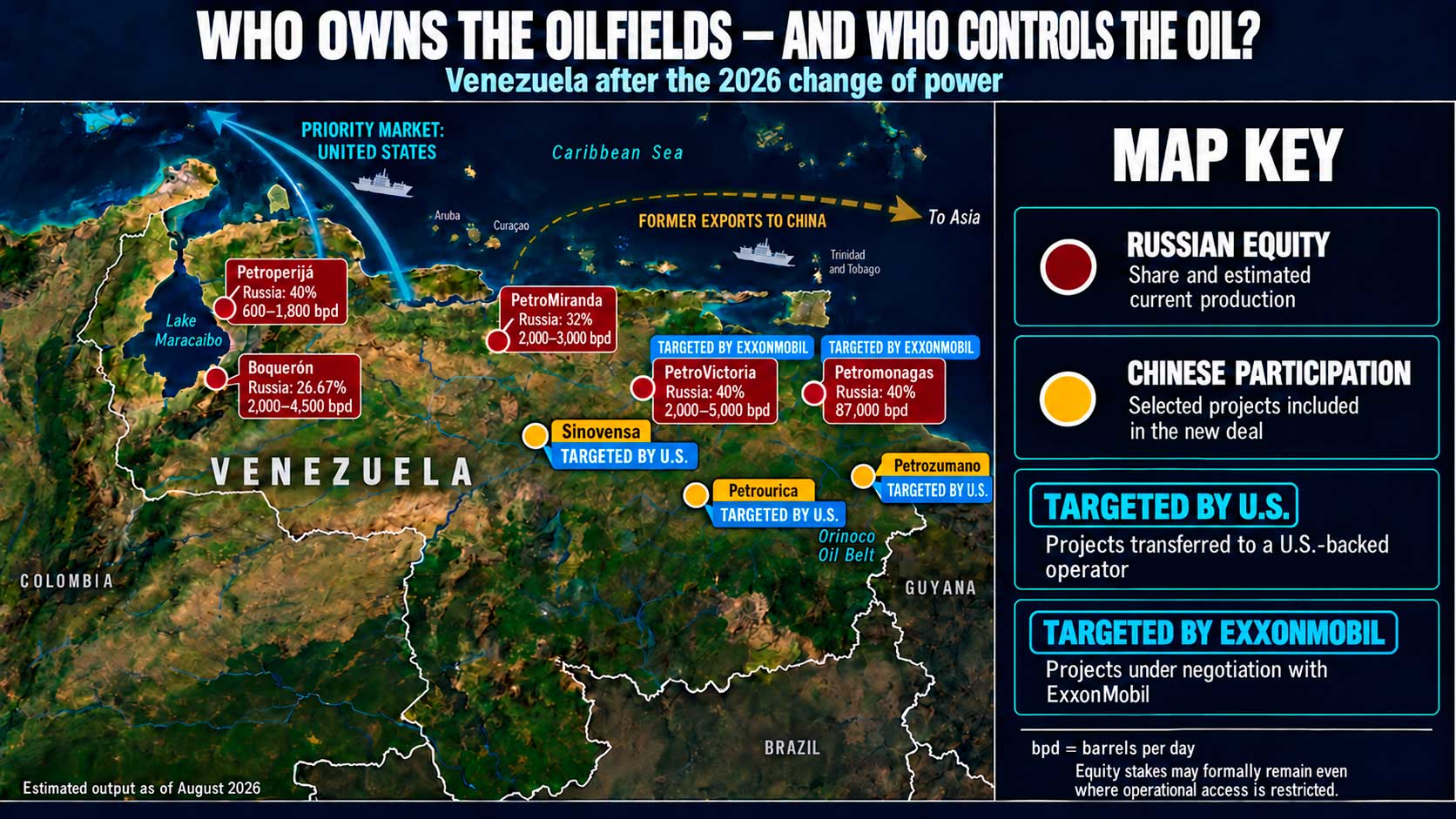
Venezuela’s oil: foreign stakes and shifting control. Graphic: Energy Europe Editorial Team.
NABEP AND EXXON: RESHAPING ACCESS TO VENEZUELAN OIL
The most significant phase of asset redistribution began in late August. Donald Trump announced a ‘historic deal’ involving North American Blue Energy Partners (NABEP), a privately held oil producer, and covering 17 oil projects. The White House’s announcement described the fields as holding approximately 65 billion barrels of proven oil reserves. This is the terminology and estimate used in the announcement, rather than an independently verified assessment of the fields’ resources.
According to NABEP’s published explanation, the US government holds rights to a 35 per cent stake in its parent company and, after PDVSA receives its share, may purchase 20 per cent of production at cost, with a right of first refusal on the remainder at market prices. The White House also states that Washington may veto any board appointment and that a majority of directors must be US citizens. The US government’s agreement with NABEP is governed by US law and subject to US courts; this does not mean that every underlying Venezuelan project contract is governed by US law.
In September, Reuters reported that ExxonMobil was considering a return to a key Russian asset: Petromonagas, formerly known as Cerro Negro. Bloomberg also named PetroVictoria among the assets of interest to Exxon. According to the agency’s sources, the company would like to regain control of both projects, which it managed before their nationalisation under Hugo Chávez.
The Russian stake in each enterprise stands at 40 per cent. Exxon’s return would mark a symbolic reversal of Venezuela’s entire oil policy.
The company left the country following the nationalisation of its assets in 2007, and its stake in Petromonagas was later acquired by Rosneft. Now, the former American operator may return to take the place of the Russian participant.
This is therefore not a single asset transfer. A package of 17 projects is being awarded to NABEP, Exxon is conducting separate negotiations over its return to the Orinoco Belt, and Chevron, Eni and other authorised companies are expanding their presence under their own agreements.
These processes are at different stages: the allocation of projects to NABEP, Exxon’s negotiations and other companies’ expansion do not necessarily mean that Russian and Chinese participants have already been displaced. Taken together, however, they indicate the direction of the realignment: opportunities for new operators are increasingly tied to Washington’s approval.
CHINA: FROM PRIVILEGED BUYER TO RESTRICTED ACCESS
China’s position in Venezuela differed from Russia’s in scale. Beijing was simultaneously the largest buyer of Venezuelan oil, a creditor to Caracas and an investor in oil production companies.
The exact supply volumes varied according to the method of calculation, as a significant proportion of the oil entered China labelled as crude from Malaysia, Brazil and other countries. According to one Reuters estimate, China purchased around 470,000 barrels of Venezuelan oil per day in 2025. Internal PDVSA documents put the figure even higher, at around 642,000 barrels per day, or three-quarters of Venezuela’s total exports.
However, the dependence was asymmetrical. China was Caracas’s main market, whilst Venezuelan oil accounted for only around 4–5 per cent of China’s seaborne imports. The loss of these supplies is therefore painful for individual Chinese refineries, but does not pose a critical threat to the country’s overall energy security.
Before the change of government, independent Chinese refineries received heavy Venezuelan crude at a substantial discount. Some of these supplies were also used to service Caracas’s debt to Beijing, which exceeded $10 billion.
Once US control over exports was established, this model began to unravel. In January, PetroChina advised traders against purchasing cargoes sold through the new US system.
The August deal dealt a blow to Chinese involvement in production. Reuters reported that five of the 14 newly awarded projects within NABEP’s 17-project portfolio had been operated by Chinese companies. Two were operated by China Concord Resources, one by Sinopec and another by the China National Petroleum Corporation (CNPC). The report did not identify the operator of the fifth Chinese-operated project or name the fields.
Beijing has officially demanded protection for the legitimate rights of Chinese companies and stated that Venezuela has the right to choose its own partners. These protests have not yet restored the previous level of access in practice.
For China, the main loss is therefore financial and geopolitical rather than primarily related to energy supplies. Beijing is losing a mechanism for repaying debts with oil, access to cheap raw materials and its long-term position in a country with the world’s largest proven oil reserves. At the same time, the United States is transforming Venezuela from a supplier to the Chinese market into a potential source of crude for American refineries.
THE ‘PAPER TIGER’ AND ITS CONSEQUENCES
If Russian and Chinese influence is measured by legal ownership of individual stakes, it is too early to speak of its complete disappearance. Some joint ventures continue to operate, some fields are still producing, and Venezuela has not announced a general confiscation of Russian or Chinese assets.
However, their ability to manage projects independently, invest funds, select buyers, export oil and receive revenue faces substantial restrictions. The available evidence does not establish how much operational control or income each participant retains.
Russia’s position appears to be the most difficult. Transactions involving specified Russian parties are excluded from key American general licences, restricting access to the business those licences authorise.
China is in a more stable position. It retains some production facilities and can purchase Venezuelan oil through intermediaries authorised by Washington. However, Beijing no longer controls the terms of trade and cannot guarantee that supplies will be used to repay debts or sold at the previous discount.
According to Blas Regnault, a researcher specialising in energy policy and oil industry governance, the current system leaves Venezuela with no autonomy over its own oil policy. ‘There’s no sovereignty of any kind over the resource itself, over what’s being sold. On top of that, there’s a lot of opacity,’ he said.
Russia and China retain ownership interests and an operational presence in parts of the sector, but face tighter constraints on investment, exports and access to revenue. The extent of their remaining control and financial returns is not fully clear. Washington has not acquired formal ownership of Venezuela’s oil industry, but its licensing and payment arrangements give it substantial leverage over key commercial operations.