


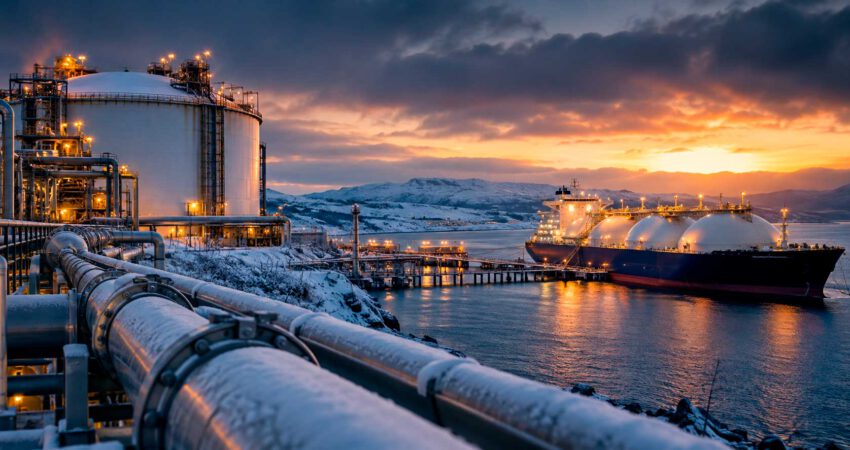
Europe’s gas storage facilities are considerably less full than in previous years. At the same time, the conflict in the Middle East has disrupted global trade in liquefied natural gas. The EU nevertheless considers its gas supply secure. How serious are the risks for the coming winter, and what could the developments mean for 2027?
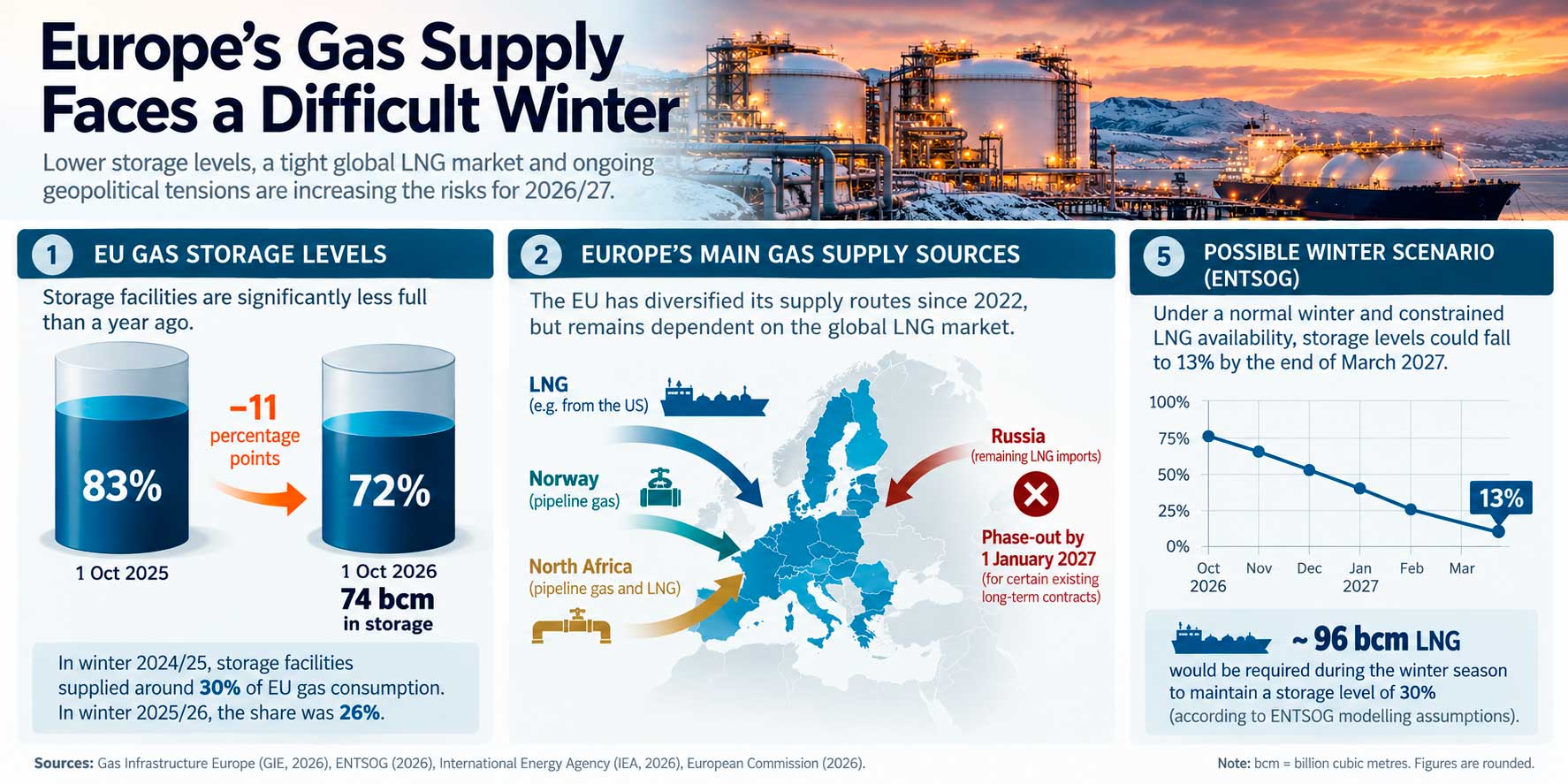
Europe is entering the heating season with unusually low gas reserves. On 1 October 2026, underground gas storage facilities across the European Union were 72% full, around eleven percentage points below the level recorded a year earlier. In total, they held approximately 74 billion cubic metres of natural gas, according to the latest figures from Gas Infrastructure Europe.
The difference is substantial, but it does not automatically mean that Europe is facing a gas shortage. Since the energy crisis of 2022, European countries have secured new suppliers, built additional terminals for liquefied natural gas and reduced their gas consumption. At the same time, their energy supply has become more dependent on the international market for liquefied natural gas, or LNG, where European buyers compete with customers in Asia for available shipments.
Whether Europe gets through the winter without major difficulties will therefore depend on more than the amount of gas already in storage. Temperatures, continuing imports and the prices companies must pay to secure additional supplies will be equally important.
Lower Gas Reserves, but No Immediate Shortage
Europe’s gas storage facilities help balance seasonal fluctuations in demand. Gas is injected during the warmer months and withdrawn when temperatures fall. Last winter, storage facilities supplied around 26% of the EU’s total gas consumption, compared with approximately 30% the previous winter.
However, the situation varies considerably between member states. Reserves are relatively low in parts of north-western Europe, while other countries have larger stocks or can rely more heavily on continuing pipeline deliveries and LNG terminals. The European average therefore reveals relatively little about how well individual regions are prepared for a cold winter.
In autumn 2023, Europe’s gas storage facilities reached exceptionally high filling levels. Even then, experts warned about the limits of Europe’s gas supply, despite the considerably more favourable supply situation.
The European Commission nevertheless sees no immediate threat to physical gas supplies. Following a meeting of its Gas Coordination Group on 8 October, it stated that Europe’s gas network could accommodate additional LNG volumes and partly compensate for lower storage levels.
The European Network of Transmission System Operators for Gas, ENTSOG, also confirms in its latest winter outlook that existing infrastructure has sufficient capacity under various conditions. Europe’s LNG terminals can receive and regasify around 145 billion cubic metres of natural gas over a winter season. However, this technical capacity does not guarantee that equivalent volumes will actually be available for import.
The Expected LNG Surplus Fails to Materialise
At the beginning of 2026, many market observers expected conditions to improve. New export facilities, particularly in North America, were set to increase global LNG supplies significantly. After years of high prices, more favourable purchasing conditions appeared possible.
The war in the Middle East has changed those expectations. Attacks on energy facilities in Qatar and disruptions to shipping through the Strait of Hormuz have affected one of the world’s most important LNG export hubs.
According to the International Energy Agency, LNG shipments from Qatar and the United Arab Emirates fell by around 35 billion cubic metres between March and June compared with the same period a year earlier. Additional exports from other regions compensated for roughly three-quarters of this shortfall.
The United States has played a particularly important role. New American export facilities are increasing supply and giving European importers additional options. However, US LNG is also traded on the international market. If Asian buyers offer higher prices, flexible shipments can be redirected to Asia.
As imports from the United States have increased, questions have also emerged about Europe’s growing dependence on American liquefied natural gas.
The IEA now expects global LNG supply to remain broadly unchanged over 2026 as a whole. Damage to export facilities in the Middle East could also continue to affect the market into 2027. For Europe, this means that additional import terminals improve its technical capabilities but offer no protection against a global shortage.
More Supply Routes Improve Security, but Not Independence
Since gas deliveries from Russia to Europe are drastically reduced, the EU has substantially diversified its supply routes. Gas from Norway, LNG from the United States and deliveries from North Africa have become increasingly important.
The Mediterranean is also emerging as a new energy corridor for Europe. Supplies from North Africa are intended to complement existing import routes and reduce dependence on individual suppliers.
Despite these changes, Russian LNG continues to enter the EU, including shipments from the Yamal production region in Siberia. In early 2026, the EU decided to phase out these imports. For certain existing long-term LNG contracts, the import ban will take effect on 1 January 2027. The measure forms part of Europe’s strategy to end its energy dependence on Russia and reduce the country’s revenues from energy trade with the EU. The details are set out in EU Regulation 2026/261.
The planned phase-out comes at a time when the global LNG market is already under pressure from the conflict in the Middle East. European importers will therefore need to secure additional volumes from other countries. The United States is likely to play an important role, although its export capacity cannot be expanded indefinitely at short notice.
A wider range of supply routes makes Europe’s gas system more resilient to disruptions involving individual suppliers. It cannot, however, eliminate international price volatility or regional supply difficulties.
Gas is not equally accessible throughout Europe. Countries with direct access to LNG terminals and well-developed pipeline networks can respond more flexibly than landlocked countries in Central, Eastern and South-Eastern Europe. ENTSOG therefore also examines potential regional bottlenecks that could arise if low storage levels coincide with high demand and disrupted deliveries.
When Gas Is Available but Remains Expensive
The coming winter could prove difficult for Europe’s economy even without major supply disruptions.
According to the International Energy Agency, European gas prices in the second quarter of 2026 were on average around 32% higher than a year earlier. In Asia, spot prices for liquefied natural gas rose by approximately 45%.
Energy analysts also expect prices to remain elevated in the coming months. As Reuters reported on 12 October 2026, Andreas Schroeder, Head of Gas and LNG Analytics at market intelligence company ICIS, believes that markets have not yet fully accounted for Europe’s additional gas requirements to refill storage facilities. Even if the conflict in the Middle East eases, demand during the summer of 2027 could therefore continue to support higher prices.
High gas prices particularly affect companies that require large amounts of energy for production. These include the chemical industry, fertiliser manufacturers and parts of the metals and glass industries. Businesses face higher operating costs and may have to reduce production if continuing operations becomes economically unviable.
The electricity market is also affected, as gas-fired power stations still account for part of electricity generation in many European countries and can influence market prices during periods of high demand.
At the same time, weaker demand helps ease pressure on gas supplies. The IEA expects European gas consumption to fall by more than 2% in 2026, partly because of growing electricity generation from renewable sources and partly because of high gas prices.
While renewable energy can reduce gas demand over the longer term, lower consumption caused by high prices may also reflect economic difficulties.
Europe’s Gas Supply in Winter 2026-2027. Graphic: Energy Europe Editorial Team.
Why Next Summer Already Matters
Perhaps the greatest uncertainty extends beyond the coming winter. The more gas Europe withdraws from storage over the next few months, the more it will need to purchase during the summer of 2027.
The potential scale of this challenge is illustrated by the latest modelling from ENTSOG. Assuming a normal winter and constrained LNG availability, European storage levels could fall to just 13% by the end of March 2027. This calculation represents a possible scenario rather than a forecast of what will actually happen.
Under the relevant modelling assumptions, ENTSOG estimates that approximately 96 billion cubic metres of LNG would be required during the winter season to maintain a storage level of 30% at its end. This figure is not a universal minimum requirement but applies only to the conditions examined in that particular scenario.
The risks would increase further during an exceptionally cold winter. ENTSOG’s modelling therefore also considers the consequences of unusually high demand combined with restricted LNG deliveries. Under such conditions, additional measures might be needed to reduce consumption or prevent regional supply problems.
Low remaining reserves would also complicate preparations for the following heating season. Europe would need to purchase particularly large volumes during the summer of 2027 to refill its storage facilities. If global LNG supplies have not recovered sufficiently by then, the additional demand could put further upward pressure on prices.
The European Commission therefore emphasises that adequate reserves are important not only for possible cold spells towards the end of this winter but also for preparations for the following one.
Europe is now better protected against the sudden loss of individual gas suppliers than it was four years ago. Yet developments over recent months show that a broader range of supply routes does not, by itself, guarantee stable prices.
Whether the winter of 2026/27 becomes another major test will depend not only on storage levels but also on the development of LNG exports, temperatures and European gas demand.
Even if supplies remain secure, Europe may have to pay a high price for that security.