


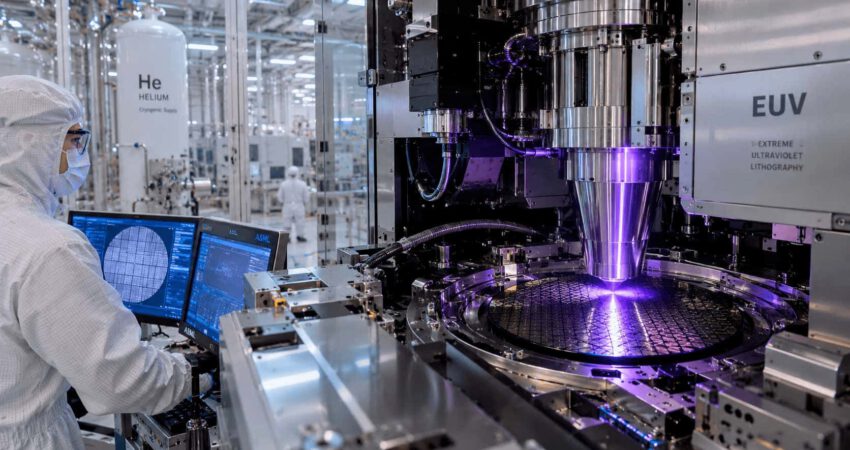
Helium is essential to advanced chipmaking, yet its supply depends on gas-processing plants, cryogenic containers and vulnerable sea routes. Even if normal shipping through Hormuz resumes, producers and semiconductor manufacturers will face a slower, more expensive recovery.
The artificial intelligence boom depends on some of the world’s most advanced semiconductor factories. Those factories, in turn, depend on a gas most consumers rarely think about: helium.
When Iranian attacks forced Qatar to halt gas production in March 2026, the immediate impact was felt in global energy markets. LNG prices surged, while buyers in Europe and Asia scrambled to secure alternative suppliers and shipping routes.
But another, less visible crisis was developing in parallel. Qatar is not only one of the world’s largest LNG exporters; it is also one of the dominant suppliers of helium – a gas essential to semiconductor manufacturing.
Before the attacks, Qatar had around 77 million tonnes per year of LNG production capacity. Damage at Ras Laffan subsequently sidelined around 12.8 million tonnes per year, or 17% of the country’s LNG export capacity, with repairs expected to take three to five years, according to Reuters. QatarEnergy also said the damage would reduce helium output by around 14%, illustrating how damage to LNG infrastructure can rapidly affect a much smaller but strategically important industrial-gas market.
The disruption has exposed a hidden dimension of energy security. A crisis that begins in natural-gas infrastructure in the Gulf can travel through the supply chain all the way to factories producing the chips behind the global AI boom.
THE GAS INDUSTRY’S HIDDEN BY-PRODUCT
Helium is the second-most abundant element in the universe, but it is surprisingly difficult to obtain economically on Earth. Commercially recoverable helium accumulates underground over geological timescales, largely through the radioactive decay of heavy elements. The gas that remains trapped in suitable reservoirs is commonly found mixed with natural gas.
As a result, most helium production is a by-product of natural-gas processing. Only a limited number of gas reservoirs contain helium at concentrations high enough to make recovery commercially viable.
In Qatar, helium recovery is closely linked to gas processing and LNG production. Natural gas must first be extracted and treated before helium can be separated, purified and liquefied. This means helium output cannot simply be increased when prices rise. It depends on upstream gas production, processing plants, liquefaction infrastructure and specialised transport systems.
Transport is another constraint. Liquid helium must be kept at approximately -269°C and shipped in specialised cryogenic containers. These containers circulate through a closed-loop system: they travel to a production site, are filled, shipped to the customer, emptied and returned.
When maritime transport is disrupted, containers can end up stranded far from production sites, making shortages worse even when some production remains available. This makes helium fundamentally different from commodities such as oil or LNG: exceptionally high prices cannot persuade producers simply to “open the taps”.
WHY ONE GAS HUB MATTERS TO THE WORLD
According to the U.S. Geological Survey’s Mineral Commodity Summaries 2026, global helium production in 2025 was approximately 190 million cubic metres. The United States produced around 81 million m³ and Qatar approximately 63 million m³. Russia produced around 18 million m³ and Algeria around 11 million m³.
The United States and Qatar alone therefore accounted for roughly three quarters of global production.
Production volumes, however, do not tell the whole story. The United States has a large domestic helium market, while Qatar is heavily export-oriented. USGS data show that Qatar exported 51,109 tonnes of helium in 2024, up from 39,053 tonnes in 2023. China, the Netherlands, Germany, South Africa and South Korea were among its leading destinations.
That makes Qatar not merely one of the largest producers, but one of the most important suppliers to the internationally traded helium market.
Its role had been strengthening before the crisis. In September 2025, industrial-gases group Messer signed a long-term agreement with QatarEnergy for approximately 3 million m³ of high-purity helium annually. The agreement was intended to diversify supply and improve reliability for Messer customers worldwide.
Qatar’s helium system is centred on the North Field, the giant natural-gas reservoir whose geological extension in Iranian waters is known as South Pars. According to QatarEnergy LNG, the field contains helium at an estimated concentration of only around 0.04%. But the enormous scale of the field and its gas-processing infrastructure has allowed Qatar to become one of the world’s dominant producers.
Ras Laffan Helium 1 came on stream in 2005 with a design capacity of 700 million standard cubic feet per year. Ras Laffan Helium 2 followed in 2013 with annual capacity of 1.5 billion standard cubic feet. Helium 3 came online in 2021 with a design capacity of 400 million standard cubic feet per year. Together, Qatar’s three existing facilities have a combined nameplate capacity of approximately 2.6 billion standard cubic feet per year, according to QatarEnergy LNG. This is equivalent to roughly 74 million cubic metres, although production, nameplate capacity and trade figures should not be treated as directly interchangeable.
Before the war, Qatar had planned substantial additional helium capacity as part of the North Field expansion. The expansion timetable has since become uncertain following the damage to the country’s gas infrastructure.
The same concentration that made Qatar’s helium industry efficient has therefore become a source of global vulnerability.
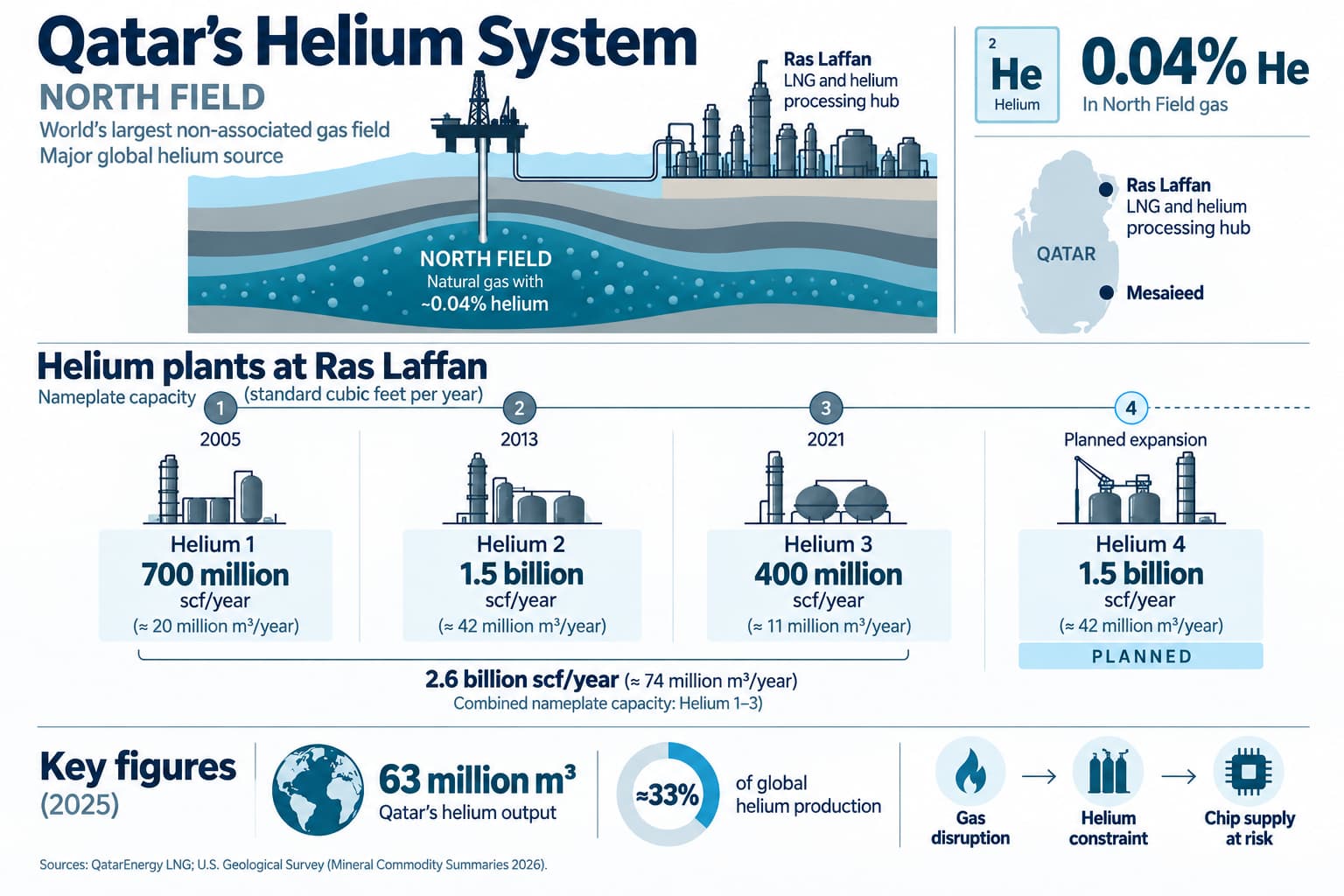
Qatar’s helium production system. Graphic by the Energy Europe Editorial Team.
THE GAS INSIDE THE CHIP FACTORY
Semiconductor manufacturing is one of the most strategically important industrial uses of helium. Modern fabrication plants cost billions of dollars and depend on uninterrupted supplies of highly specialised gases, chemicals and equipment.
Helium is used in chipmaking for cooling, leak detection and precision manufacturing. Its thermal properties, chemical inertness and extremely low boiling point make it difficult to replace in several high-performance applications.
For semiconductor companies, the direct cost of helium is relatively small compared with the value of the chips being produced. The greater risk is physical availability. If a fabrication plant cannot obtain enough helium for an essential process, production can be constrained regardless of how valuable its output is.
That vulnerability has become more important as investment in AI accelerators, advanced logic chips and high-performance memory expands. The AI boom therefore depends not only on data centres, electricity and chipmaking equipment, but also on highly specialised industrial inputs whose supply chains are concentrated in a handful of countries.
The Semiconductor Industry Association (SIA) warned before the current crisis that the geographic concentration of helium production in countries and regions including Qatar, Russia/Siberia and Algeria created long-term supply risks for the semiconductor industry.
When Qatar’s production was disrupted, that structural vulnerability became immediate.
At the Semicon China industry gathering in March, Cameron Johnson of supply-chain consultancy Tidal Wave Solutions described a helium shortage as “an absolute concern”, according to Reuters. Industry executives said the shortage had already begun affecting parts of technology supply chains.
French industrial-gases group Air Liquide also began reallocating helium from other regions to customers affected by the disruption. The company is an important supplier to Taiwan’s semiconductor industry and operates more than 60 facilities in Taiwan, including 54 dedicated to semiconductor activities, Reuters reported.
South Korea is another important semiconductor market exposed to helium supply risk. Samsung Electronics and SK hynix operate high-value, capital-intensive production lines where disruption to specialist-gas supplies can become a serious operational constraint.
TWO SHOCKS: DAMAGED PLANTS AND BLOCKED SHIPPING
The helium crisis reflects two shocks at once: reduced Qatari production and severe disruption to normal shipping through the Strait of Hormuz.
The first is directly linked to damage to Qatar’s gas infrastructure. Helium is largely produced as a by-product of natural-gas processing, so disruption to gas production and processing affects helium availability. QatarEnergy said the damage would reduce helium output by around 14%.
The second problem is logistics. Qatar’s location inside the Gulf means its normal maritime exports depend on passage through the Strait of Hormuz.
On September 15, Reuters reported that only four commodity vessels had transited the Strait on September 14, compared with a pre-war average of around 125 large commercial vessel transits per day.
Helium suppliers have already tried to adapt. Air Liquide began reallocating volumes from other producing regions, while industrial customers reported supply constraints and sought alternative sources. These measures can mitigate the shortage, but they cannot quickly reproduce Qatar’s combination of production scale, liquefaction capacity and established export infrastructure.
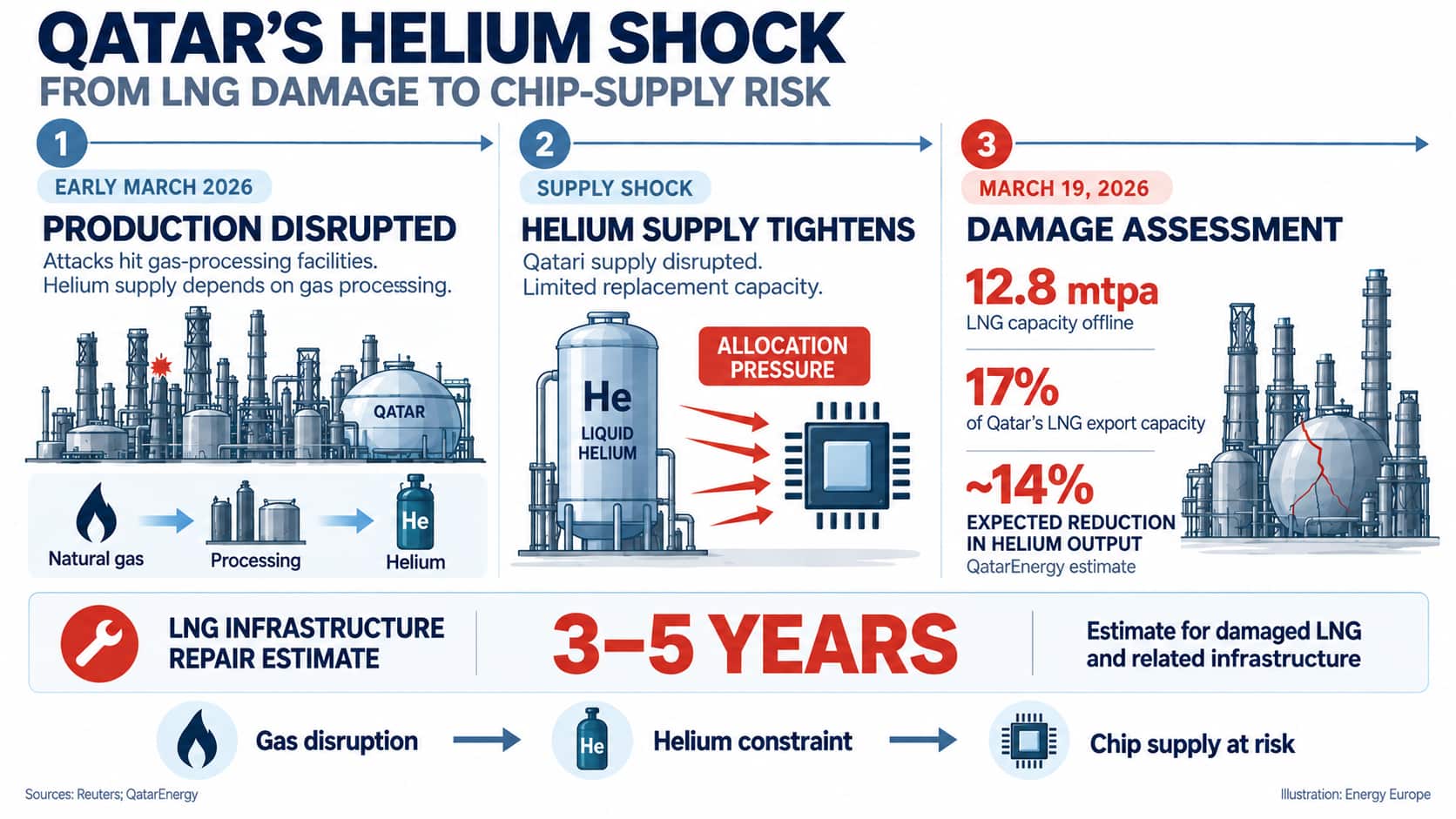
Qatar’s helium supply shock. Graphic by the Energy Europe Editorial Team.
REOPENING HORMUZ WOULD NOT MEAN RECOVERY
A return to normal shipping through the Strait of Hormuz would be an important turning point for the helium market, but it would not mean an immediate return to pre-war conditions.
First, Qatar’s helium output is linked to gas-processing infrastructure that has itself been disrupted. Even if vessels could move freely again, export volumes would depend on how much helium production was actually available.
Second, liquid-helium logistics operate as a closed cycle. Containers must be positioned at production sites, filled, delivered to customers and returned. A prolonged disruption can leave equipment in the wrong parts of the supply chain. Restoring the normal circulation of containers would therefore take time.
Third, customers would need to rebuild inventories. Semiconductor manufacturers, medical users and research facilities would be unlikely to abandon more defensive procurement strategies immediately after shipping resumes.
The initial effect of reopening would therefore probably be psychological and financial: less emergency buying, lower spot-market pressure and greater confidence that inventories could be replenished.
But the market could retain a risk premium until both Qatari production and transit through Hormuz had demonstrated sustained reliability.
HOW CHIPMAKERS ARE DEFENDING SUPPLY
For semiconductor manufacturers, the immediate priority is not the price of helium, but continuity of supply. In the short term, chipmakers are likely to conserve available helium, draw down inventories and prioritise their most valuable and difficult-to-interrupt production lines.
If the shortage persists, manufacturers may need to slow lower-priority production or reallocate helium between fabs. At Semicon China in March, Cameron Johnson warned that companies could be forced to slow production or prioritise critical products. Reuters reported that helium tightness had already begun affecting parts of global technology supply chains.
Over the longer term, the Qatar shock is likely to encourage larger buffer stocks, more helium recovery and recycling, and geographically diversified supply contracts. Air Liquide already demonstrated the value of diversified sourcing in March, when it began reallocating helium from other regions to affected customer.
THE RACE FOR ALTERNATIVE SUPPLY
On paper, the world has several alternative sources of helium. In practice, none can rapidly reproduce Qatar’s combination of scale, export orientation, liquefaction infrastructure and established logistics.
The United States remains the world’s largest producer, with around 81 million m³ in 2025, according to the USGS. But domestic demand, existing contracts and processing constraints limit its ability to replace Qatari exports at short notice.
Algeria produced around 11 million m³ in 2025. Its proximity to Europe makes it particularly relevant for European diversification, but its scale is far smaller than Qatar’s.
Canada is an emerging producer and offers longer-term diversification potential. The USGS reported that a new helium facility began operations in Canada in 2025, alongside new facilities in the United States and South Africa. Such projects can make the global supply base more resilient, but developing helium production requires suitable geology, separation and purification facilities, liquefaction capacity and specialised logistics. Canada is therefore part of a medium-term solution rather than an immediate replacement for Qatar.
Russia produced around 18 million m³ in 2025 and has substantial resources, but Russian helium remains unavailable to many Western buyers. The USGS notes that European Union and United States sanctions imposing import bans on helium from Russia continued into 2025.
China is a different case. It is primarily a major consumer and importer rather than an alternative supplier. Its efforts to secure helium for domestic industries, particularly semiconductor manufacturing, could intensify competition for alternative supplies. If Chinese buyers seek more helium from producers outside Qatar, European and other Asian importers may find themselves competing for the same limited volumes.
The central constraint is therefore not simply geology. New helium supply requires suitable gas reservoirs, processing and purification plants, liquefaction capacity, cryogenic containers, trained operators and secure trade routes. Each element takes time to develop.
Recycling can improve resilience, especially for large industrial and scientific users. But recycling reduces dependence on primary helium production – it does not eliminate it.
THE NEW MEANING OF ENERGY SECURITY
Helium is a tiny market compared with oil or LNG, yet its strategic importance is disproportionately large. It is a critical industrial input whose supply is embedded in infrastructure built primarily to produce and process natural gas.
The Qatar disruption demonstrated that energy-security risks do not stop at fuel markets. They can travel through supply chains into semiconductor plants, medical systems and other advanced industries.
For the AI economy, the lesson is particularly striking. The infrastructure behind artificial intelligence is usually discussed in terms of computing power, data centres, electricity and advanced chips. But the supply chain reaches much further upstream – to specialised industrial gases, natural-gas processing facilities and maritime routes thousands of kilometres from the world’s semiconductor fabs.
The reopening of the Strait of Hormuz would remove one major transport constraint. It would not, however, erase the lesson of the crisis.
A more resilient helium market requires diversified production, sufficient liquefaction and container capacity, recycling, strategic inventories and long-term contracts that recognise helium as a critical material rather than an ordinary industrial gas.
For policymakers, energy companies and industrial consumers, the implication is clear: energy security is not only about where oil and gas come from. It is also about the strategically important materials embedded in the infrastructure that produces them – including the invisible gas sustaining the global AI boom.