


Europe is turning to artificial intelligence to manage the next stage of its energy transition. AI is expected to help integrate more renewable power, ease grid congestion and unlock demand-side flexibility – but the rapid growth of data centres is also creating a new challenge for Europe’s electricity networks.
The European energy system is entering a new phase in which the further growth of renewable energy sources (RES) depends increasingly not only on the construction of new capacity, but also on the quality of grid, demand and data management. The higher the share of RES, the more difficult it becomes to maintain the balance between electricity generation and consumption. Solar and wind generation depend on the weather, while demand fluctuates according to the number of electric vehicles and energy storage systems, as well as the volume of industrial loads. Operators therefore need to forecast future consumption with ever greater accuracy in order to make the most efficient use of existing infrastructure.
Against this backdrop, on 3 June 2026, the European Commission presented the Strategic Roadmap for Digitalisation and AI in the Energy Sector. The document establishes AI as one of the most important tools for integrating renewable energy sources, optimising grids, managing demand and enhancing the resilience of energy infrastructure.
One of the key elements of the roadmap is the AI.grids initiative. It is designed to lay the foundations for European AI models to be used in the planning and management of electricity grids. The first proof-of-concept models are due to be developed and tested in the first quarter of 2027, with the first operational models expected by the end of 2027.
Funding will be channelled through Horizon Europe – the European Union’s flagship programme for supporting research and innovation. In 2026-2027, around €75 million will be allocated to AI technologies in the energy sector. Of this amount, €30 million in 2026 and €20 million in 2027 are to be allocated to AI foundation models for grid management and planning. A further €90 million is earmarked for advanced solutions for electricity grids, and €190 million for broader digital solutions in renewables, building renovation and energy efficiency.
Managing renewables with AI
The first practical area of focus is the management of so-called “flexible demand”. At certain times of the day, there may be a surplus of renewable electricity, while at other times there may be a shortage. Demand flexibility will allow part of consumption to be shifted to times when electricity is cheaper and more readily available. For industry, this means the ability to adapt energy-intensive processes to market signals. For households, it means making the use of smart meters, dynamic tariffs, home batteries, heat pumps and electric vehicle charging points cost-effective.
AI will be essential for coordinating a growing number of market participants. By analysing data on consumption, weather, grid conditions, available generation and prices, it can enable businesses, aggregators and households to adjust demand automatically in response to changing system conditions.
According to the European Commission’s estimates, digital demand response could deliver European consumers more than €71 billion in direct annual electricity savings. It could also bring more than €300 billion in wider system benefits – through reduced demand for reserve capacity, more efficient use of grids, reduced congestion and a decrease in the volume of clean electricity that has to be curtailed because of insufficient grid capacity.
Dries Acke, Deputy CEO of SolarPower Europe, linked AI not only to the integration of renewable energy sources but also to its practical impact on the entire energy system: “Digitalisation and AI are becoming indispensable to building a more flexible, efficient and resilient energy system. They will help optimise electricity grids, unlock demand-side flexibility and support increased renewable integration, thereby reducing system costs, strengthening energy security and accelerating Europe’s decarbonisation efforts.”
Digital twins and predictive maintenance
The second area is predictive maintenance and digital twins for grids. This involves a shift from reactive repairs following a fault or strictly scheduled maintenance to data-driven maintenance. Algorithms can analyse data from sensors, transformers, substations, power lines, thermal imaging cameras and drones. This helps to identify overheating, vibrations, equipment damage and abnormal load conditions in advance.
A digital twin is a virtual model of real infrastructure. Using such a model, it is possible to simulate in advance what will happen to the grid if a new solar farm is connected, consumption rises sharply, heat increases cooling demand, or a storm damages part of the power lines. This matters especially in Europe, where the main obstacle is no longer only generating clean power, but getting it through a grid that cannot always absorb, move and deliver it where it is needed. The energy transition is increasingly limited not by the availability of renewable electricity, but by the infrastructure required to use it efficiently.
In its report Energy and AI, the International Energy Agency links the application of AI in the energy sector to three practical benefits: cost reductions, better integration of renewable energy sources, and increased capacity in existing grids. “In the Widespread Adoption Case, the application of AI in power plant operations and maintenance yields potential cost savings of up to USD 110 billion annually by 2035 from avoided fuel costs and lower operating costs. AI also enables greater integration of renewable electricity into the grid. Our analysis finds that up to 175 GW of additional transmission capacity could be unlocked in existing lines through the use of AI,” the report states.
The energy cost of AI
The third area relates to the growth in energy consumption by AI itself. The development of generative models, cloud services and digital infrastructure is increasing demand for data centres. As part of the AI Continent Action Plan and the forthcoming Cloud and AI Development Act, the European Union plans to significantly increase data centre capacity. According to the European Commission’s estimates, installed capacity could rise from approximately 12 GW in 2025 to 28 GW by 2030. Data centres already account for around 2.5 per cent of electricity consumption in the EU.
According to the IEA, global electricity demand from data centres could more than double by 2030, reaching around 945 TWh. This is slightly more than Japan’s current total electricity consumption. AI will be the main driver of this growth: demand from AI-optimised data centres could increase more than fourfold.
Fatih Birol, Executive Director of the International Energy Agency, describes the scale of this challenge directly: “Global electricity demand from data centres is set to more than double over the next five years, consuming as much electricity by 2030 as the whole of Japan does today. The effects will be particularly strong in some countries.”
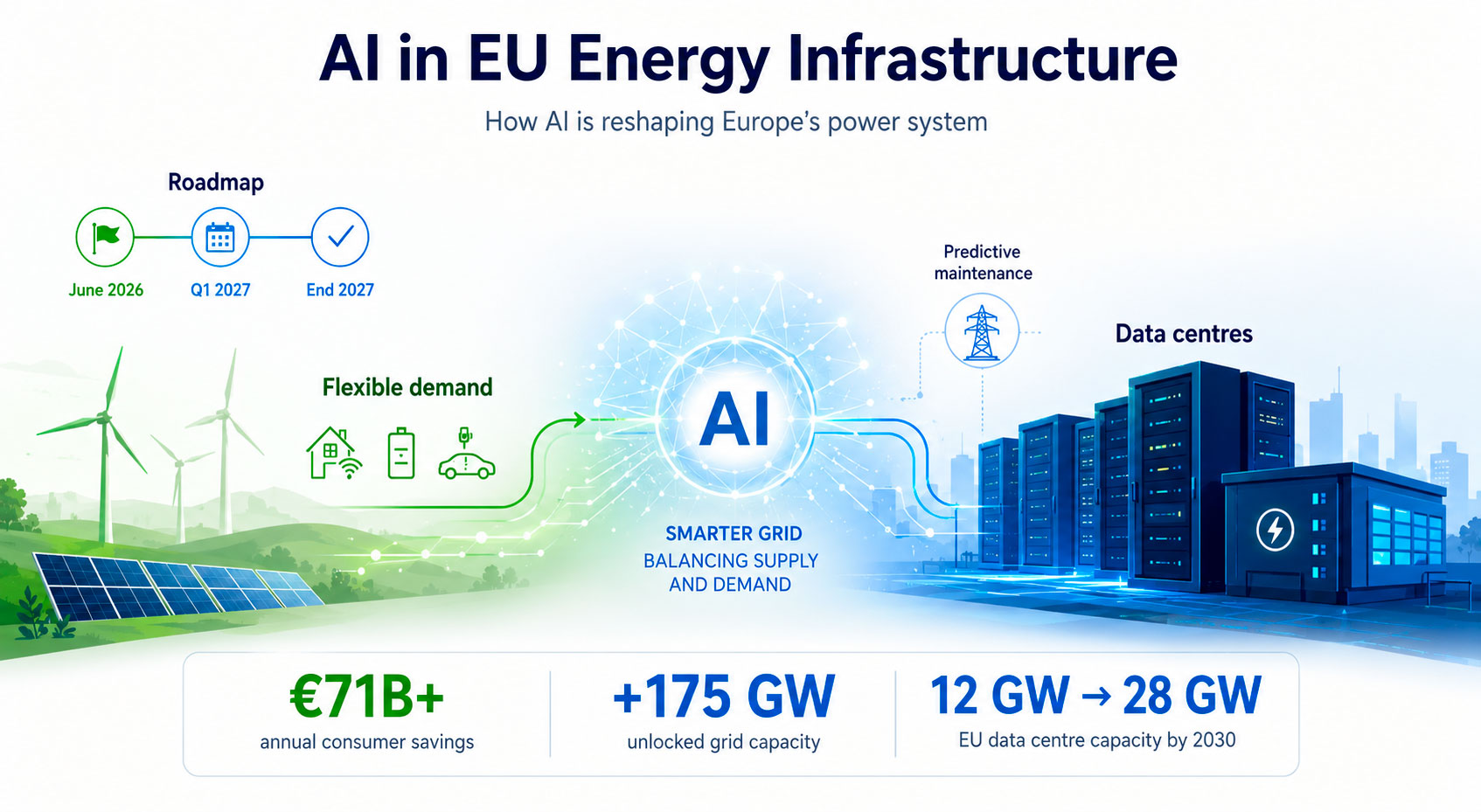
How AI is reshaping Europe’s power system. Graphic by the Energy Europe Editorial Team.
Data centres as a new grid challenge
For Europe, the key risk is that data centres require large and stable grid connections. Their siting can exacerbate local constraints, particularly in regions with high industrial demand or weak grid infrastructure. Data centres also compete for grid access with industrial facilities, renewable energy projects, and the electrification of transport and heating.
Elisabeth Cremona, Senior Energy Analyst at Ember, points out that grid constraints are already beginning to influence the geography of investment in data centres: “Grids are ultimately deciding where investments go … they are now effectively a tool to attract investment.”
The European Commission therefore proposes that data centres be viewed not only as a source of additional demand, but also as a potential source of flexibility. The roadmap provides for the development of a model for tripartite agreements between data centre operators, energy companies and public authorities. Such agreements should take into account access to grids, the use of clean electricity, energy efficiency, heat recovery and participation in demand response.
Not a replacement for investment
The strategic roadmap confirms that digitalisation and AI are becoming embedded in EU energy policy. But their role is enabling rather than a substitute for investment: they can make grids run smarter, connect new renewable capacity faster, anticipate congestion and improve investment planning – yet they cannot replace the hard infrastructure the energy transition still lacks.
That is the central limit of Europe’s AI moment. The region’s real bottlenecks remain physical and political: weak grid capacity, slow permitting, underinvestment and fragmented regulation. If grid expansion, market design and digital tools advance together, AI can lower system costs and improve resilience. If they do not, it will merely optimise a constrained system rather than solve it.
More on this topic: Europe’s push to electrify the economy by 2040