


Electric cars are making a quiet comeback in Europe: by 2025, they had reached a market share of 17.4 per cent in the EU, and as much as 19.1 per cent in Germany. Yet, at 34.5 per cent, hybrids remain clearly in the lead – acting as a bridge between the old and new worlds of motoring. Despite the rapid expansion of the charging infrastructure, the major breakthrough has yet to materialise. Whilst some experts see this as merely a short transitional phase, others expect the market to remain multi-track in the long term.
The comeback of the electric car is proving to be a quiet one. After a mixed year in 2024, electric mobility in Europe is gaining ground again – but there is still no sign of a breakthrough. In 2025, battery-electric passenger cars achieved a market share of 17.4 per cent in the EU, up from 13.6 per cent the previous year. In Germany, the figure was even higher at 19.1 per cent: 545,142 new battery-electric cars were registered out of a total of 2,857,591 new registrations. The electric car is therefore recovering, but the major leap has yet to materialise. Rather than undergoing a clear technological shift, the market remains in a transitional phase.
Hildegard Müller, President of the German Association of the Automotive Industry (VDA), emphasises that seven out of ten electric cars come from German manufacturers. Overall, however, demand has fallen short of expectations, partly because charging infrastructure remains inadequate and electricity prices for charging are too high. “After years of crisis and economic uncertainty, we are now realising that the ramp-up of electric mobility is not working out as we all imagined,” she notes.
HYBRIDS BRIDGING THE TRANSITION TO THE NEW CAR MARKET
While the electric car market is growing, other powertrains still dominate the scene. Hybrid vehicles, in particular, strike a chord with many buyers. With a market share of 34.5 per cent, they were the best-selling powertrain type across the EU in 2025. In Germany, hybrids accounted for an even higher 39.5 per cent of new registrations. This points to a market that is not reinventing itself abruptly, but transforming step by step. Many drivers want to move towards electric driving without completely abandoning the familiar world of petrol stations, range considerations and combustion engines. Automotive experts believe that many customers see hybrids as a psychologically safe bridge: they want to be part of the transition, but not guinea pigs for inadequate infrastructure.
The reason lies less in the technology itself than in everyday practicalities. Although charging infrastructure is expanding rapidly – in 2024, the number of public charging points in Europe rose by more than 35 per cent to just over one million, according to the IEA – the rollout remains uneven. While urban areas are comparatively well served, charging in rural areas or regions with weaker infrastructure is often still more difficult. Across the EU, the number of charging points grew by more than 50 per cent in 11 of the 27 member states in 2024, yet a large share of these points remains concentrated in just a few countries.
At the same time, economic factors are slowing the momentum.
In many segments, electric cars are still more expensive to buy than comparable combustion-engine or hybrid vehicles, even though the price gap is narrowing. Subsidy schemes have been revised or cut in several countries, further unsettling demand. For many private buyers, the decision therefore remains a matter of calculation: higher purchase costs today versus lower running and energy costs tomorrow. Particularly in times of economic strain, it is often not the best long-term solution that prevails, but the one that feels most predictable in the short term. Motoring expert Ferdinand Dudenhöffer put it this way: “The ramp-up of electric mobility is not a sure-fire success. Electric mobility is currently still a luxury. The general public cannot afford it.” This caution helps to explain why the market is not moving in a straight line towards battery-electric cars.
AN EU MARKET MOVING AT DIFFERENT SPEEDS
Added to this is the fact that demand across Europe varies considerably from region to region. In countries with higher purchasing power, a denser charging network and more stable subsidy schemes, the transition is progressing much faster than in places where incomes and infrastructure are weaker. Europe’s shift in drive systems is therefore not a uniform process, but rather a patchwork. This makes the ramp-up more difficult for manufacturers: they must simultaneously develop more affordable mass-market models, protect their margins and respond to very different national markets. Competition is also intensifying as Chinese suppliers increase pressure, particularly in the lower and mid-priced segments. Europe’s industry therefore faces the dual challenge of becoming both more climate-friendly and more competitive. Industry analysts see the transformation not as a sprint, but as a long-distance race. Those who invest too late risk losing entire value chains.
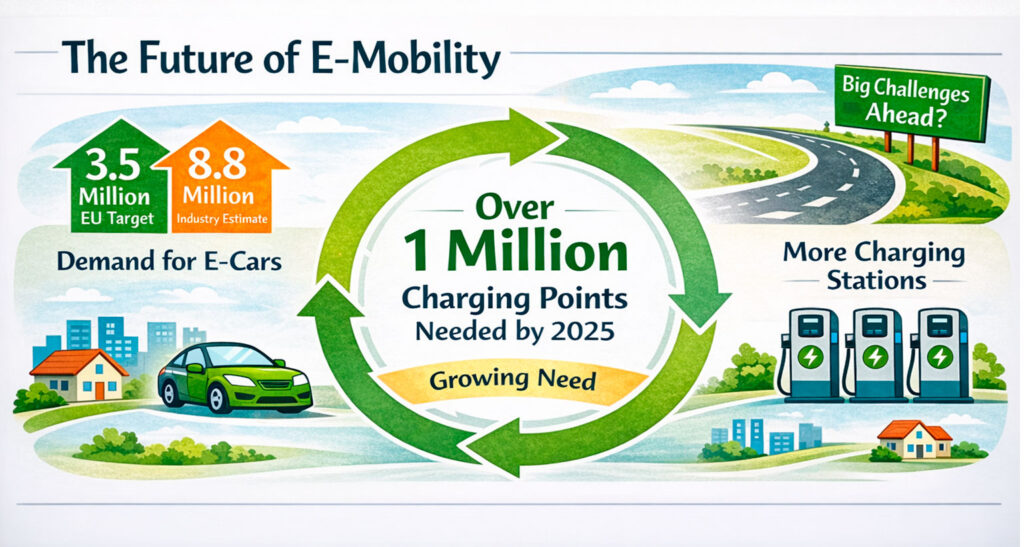
Challenges in Switching to Electric Vehicles, Based on 2025 Statistics, Graphic by Energy Europe Editorial Team
POLITICS AND ENERGY SYSTEMS SEND MIXED SIGNALS
Politics, too, is sending mixed signals. On the one hand, the EU is sticking to its CO2 targets for road transport. On the other, a relaxation of the rules was agreed for 2025: manufacturers may meet the CO2 targets for the years 2025 to 2027 as a three-year average, rather than separately for each year. This is intended to give the industry some breathing space, but it also shows that the transition is being steered politically not only through pressure, but increasingly through transitional arrangements. For consumers, this reinforces the impression that, while the shift is politically desired, its pace and concrete implementation have not yet been definitively settled. William Todts of Transport & Environment criticises the fact that any subsequent watering down of CO2 targets creates confusion in the market and undermines planning certainty for both manufacturers and customers.
The energy system is also coming more sharply into focus. With every additional electric car, electricity demand rises. At the same time, electric vehicles could help make grids more flexible in the long term – for example, through smart charging. This is not yet a mass phenomenon. But as the number of electric vehicles grows, it is not only the car market that is changing, but also the relationship between mobility and energy supply. According to IEA forecasts, the global EV fleet could more than triple by 2030, while the sector’s electricity demand could rise to around 780 terawatt hours. ” If EV charging is deployed and managed smartly however, EVs can become a flexibility resource able to aid in their own integration and that of higher shares of variable renewables or other distributed energy resources into the grid,” states a report by the International Energy Agency (IEA). The electric car is therefore no longer merely a transport product, but part of a broader industrial and energy transformation.
So while the electric car is gaining momentum, diesel continues to lose ground. Its decline has been under way for years and is now accelerating: in Germany, its share of new registrations fell to 13.8 per cent in 2025. The key point, however, is that diesel is not being replaced one-to-one by electric cars; instead, hybrids are filling the gap. The market is therefore undergoing a fundamental shift – in 2025, the combined share of petrol and diesel cars in the EU fell to 35.5 per cent, down from 45.2 per cent the previous year. Transport researchers describe this phase as “a long transition period in which old and new technologies coexist before a new normal emerges”.
THE FUTURE OF THE CAR REMAINS MULTI-TRACK FOR NOW
The result is not a clear technological shift, but a coexistence of different systems. Electric, hybrid and petrol vehicles all continue to exist side by side. Political targets have been set, and regulatory pressure is high. Yet the market follows its own logic: cost, comfort and everyday practicality remain the decisive factors.
At the same time, looking ahead shows that the real test is still to come. If the market share of electric cars is to rise further, not only must more vehicles be sold, but significantly more charging points must also be installed. The European Commission expects around 3.5 million publicly accessible charging points by 2030, while industry representatives from ACEA believe as many as 8.8 million will be needed. Even the Commission’s lower target would therefore require the current stock of just over 1 million charging points to more than triple.
The decisive factor will be whether policymakers and industry now shift from announcements to full-speed implementation. Only then will it show whether electric vehicles truly become the new normal or remain stuck in a prolonged transition phase.
The future of the combustion engine therefore remains more open than many debates suggest. Its demise may be politically mandated, but the timing and practicalities are far less clear-cut. Electric cars are gaining ground, but more slowly and unevenly than many had hoped. And Europe’s motorists? For the time being, they will continue to drive a mixed fleet.