

'/%3E%3C/svg%3E)

The Strait of Hormuz has once again become a source of global alarm – and this time, the issue is not only war, but also the risk of a major energy shock. Disruptions along this route could trigger a surge in oil and gas prices, drive up inflation, and hit the world’s largest economies. That is why a local escalation in the Middle East is rapidly turning into a global stress test for markets and governments. At the same time, experts argue that policymakers should use this moment to rethink energy security architecture and reduce the risk of similar crises in the future.
At the end of February 2026, the US and Israel carried out a series of coordinated air strikes on targets in Iran, including military infrastructure and facilities linked to missile and nuclear programmes. Oil prices had already climbed to multi-month highs even before the start of this military conflict in the hydrocarbon-rich region, as traders feared the consequences of possible strikes on Iran. In response, Tehran launched attacks on the oil refining and gas infrastructure of Persian Gulf countries. Against this backdrop, the escalation around the Strait of Hormuz is increasing the risk of the biggest energy crisis in decades, rapidly turning a military episode into a global economic stress test.
STRAIT OF HORMUZ
The Strait of Hormuz, a strategic corridor through which up to 30 per cent of the world’s seaborne oil trade and about 20 per cent of global LNG supplies pass, has become a key point of tension. It is a central artery of the global energy system. Against the backdrop of the war, shipping through the Strait of Hormuz has almost completely stopped: shipping companies and traders have suspended the transport of energy resources because of security threats and official warnings. As a result, around 15 million barrels of oil per day – approximately 30 per cent of global seaborne crude oil trade – may fail to reach the market. Even if alternative infrastructure is used to bypass the strait, losses could still amount to 8-10 million barrels per day, according to Rystad Energy. “Whether the Strait is closed by force or rendered inaccessible by risk avoidance, the impact on flows is largely the same,” said Jorge Leon, senior vice president and head of geopolitical analysis at the independent research and energy intelligence company Rystad Energy. “Unless de-escalation signals emerge swiftly, we expect a significant upward repricing,” he added. Even a partial disruption of shipping here would deal a blow not only to regional exporters, but to the global economy as a whole.
RISK OF A MAJOR SHOCK HANGS OVER OIL MARKETS
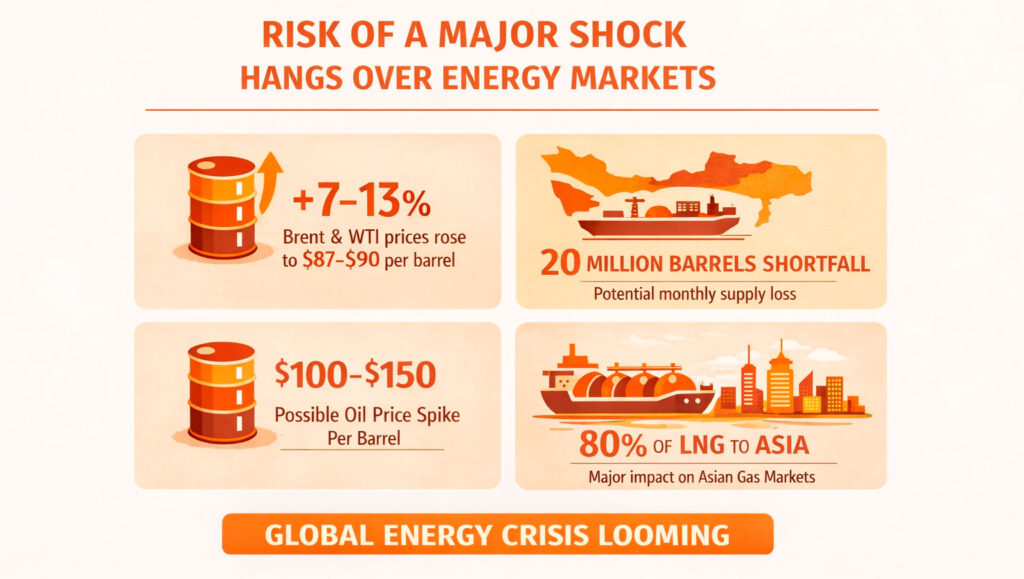
Markets reacted instantly: Brent and WTI prices rose by 7-13 per cent in the first few days, reaching around $87-90 per barrel. This was hardly surprising, as the US and Israeli war against Iran and the effective closure of the crucial Strait of Hormuz alarmed investors, despite promises by major producers to increase output. The OPEC+ group agreed to raise production from April in an attempt to calm the markets, but this had little effect on the situation. However, the main cause of market anxiety was not so much current supply as the possible scale of further escalation. On Wall Street, some are discussing a scenario in which a complete closure of the Strait of Hormuz could trigger the biggest energy crisis in modern history.
Iran produces about 3.3 million barrels of oil per day, ranking third among OPEC countries, and holds one of the largest oil reserves in the world – about a quarter of all reserves in the Middle East and 12 per cent of global reserves. If transport remains completely restricted, the shortfall could amount to tens of millions of barrels per month. “If the conflict is prolonged and, in particular, if it affects actual oil supply, due to disruptions to Iranian supply or to Iranian attempts to block the Strait of Hormuz, it could cause oil prices to jump, perhaps to $100 per barrel,” said William Jackson, chief emerging markets economist at Capital Economics. With exports from Persian Gulf countries completely blocked, some analysts are already predicting prices could rise to $150 per barrel. In the event of a prolonged crisis, prices could indeed settle above $100 per barrel, and if there is serious damage to infrastructure in Saudi Arabia, the UAE, Kuwait or Qatar, they could climb significantly higher.
Some countries have limited options for bypassing the strait. Saudi Arabia and the UAE can redirect part of their exports via alternative pipeline routes to ports outside the Strait of Hormuz. However, this capacity covers only a fraction of total volumes. For example, the UAE can transport approximately 1.5 million barrels per day around the strait, while its total exports stand at around 2.7 million. For Iraq, Kuwait, Bahrain and Qatar, there are virtually no alternatives – their exports depend almost entirely on this corridor. OPEC+ and key producers therefore find themselves in a difficult position. On the one hand, some countries are technically capable of increasing production to offset the shortfall. On the other hand, logistical constraints, risks to the tanker fleet and rising insurance premiums turn the issue of production into one of delivery: even where spare capacity exists, it is far from certain that the additional volumes can quickly be brought to market and physically delivered to consumers.
THE IMPACT SPREADS TO ASIAN AND EUROPEAN GAS MARKETS
The situation on the gas market is no less sensitive. About 80 per cent of the LNG passing through the Strait of Hormuz is destined for Asian economies – China, India, Japan, South Korea and Taiwan. The remaining 20 per cent goes to Europe. This means the main shock will be felt in Asia, but Europe will also come under pressure, especially given its already restructured import system after 2022.
The escalation is already beginning to affect the region’s infrastructure. QatarEnergy halted LNG production after Iranian drone attacks on key company facilities, further heightening nervousness on gas markets. If LNG supplies are not resumed, prices could return to or exceed the highs seen in 2022. For many developing countries in Asia, as well as for some European economies, this would mean a sharp deterioration in the trade balance, inflation spikes and a growing risk of recession.
In terms of scale, the potential shock of the current situation could exceed the impact of the oil embargo of the 1970s. At that time, the crisis became a catalyst for deep inflation and for a structural rethinking of Western energy policy. In the current environment, the global economy is even more interconnected and energy markets are even more financially integrated. The overall impact will depend on how far oil prices rise. Crude oil remains a key component of the global economy, so any sharp increase in its price inevitably pushes up the cost of many other goods.
Even the United States, which formally enjoys a high degree of energy self-sufficiency, will not remain unaffected. Rising global prices are automatically reflected in the domestic US fuel market. Retail petrol prices are already increasing. In 2022, the average price exceeded $5 per gallon, a surge that was accompanied by a sharp drop in the Biden administration’s approval ratings. A new spike in fuel prices could become a serious political factor in the run-up to the congressional midterm elections. For Democrats, this would become a significant electoral issue, and for the current administration, it would represent an additional risk at a time of difficult foreign and economic policy negotiations.
INFLATION AND MONETARY POLICY
Rising oil and gas prices quickly feed into consumer inflation. “On average, a 5 per cent rise in oil prices per year adds about 0.1 percentage points to inflation in advanced economies,” said William Jackson.
European Central Bank chief economist Philip Lane warned that a prolonged war in the Middle East could drive inflation higher in the eurozone and slow economic growth. “Directionally, a jump in energy prices puts upward pressure on inflation, especially in the near term, and such a conflict would be negative for economic activity. The scale of the impact and the implications for medium-term inflation depend on the breadth and duration of the conflict,” he said.
Higher inflation could weaken consumer confidence and spending, while also forcing central banks to keep interest rates higher for longer or even raise them further, leading to an additional slowdown in economic growth and potentially even stagnation. This would increase pressure on central banks around the world and limit their room to cut rates. For developed economies, that means the risk of a renewed inflationary wave amid already slowing growth. For emerging economies, it means rising debt burdens and capital outflows.
ERA OF ELEVATED RISK
In the short term, markets are likely to remain highly volatile, and geopolitical risk premiums will stay elevated, with any escalation around the Strait of Hormuz triggering sharp price swings. At the same time, the gradual emergence of diplomatic signals and the accumulation of crisis-management experience could make such spikes shorter and more predictable.
In the medium term, the crisis is likely to accelerate route diversification, force a review of logistics chains and encourage the expansion of strategic reserves, making the system more resilient to future shocks. Countries will seek to reduce their dependence on narrow transport corridors and unstable regions while strengthening regional and interregional energy cooperation.
If the crisis drags on, it could lead not only to another wave of turbulence, but also to the emergence of a new pricing and infrastructure reality in which risk is more fully reflected in both models and policymaking. That would entail a profound restructuring of the global energy architecture, while also creating opportunities to accelerate the energy transition, develop alternative infrastructure and strengthen the long-term resilience of the global economy.