


WindEurope expects Europe to install around 24 gigawatts of new wind power capacity in 2026, putting the continent on course for a record year. Strong growth in the first half of the year, new offshore connections and Germany’s position as the largest market underpin the forecast. Whether this translates into a lasting increase in annual installations will depend on the strength of the project and investment pipeline behind today’s construction activity.
The forecast is supported by a sharp rise in completed projects. Europe installed 8.8 gigawatts of new wind power capacity between January and June 2026, 30 per cent more than in the same period a year earlier. WindEurope says installation activity remained strong over the summer.
Yet the industry’s immediate success raises a longer-term question. High financing costs, permitting delays, supply-chain constraints and uncertainty surrounding auctions have hampered projects in recent years. Will 2026 mark the start of sustained expansion, or prove to be an exceptionally strong year?
A record with a caveat
The prospect of 24 gigawatts of new wind power capacity is remarkable, but should not be taken for granted. Large-scale projects, particularly offshore, cannot be accelerated at will. Delays involving components, cables, construction or grid connections can postpone the commissioning of entire projects.
A look at the order books provides one indicator of future activity. In the first half of the year, firm turbine orders totalling 10.6 gigawatts were recorded in Europe. According to the latest figures from WindEurope, this volume was 12 per cent below the corresponding figure for the previous year. Of these orders, 7.8 gigawatts were for onshore turbines and 2.8 gigawatts for offshore turbines. These orders should be distinguished from capacity awarded support in auctions and from projects that have secured financing, which measure different stages of the future project pipeline.
WindEurope’s chief executive, Tinne Van der Straeten, cautioned against assuming that the current pace will continue: “2026 may well be a record wind year. But we can’t take that momentum for granted.” She pointed to decisions on permitting, auctions, grids and electrification as crucial to sustaining it.
The European wind industry thus remains in a transitional phase. In recent years, the policy framework for deployment has been further developed in key areas. The European Commission cites, among other things, faster permitting, improved auction design and better access to finance as central components of European wind energy policy.
A record year primarily reflects the projects being completed today. For the years ahead, the key question is whether enough new projects are developed, awarded and financed to replenish the pipeline behind them.
Deployment is accelerating
Of the 8.8 gigawatts installed in Europe in the first half of 2026, 7.1 gigawatts came from EU Member States. The distinction matters: WindEurope’s European figures also include markets outside the EU, notably the United Kingdom. With 789 megawatts of new capacity, the UK was the second-largest European market behind Germany in the first half of the year.
Seventy-four per cent of newly installed capacity came from onshore wind, equivalent to 6.5 gigawatts. Onshore projects therefore remain the mainstay of European deployment, but a large pipeline does not guarantee that projects will be built on schedule.
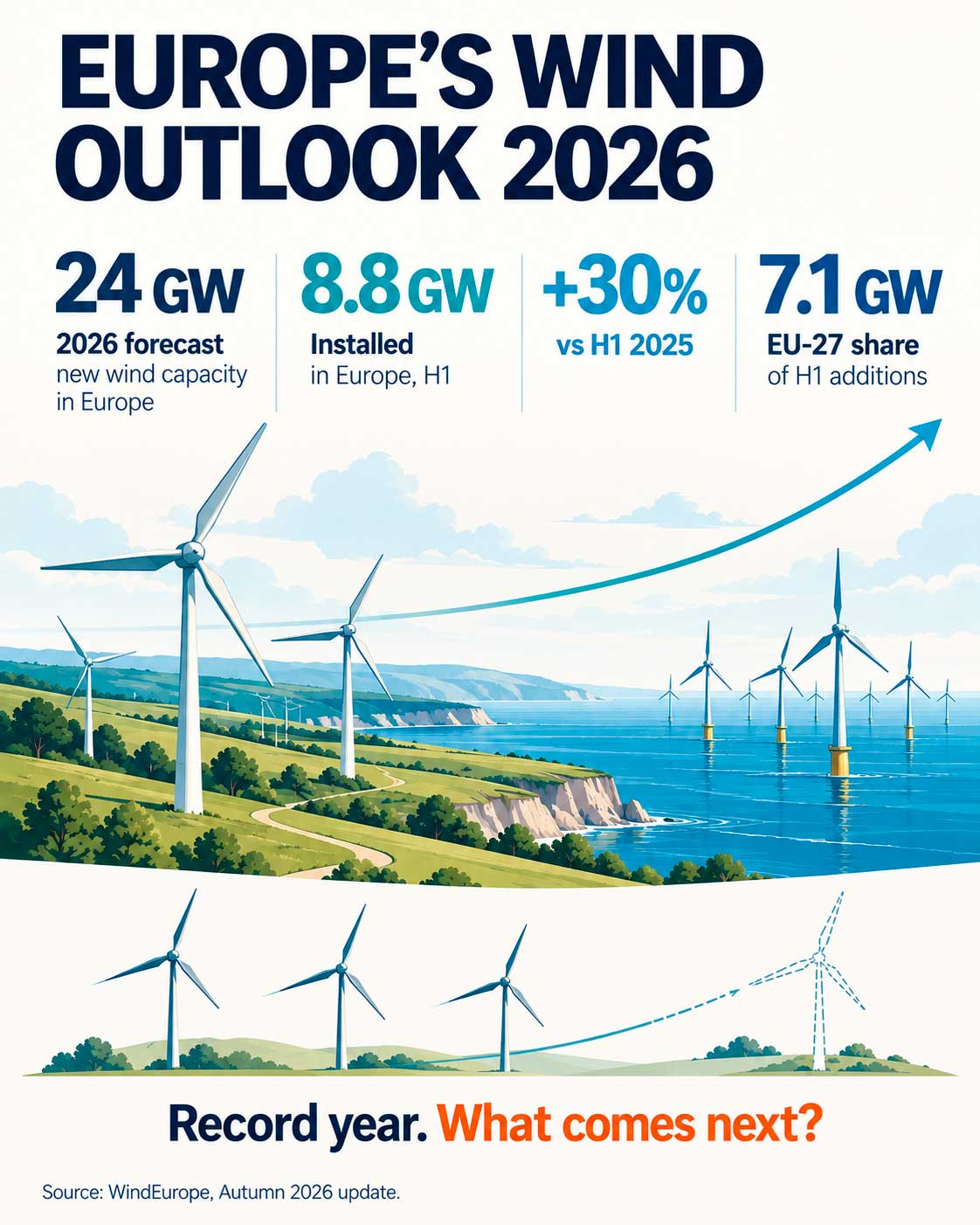
Europe on track for a record year in wind power. Graphic: Energy Europe Editorial Team.
Germany is driving the market
In the first half of 2026, Germany was clearly the largest European wind market. With 3.4 gigawatts of new capacity, Germany accounted for just under 39 per cent of total European additions. The UK followed with 789 megawatts, and Spain with 612 megawatts.
Germany’s share also highlights how concentrated Europe’s current expansion remains. The trend in permitting is particularly striking: according to WindEurope, Germany approved more than nine gigawatts of new onshore wind capacity in the first half of the year alone. In Spain, France, the UK, Italy and Ireland, by contrast, permitting volumes declined.
Germany’s high permitting volumes can support deployment in the coming years, but a more resilient European market will depend on a broader group of countries maintaining a steady flow of new projects.
Offshore: A return to industrial momentum
The acceleration is particularly evident at sea. In the first half of 2026, 2.3 gigawatts of new offshore capacity was connected to the grid in Europe. A total of 182 turbines came online across nine wind farms. That was three times as much new capacity as in the first half of 2025.
This figure is at least as relevant to European industrial policy as it is to electricity generation. Offshore wind involves a complex value chain: turbines and foundations must be manufactured, ports expanded, cables laid, offshore substations built and specialised installation vessels made available. Actual deployment therefore depends on many industrial components coming together at the same time.
For coastal regions and port locations, this can generate demand in steel processing, mechanical engineering, maritime services, cable manufacturing and maintenance. At the same time, Europe is competing internationally for production capacity and skilled workers. Without reliable order volumes, it becomes more difficult for companies to plan long-term investments in additional manufacturing capacity.
For the industry’s longer-term outlook, forthcoming auctions matter as much as the wind farms now being completed. In the first half of 2026, five European countries awarded support for a total of 17.2 gigawatts of wind power capacity – 8.8 gigawatts onshore and 8.4 gigawatts offshore. This is a measure of awarded support rather than turbine orders or financed capacity. For the second half of the year, the report lists planned auctions for more than 24 gigawatts.
Auction design has itself become an instrument of industrial policy. Under the Net-Zero Industry Act, EU Member States must take into account criteria that go beyond price in a proportion of their renewable energy auctions. The European Commission explained in July 2026 that these criteria include, among other things, sustainability, supply chain resilience, responsible corporate governance, and cyber and data security.
As a result, auctions do not merely determine which projects are awarded support; they also influence whether turbine manufacturers, suppliers and port operators have sufficient planning certainty to expand their capacities.
From targets to investable projects
Europe’s renewable energy targets are ambitious. The EU’s Renewable Energy Directive sets a binding target of at least 42.5 per cent renewable energy in gross final energy consumption by 2030, with an ambition to reach 45 per cent. For the wind industry, however, what matters less is how many gigawatts are specified in long-term strategies than whether these translate into investable projects with robust timetables. For this to happen, several conditions must be met simultaneously.
Firstly, the sector needs reliable auctions. Developers invest over many years before a turbine generates electricity or a foundation is laid. They require clear rules regarding revenues, risks and timetables. If tenders are postponed or conducted under conditions that make projects economically difficult to realise, the project pipeline can slow down.
Secondly, permitting remains crucial. Accelerated procedures must work in practice, with adequately resourced authorities, clear deadlines, digitised processes and early involvement of local communities. The differences between Germany and several other major European markets show that progress on permitting has so far been uneven.
Thirdly, the industry needs predictable supply chains. Wind power projects are not determined solely by the availability of turbines. Cables, transformers, vessels, port space, skilled labour and raw materials can also become bottlenecks. Particularly in offshore wind, a bottleneck in just one of these areas can delay the construction of entire wind farms.
Fourthly, grid connections must be predictable. For developers, a grid connection is above all a matter of certainty regarding timing and investment. If the connection of a wind farm is delayed, it is not just its commissioning that is postponed; financing, delivery schedules and contractual deadlines can also come under pressure.
Financing provides another measure of future activity. According to WindEurope, €9 billion was raised for new European wind projects in the first half of 2026. This financed 5.2 gigawatts of capacity expected to be installed over the coming years – approximately 4.5 gigawatts onshore and 0.6 gigawatts offshore, using WindEurope’s rounded breakdown.
What 2026 says about Europe’s wind market
By the end of June 2026, Europe had more than 311 gigawatts of installed wind power capacity: 270.5 gigawatts onshore and 40.9 gigawatts offshore. The EU-27 accounted for just under 252 gigawatts.
WindEurope expects a total of 148 gigawatts of new wind power capacity to be installed in Europe between 2026 and 2030. Of this, 111 gigawatts are expected to be installed in the EU-27. According to the industry forecast, this would bring total installed capacity to 436 gigawatts in Europe and 342 gigawatts in the EU by 2030.
The outlook beyond 2026 is less certain. The current figures show a clear acceleration: 8.8 gigawatts in the first half of the year, 30 per cent more than in the previous year, and the prospect of 24 gigawatts for the year as a whole.
The prospect of a record year shows that Europe can deliver wind projects at greater scale. It does not, by itself, establish a lasting new pace. Turbine orders fell in the first half of 2026 even as installations rose. The test now is whether auctions, permitting decisions and financing can turn today’s construction activity into a dependable pipeline for the years ahead