


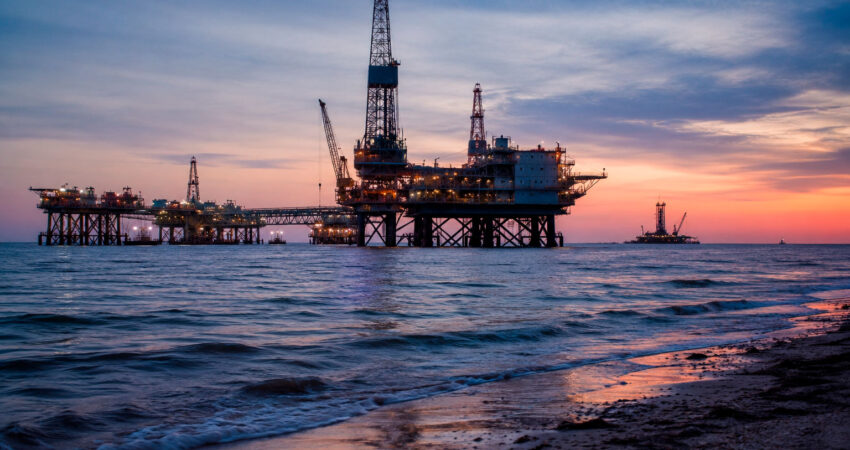
Berlin is opening up an additional route for gas and oil from the Caspian region and, in the longer term, for green electricity and hydrogen. For Germany, this offers a way to strengthen supplies to industry, create new business opportunities and make the European energy market more resilient.
Berlin and Baku Expand Their Energy Partnership
Although Azerbaijani President Ilham Aliyev’s visit to Berlin on 21 July 2026 did not result in the signing of a major new gas contract, its significance for energy policy extends far beyond a single deal.
Germany and Azerbaijan adopted a Joint Declaration on the Strategic Agenda for their bilateral partnership and agreed to establish a German-Azerbaijani Economic Council. The main areas of future cooperation include gas supplies, renewable energy, green and low-carbon hydrogen, energy efficiency, infrastructure and cross-border energy flows. Following the meeting, the German Federal Government also emphasised the breadth of the energy agenda.
This agenda shows that Berlin no longer regards Azerbaijan solely as an additional supplier of oil and gas. The country is gradually becoming part of a broader European energy architecture: a supplier of fossil fuels during the transition, a hub for Caspian transport routes and a potential partner for green electricity and hydrogen.
Germany’s national interests largely coincide with those of the European Union. The wider the range of suppliers, pipelines, LNG terminals and interconnections between national networks, the lower the risk that a disruption on a single route will cause shortages or allow an external partner to impose political conditions.
Germany gains additional supply options for its industry and another route serving the south of the country. At the same time, the EU strengthens its southern energy import corridors, deepens its links with the South Caucasus and reduces the single market’s dependence on individual suppliers.
Germany Diversifies Its Energy Supplies
After Russian gas supplies were halted, Berlin did not seek another country capable of filling the entire gap. Instead, Germany spread its imports across several sources and routes, built its own infrastructure for the direct import of liquefied natural gas and strengthened its links with neighbouring European energy markets.
Klaus Müller, President of the Federal Network Agency, underlined the need for extensive network development as early as 2023:
“The aim is to prepare the network for greater diversification of our gas supply sources.”
According to the regulator, Germany’s gas transmission network must be able to handle larger volumes of LNG as well as additional imports through the Netherlands, Belgium and other cross-border connections. At the same time, infrastructure planning must take account of the expected decline in gas consumption and Germany’s climate targets. The quotation above is an editorial translation of Müller’s German-language statement.
The effects of this restructuring are already visible in Germany’s import statistics. In 2025, the country imported a total of 1,031 TWh of gas. According to the Federal Network Agency, 44 per cent came from Norway, 24 per cent entered through the Netherlands and 21 per cent through Belgium. A further 106 TWh, equivalent to 10.3 per cent of total imports, entered the grid through Germany’s LNG terminals in Wilhelmshaven, Brunsbüttel, Lubmin and Mukran.
Germany also exported 221 TWh of gas to neighbouring countries, primarily Austria, Czechia and Switzerland. Domestic consumption totalled 864 TWh, of which industry accounted for 60 per cent.
In these statistics, the Netherlands and Belgium appear not only as producers but, above all, as major entry and transit hubs. Their networks give Germany access to Norwegian pipeline gas, European LNG terminals and the cross-border trading market.
The lost Russian volumes were therefore replaced not by a single new supplier, but by a combination of countries and transport routes. Norway supplies pipeline gas from the north. LNG terminals connect Germany to the global market. Western interconnection points provide access to neighbouring infrastructure. The Southern Gas Corridor now adds a Caspian source of supply.
Azerbaijani Gas Reaches the German Market
Azerbaijani gas reaches Europe through the Southern Gas Corridor, which is around 3,500 kilometres long. The route begins at the Shah Deniz gas field in the Caspian Sea, passes through Azerbaijan and Georgia and then crosses Turkey through the Trans-Anatolian Pipeline, TANAP. It continues through Greece and Albania via the Trans-Adriatic Pipeline, TAP, before crossing beneath the Adriatic Sea to Italy. From there, the gas can be transported onwards through Europe’s interconnected gas network.
European Commission statistics show that Azerbaijani gas exports to the EU increased by 40% between 2021 and 2024. The upward trend continued in 2025, with Azerbaijani Ministry of Energy reporting exports of 12.8 billion cubic meters to European markets. In January 2026, Azerbaijan also began supplying natural gas to Germany and Austria.
The commercial basis for supplies to Germany is a ten-year contract concluded in June 2025 between SOCAR and the German state-owned energy company SEFE. Deliveries began in the same year. The annual volume is expected to rise gradually to as much as 15 TWh, or around 1.5 billion cubic metres, according to SEFE.
The long-term offtake agreement also provides a commercial basis for investment in additional production, compressor stations and transport infrastructure. According to SEFE, the partnership is intended to bring more pipeline gas to Europe and enhance the continent’s security of supply.
SEFE CEO Egbert Laege said: “With this partnership, we are establishing a new route for significant gas volumes to reach Europe, thereby diversifying our portfolio and increasing the security of supply of our customers.”
Even the maximum contractual volume is equivalent to less than two per cent of Germany’s current annual gas consumption. It is therefore not comparable with the volumes Germany received from Russia before 2022. In the new energy architecture, however, the importance of a supply arrangement is not measured solely by its market share.
Every additional source that can physically reach the European market increases competition among exporters, reduces the risk of shortages when other routes are disrupted and strengthens the negotiating position of European buyers. Multiple contracts with different countries, using separate and geographically diverse transport routes, create a more stable system than excessive dependence on a single major supplier.
It is particularly significant that the contract with SOCAR was concluded by SEFE. The company emerged from the former Gazprom Germania. It received its current name in June 2022, and the Federal Republic of Germany became its sole owner in November of the same year.
A company that was previously one of the principal instruments of Gazprom’s presence in the German market is now signing long-term contracts with alternative exporters. The agreement with SOCAR therefore has symbolic as well as economic significance.
The Southern Gas Corridor Needs More Capacity
The Southern Gas Corridor’s transport capacity is not unlimited. TAP and TANAP were designed for specific throughput volumes. Further export growth therefore depends not only on Azerbaijan’s ability to produce more gas, but also on the capacity of the entire transport chain between the Caspian Sea and European markets.
Expansion would require additional compressor stations, new connections between national networks and investment in gas production. Long-term offtake agreements such as the SOCAR-SEFE contract give producers and infrastructure operators greater confidence when making investment decisions.
This leaves Germany and the EU facing a difficult policy trade-off. Europe will need reliable non-Russian gas supplies in the coming years. At the same time, the Union aims to reduce fossil-fuel consumption and accelerate the electrification of industry, transport and heating.
European energy policy therefore cannot consist of supporting every new gas pipeline simply because it is not connected to Russia. New projects make most sense when they remove existing bottlenecks, link national markets, strengthen competition and can later also be used for hydrogen or other low-carbon gases.
TAP is already examining the potential of its infrastructure to transport hydrogen blends. TAP Managing Director Luca Schieppati said:
“New volumes of hydrogen and other renewable gases could also be transported through TAP’s capacity expansion to foster long-term sustainability and enable energy transition in the region.”
According to the operator, an initial assessment found that the pipeline could potentially be retrofitted to transport hydrogen blended with natural gas. Further testing of materials and equipment is continuing.
Natural gas therefore remains an important safeguard during the transition, particularly for industry, heating and the balancing of variable electricity generation. New gas infrastructure must not, however, become an obstacle to Europe’s climate targets.
How Germany Benefits
For Germany, the most important practical benefit of the partnership is greater security of supply. Natural gas is still required in the chemical industry and in the production of glass, ceramics, fertilisers and metals. It is also used in heating and in power stations that balance fluctuations in wind and solar generation.
The more supply sources and transport routes are available, the lower the risk that an accident, armed conflict or political decision affecting a single route will leave German companies facing shortages.
The new agreement does not guarantee low prices. Gas prices will continue to be determined by conditions in the wider European market. Additional gas that can physically reach the market can, however, reduce the need for costly short-notice purchases on the spot market, mitigate sudden price shocks and limit the ability of individual exporters to impose their terms.
The route’s geography is equally important. Azerbaijani gas reaches Europe from the south through Italy and the interconnected Central European network. This creates an additional supply option for southern Germany, which is farther from the LNG terminals in the north and closely connected to the gas networks of Austria, Switzerland and Italy.
During the talks in Berlin, the German side explicitly highlighted the importance of the Caspian corridor for southern Germany. Existing infrastructure already extends in that direction and could be expanded further if necessary. The Federal Government also reported that a proposed investment programme could create new opportunities for German companies in Azerbaijan.
The planned bilateral Economic Council is intended to facilitate cooperation in energy, infrastructure, mechanical engineering, transport and digital technologies. Expanding production, modernising networks, building compressor stations and developing wind farms and a hydrogen economy will require equipment, engineering solutions and specialised services.
Germany is therefore interested not only in importing energy, but also in ensuring that its companies participate in building the new infrastructure.
The Caspian Route Broadens Europe’s Oil Supply Options
A similar logic applies to the oil market. Azerbaijan will not become Germany’s largest oil supplier, nor is this Berlin’s objective. The country’s significance lies not only in its own hydrocarbon resources, but also in a route that connects the Caspian Sea to the Mediterranean while bypassing Russian territory entirely.
The Baku-Tbilisi-Ceyhan oil pipeline runs through Azerbaijan, Georgia and Turkey and ends at the Mediterranean port of Ceyhan. It is 1,768 kilometres long. Between the start of operations in June 2006 and the end of 2024, the pipeline transported more than 4.4 billion barrels of crude oil. Alongside Azerbaijani oil, it also carries smaller volumes from Kazakhstan and Turkmenistan, according to project operator BP.
For Germany, this transport route has strategic value in its own right. The experience of recent years has shown that a country may stop purchasing Russian crude oil while remaining dependent on transport infrastructure that crosses Russia.
Diversification must therefore concern not only where the oil originates, but also how it is delivered. The route through Azerbaijan, Georgia and Turkey broadens the range of available options and reduces the European market’s dependence on Russian transport infrastructure.
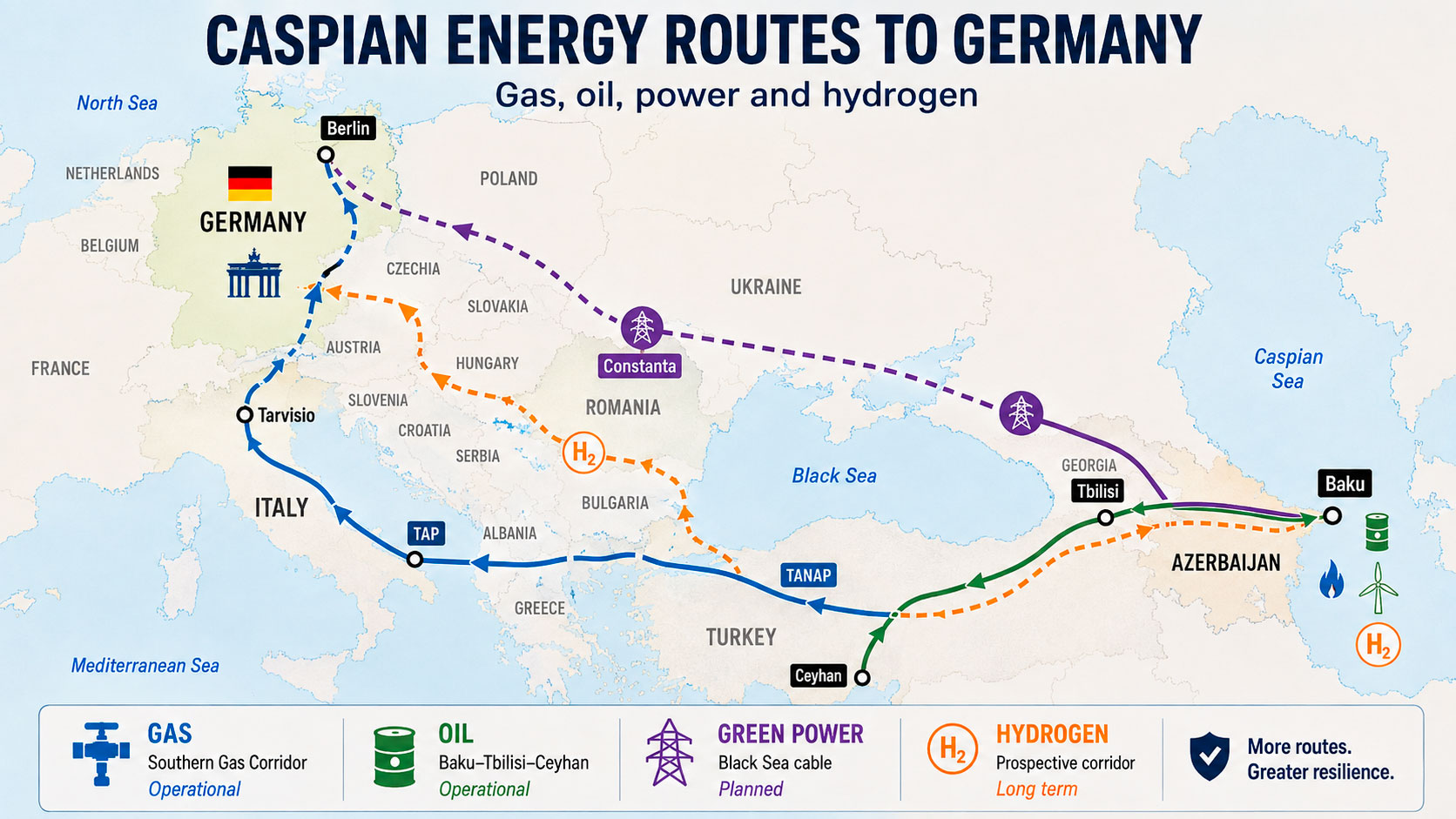
From the Caspian to Europe: gas, oil, power and hydrogen routes. Graphic by the Energy Europe Editorial Team.
Next Step: Green Electricity from the Caspian Region
In the longer term, the most interesting aspect of German-Azerbaijani cooperation lies beyond the traditional oil and gas sector. The declaration signed in Berlin explicitly identifies renewable energy, green and low-carbon hydrogen, energy efficiency and cross-border energy infrastructure as areas for joint work.
The central project is the Caspian Sea-Black Sea-Europe Green Energy Corridor, which is being developed by Azerbaijan, Georgia, Romania and Hungary. At its heart would be a high-voltage subsea cable of around 1,200 kilometres across the Black Sea, with a transmission capacity of 1,000 MW. The cable could feed electricity from the South Caucasus into the European grid through Romania.
The project remains in the planning phase, but it has entered the technical study stage. The Italian engineering company CESI was commissioned to conduct the feasibility study.
Stefano Malgarotti, CESI’s Engineering Consulting Director, said:
“CESI has already selected the route and the location of the converter stations.”
He added that the next stages would include environmental and social impact assessments, together with geophysical and geotechnical studies of the Black Sea seabed.
The Green Energy Corridor Energy Company was established to implement the project. Its first and second phases have been included in the TYNDP 2026 project portfolio and are now being assessed as part of the European network-planning process. A cost-benefit analysis is due to be carried out during 2026, with the results expected by the end of the year, according to the Azerbaijani Ministry of Energy.
Inclusion in the portfolio is neither a final construction decision nor a guarantee of electricity supplies to Germany. It does, however, bring the project into the European infrastructure-planning process and fulfils one of the prerequisites for a future application for Project of Mutual Interest, or PMI, status. Electricity and gas projects must be included in the latest available TYNDP before they can be considered for the EU’s PCI and PMI lists.
For the European Union, the corridor is of interest not only as a potential source of additional electricity. It would connect the South Caucasus more closely to the European single market, broaden the geographical base of renewable electricity supply and support the alignment of the partner countries’ energy-market rules with EU standards.
For Azerbaijan, it offers an opportunity to evolve gradually from a predominantly oil and gas exporter into a more diversified energy supplier. For Germany, it could provide new sources of green electricity and new projects for energy, grid and engineering companies.
Hydrogen Gives the Partnership a Longer-Term Dimension
Hydrogen is another area of long-term cooperation. Germany expects its demand for hydrogen and hydrogen derivatives to reach between 95 and 130 TWh by 2030. Of this, between 50 and 70 per cent, equivalent to approximately 45 to 90 TWh, is expected to be imported.
Hydrogen will be required primarily in the steel and chemical industries and in other sectors where direct electrification is technically difficult or economically impractical. Germany has domestic production potential, but it is not expected to meet the full future needs of its industry.
Azerbaijan, for its part, can draw on the wind potential of the Caspian Sea, its existing energy infrastructure and decades of experience with major export projects. Together with DNV Energy Systems Germany and with support from the European Bank for Reconstruction and Development, the country is developing a national hydrogen strategy.
In January 2026, the Azerbaijani Ministry of Energy and DNV began work on the strategy’s implementation phase. This includes a regulatory framework and specific measures to develop a hydrogen market. The implementation plan is expected to be completed in the first half of 2026.
Commercial hydrogen supplies to Germany nevertheless remain a distant prospect. Additional wind and solar generation, electrolysers, storage facilities and export infrastructure would all need to be built. Azerbaijan would also have to achieve a price level that is competitive with offers from other potential supplier countries.
The fact that hydrogen is already part of the strategic German-Azerbaijani agenda nevertheless shows that Berlin views relations with Baku as extending well beyond the current phase of gas cooperation. Germany has an interest in ensuring that today’s fossil-fuel suppliers participate in the European energy transition and gradually prepare to export low-carbon energy carriers.
Azerbaijan Strengthens Europe’s Energy Security
Azerbaijan will not become Germany’s most important energy supplier. That is precisely why the partnership fits Germany’s revised strategy. Berlin is no longer designing its supply system around a single country and a single route.
Norway remains Germany’s leading pipeline supplier. LNG terminals connect the country to the global market. The Netherlands and Belgium provide access to Western European infrastructure. The Southern Gas Corridor adds a Caspian source of supply. The Baku-Tbilisi-Ceyhan pipeline provides an additional oil route independent of Russia. In the longer term, the Black Sea power cable and hydrogen projects could link the Caspian region more closely to the European energy system.
Such a system is more complex than direct dependence on a single major exporter. It requires terminals, network interconnections, reserve capacity, common European rules and continuous coordination among EU Member States.
That complexity, however, creates resilience. In future, the disruption of a single route should no longer be capable of endangering the entire economy.
Germany’s national interest aligns with that of Europe as a whole. Germany gains additional energy sources for its industry, better supply options for the south of the country and new markets for its companies. The European Union strengthens its southern import corridors, promotes competition and reduces its vulnerability to external political pressure.
Cooperation must nevertheless take place on European terms: without creating new one-sided dependencies, with transparent contracts, competition among suppliers and infrastructure compatible with the EU’s climate targets.
Azerbaijan’s importance lies not in becoming the centre of Germany’s energy supply, but in helping to make that supply more diversified, flexible and resilient.