


The debate over Hormuz is shifting from whether fees are acceptable to whether they could help restore predictable transit. With Europe, Gulf states and Oman exploring possible models, a once-unthinkable option is moving closer to the centre of regional diplomacy.
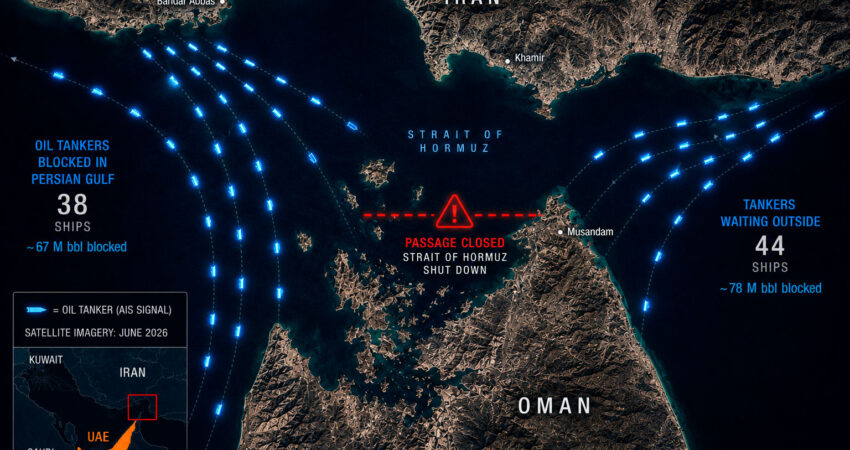
Before the war, the Strait of Hormuz, through which around a fifth of the world’s oil and LNG supplies passed, remained one of the most important routes for global energy trade. However, following the US and Israeli strikes on Iran on 28 February, the situation changed radically: Tehran blocked the strait, and the de facto suspension of shipping along this route became one of the main consequences of the conflict for the global energy market.
Since then, there has been no fundamental shift, and full-scale traffic through Hormuz has not resumed. The consequences have proved particularly severe for Europe and the Gulf states, whose economies depend directly on the stability of energy supplies from the region.
Further supply disruptions in July once again pushed the price of Brent above $100 per barrel. The longer the current situation persists, the more obvious it becomes that a return to the status quo requires a political compromise.
This is precisely why the idea of fees – which until recently many states categorically rejected – is gradually gaining support. Without such an agreement, the current situation could persist indefinitely, and full shipping operations may never be restored. Iran – and, along with it, Oman – continues to work on a plan to levy charges on vessels passing through the strait. At the same time, a growing number of experts believe that a return to the pre-war arrangement, under which the world’s most vital transit route remained free of charge, may prove impossible.
EUROPE AND THE GULF STATES RETHINK THEIR POSITION
In Europe, the possibility of introducing fees for passage through the Strait of Hormuz is being considered with increasing seriousness. According to two European sources who spoke to Bloomberg, as reported by The Guardian, the introduction of such fees is virtually inevitable. In private conversations, representatives of some Arab Gulf states are also taking a similar stance.
This shift is particularly noticeable given the stance of those countries that came under massive attack from Iran in the first weeks of the war. Previously, they had categorically rejected the idea of fees, but have now made it clear that, for the sake of de-escalation, they are prepared to change their attitude towards such a mechanism.
The stance of European countries is also becoming more pragmatic, with the key condition being that any new mechanism must comply with international law. One option that could meet this condition would be voluntary payments for passage through the Strait of Hormuz. At the same time, European governments are insisting, as a matter of principle, that Iran and Oman should not impose different conditions on vessels depending on the flag they sail under.
The political significance of these discussions is illustrated by the visit to Europe by Sultan Haitham bin Tarik of Oman. During his trip, he met with French President Emmanuel Macron in Paris and discussed plans regarding the future of the Strait of Hormuz. In a joint declaration, the two sides reaffirmed the importance of free and unconditional passage through the Strait of Hormuz, demonstrating Europe’s effort to combine the search for a practical compromise with the preservation of the principle of freedom of navigation.
This tension between the formally voluntary nature of future payments and the reality of changed shipping conditions is one of the central problems with the model under discussion. “You can call them voluntary, but before this war the Strait of Hormuz was completely open, and now it isn’t,” said Dr H. A. Hellyer, Senior Associate Fellow at the Royal United Services Institute for Defence and Security Studies (RUSI), in comments reported by the New York Times.
WHAT HORMUZ FEES COULD LOOK LIKE
It is not yet clear exactly what fees Iran ultimately intends to charge – the range of options under discussion shows just how far the future system is from being finalised. In March, the semi-official Iranian news agency Tasnim published two estimates of the country’s potential revenue: one used a fee of $2 million per vessel, the other $400,000.
In its research briefing, Oxford Economics notes that Iran has not yet officially announced the amount of the proposed fees. “Pending the introduction of a permanent system – which is likely to take into account the type and carrying capacity of vessels and provide for the sharing of revenue with Oman – Tehran, according to available information, will request one-off payments of US$2 million per vessel until a memorandum of understanding is signed,” the report states.
Such a fee would be exceptionally high compared with current charges on other strategic routes: it would be approximately five times higher than the average charge per vessel transiting the Suez Canal and 40 times higher than the average fee levied per vessel passing through the Turkish Straits.
For very large crude carriers (VLCCs), which are widely used in the Strait of Hormuz and can carry up to 2 million barrels of oil, a fee of $2 million would amount to an additional dollar per barrel. At a Brent price of $86, the figure used by Oxford Economics in its report, this would amount to around 1.2 per cent of the cost of the oil. If such a charge were to become a permanent part of transport costs, the additional cost of transit would inevitably be one of the factors putting pressure on the final price of the oil supplied.
At the same time, the very prospect of such transit fees through the Strait of Hormuz brings the long-discussed issue of diversifying export routes back into sharp focus. If the current situation drags on, countries in the region will have an additional incentive to reduce their dependence on the strait. The United Arab Emirates is pursuing this strategy most actively, planning to expand its network of oil pipelines, develop ports outside the Strait of Hormuz and increase its export capacity. The UAE’s recent withdrawal from OPEC is one indication of this approach.
Saudi Arabia also intends to increase the capacity of the existing East-West Pipeline, which, since February, has enabled it to partially bypass the Strait of Hormuz.
At the same time, market participants increasingly see the introduction of such fees as a realistic scenario rather than a purely theoretical possibility. According to Oxford Economics, betting markets indicate a 72 per cent probability of Iran introducing fees by the end of the year. This does not mean that the parameters of the future system have already been determined. But it does show how quickly an idea that until recently was considered politically unacceptable is becoming part of the market’s baseline scenario.
OMAN TAKES CENTRE STAGE IN THE SEARCH FOR A COMPROMISE
Oman plays a central role in the search for such a compromise. For Oman, the issue is not merely economic: the country has found itself drawn into a conflict it had made every effort to avoid. Its own economy, relations with its neighbours and diplomatic standing all depend on the normalisation of traffic through the strait.
“For them, what is happening in the strait is a matter of urgent national security,” says Anna Jacobs, a New York-based non-resident fellow at the Arab Gulf States Institute in Washington, speaking to the New York Times.
At the same time, Oman’s strategy goes far beyond simply seeking a technical solution to resume shipping. The state is seeking to maintain the possibility of dialogue with Tehran and prevent the maritime crisis from escalating into a wider regional conflict. “The Omani authorities are taking a longer-term view of the conflict and regional security and are seeking to keep Iran at the negotiating table,” notes Jacobs.
THE MALACCA STRAIT AS A POSSIBLE MODEL
One option currently under consideration is the system in place in the Strait of Malacca. According to a Bloomberg source, the choice of this model indicates that Oman is seeking a solution that would be acceptable to both Iran and the other countries concerned. At the same time, the Omani authorities themselves believe that such a mechanism can only work with the consent of all the Gulf states. It remains unclear whether this option would be acceptable to Tehran itself.
Management of the Strait of Malacca is informally shared between Indonesia, Malaysia and Singapore. These countries charge vessels for navigation and safety services; alongside this, a fund accepts voluntary contributions to support safe navigation.
The possibility of extending this model to the Strait of Hormuz has already been discussed with the International Maritime Organization (IMO). Its Secretary-General, Arsenio Dominguez, had previously stated that tolls or any other mechanism that impedes freedom of navigation on international waterways are not in accordance with international law. However, he subsequently acknowledged that a voluntary fund for the Strait of Hormuz might prove to be an acceptable option. According to the New York Times, he has already discussed “the management of the strait” with representatives from Oman, including the establishment of a scheme modelled on the Malacca format.
“This involves the possibility of drawing on the experience of an existing and tried-and-tested system,” noted Dominguez.
PASSAGE FEES AS A PATH TO DE-ESCALATION
Political and legal objections to such a system remain serious for the time being, but as the crisis drags on, perspectives on the matter are shifting. The situation is no longer simply a matter of restoring the previous free passage through the Strait of Hormuz, as the pre-war order – in which traffic remained free and predictable – has effectively ceased to exist. Against this backdrop, introducing fees could prove preferable to continued supply disruptions, further pressure on fuel prices and persistent risks to the global energy market.
“Despite numerous objections to the introduction of fees, it is clear that they remain the preferable option compared with ongoing disruptions to shipping. There are therefore strong arguments in favour of Iran and Oman cooperating to restore safe passage through both shipping corridors,” states the Oxford Economics report.
Analysts at Oxford Economics note that the prospects for de-escalation will depend not only on the size of the payments, but also on how predictable the new system proves to be. “A transparent fee structure that restores predictable transit conditions and ensures smooth traffic would likely more than offset any direct cost of the levy through lower risk premia and improved confidence.”
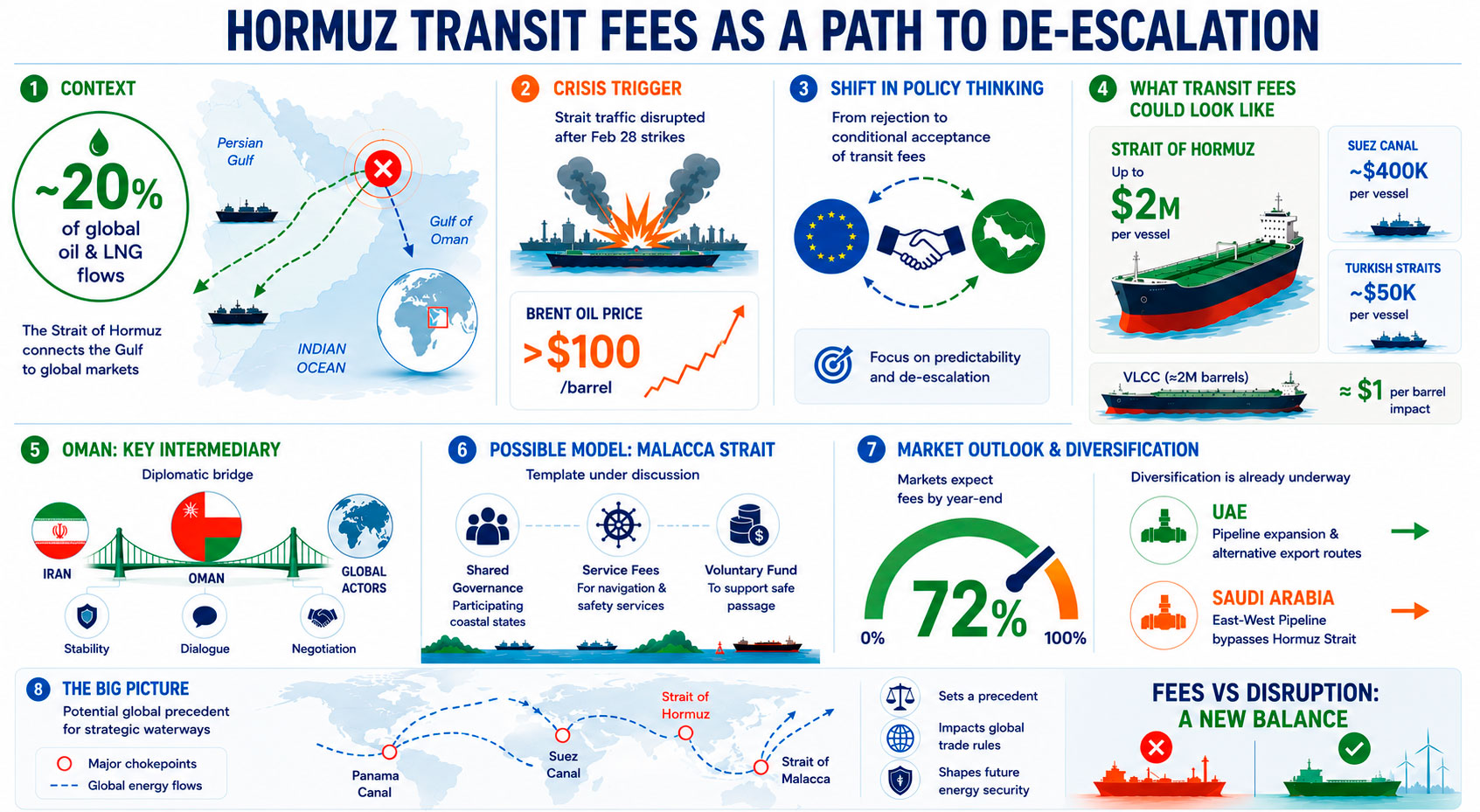
The Hormuz Fee Debate in Numbers. Graphic by the Energy Europe Editorial Team
SETTING A GLOBAL PRECEDENT
The possibility of introducing fees in the Strait of Hormuz highlights how heavily global supply chains depend on strategic waterways. At the same time, fears are mounting that the current crisis could alter the very principles governing such routes. If a payment system emerging from the current military conflict were to be established in one of the world’s most vital international straits, its consequences would extend far beyond the Persian Gulf.
“The final decision on the Strait of Hormuz could set a new precedent with global implications,” warns Adam Farrar, Senior Geoeconomics Analyst for Asia-Pacific at Bloomberg Economics.
If this plan is implemented, it will mark a significant departure from the previous status quo on one of the world’s most vital sea lanes. Furthermore, it will demonstrate just how far-reaching and unexpected the consequences of the decision by the US and Israel to strike Iran on 28 February have proved to be. Before the war, fees for passage through Hormuz were not on the agenda; today, however, some form of payment mechanism is increasingly being discussed as one possible element of a broader arrangement to restore stable shipping.
After several months of virtually blocked shipping, the debate is less and less about a simple choice between a free and a toll-based Strait of Hormuz. The question now coming to the fore is whether it will be possible to establish a transparent, non-discriminatory and multilateral mechanism that will restore predictability to one of the world’s most vital energy routes. Fees, in one form or another, may form part of such a compromise; however, their final format, conditions and even the very principle of their application remain the subject of negotiations.