


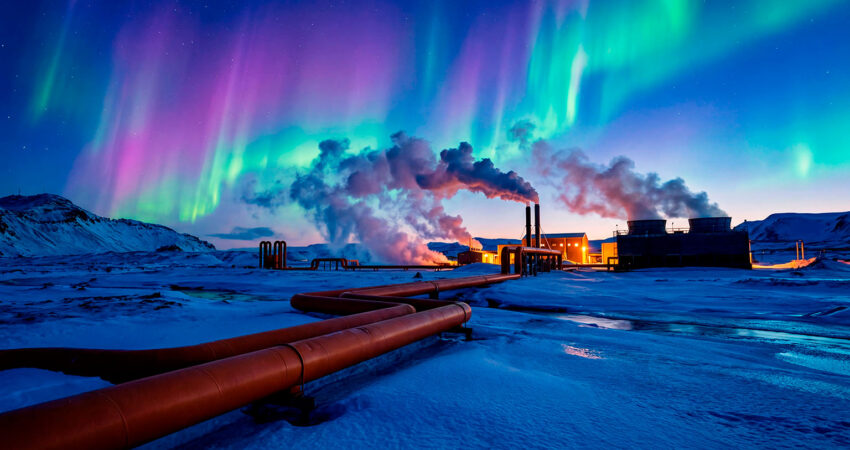
In Europe, geothermal energy is seen as one of the few renewable sources capable of supplying heat around the clock, regardless of weather conditions, and is therefore expected to help reduce dependence on fossil fuels. Although its market share remains small, political momentum for expansion is growing – particularly in the heating sector. Germany is already one of the EU’s most important geothermal markets, but it is still only at the beginning of a major scale-up.
Europe’s energy transition is shifting underground
In Europe’s energy transition, an increasing share of the debate is moving underground. While wind turbines and solar panels visibly reshape the power system, attention is shifting to what lies deep beneath the surface: an energy source that is domestic, locally usable, and available around the clock – geothermal energy. As Europe seeks to reduce its dependence on fossil fuel imports, this gives geothermal energy growing strategic relevance.
Its political appeal is particularly strong in the heating sector. In many EU countries, decarbonisation is progressing more slowly here than in electricity generation. Buildings, district heating networks, and parts of industry still rely heavily on natural gas, oil, and other fossil fuels. Geothermal energy is therefore seen as one of the few renewable options that is both climate-friendly and continuously available and capable of gradually replacing fossil-based heat.
Its contribution remains small. According to the European Commission’s Joint Research Centre, geothermal energy currently provides only about 0.2 percent of electricity and around 0.7 percent of heat in the European Union. At the same time, geothermal heat use in particular has grown by an average of around 10 percent per year since 2010. The technology remains a niche, but one with a clear upward trend.
Italy dominates power, France leads heat
A look across member states shows how uneven this expansion still is. In electricity generation, Italy has dominated the European geothermal market for decades, almost single-handedly. In 2023, Italy accounted for 772 of the EU’s total 871 megawatts of installed geothermal power capacity, while generation reached 5,692 gigawatt-hours. In most other member states, geothermal electricity still plays only a minor role.
The picture differs in heating – where geothermal energy holds its greatest policy significance. France leads the EU in geothermal heat generation, followed by Hungary and Germany. In the Greater Paris area in particular, geothermal energy has long been integrated into district heating systems. Germany is therefore already among Europe’s leading markets, but is better described as an early-growth market than a fully established pioneer.
Geothermal energy’s rising importance in Europe is also linked to its role in the future energy system. The International Energy Agency points out that it can provide electricity, heat, and storage around the clock. Because the resource is continuously available, geothermal plants can run at high capacity and help stabilise a system increasingly shaped by weather-dependent sources such as wind and solar. What fluctuates above ground can gain stability underground.
This strategic value is also beginning to show in investment figures. According to the IEA, more than 11.5 billion US dollars were invested globally in geothermal heating projects in 2025. Interest is also growing in Europe, as cities, municipalities, and utilities seek to make their heat supply more climate-friendly and less dependent on fossil fuels over the long term.
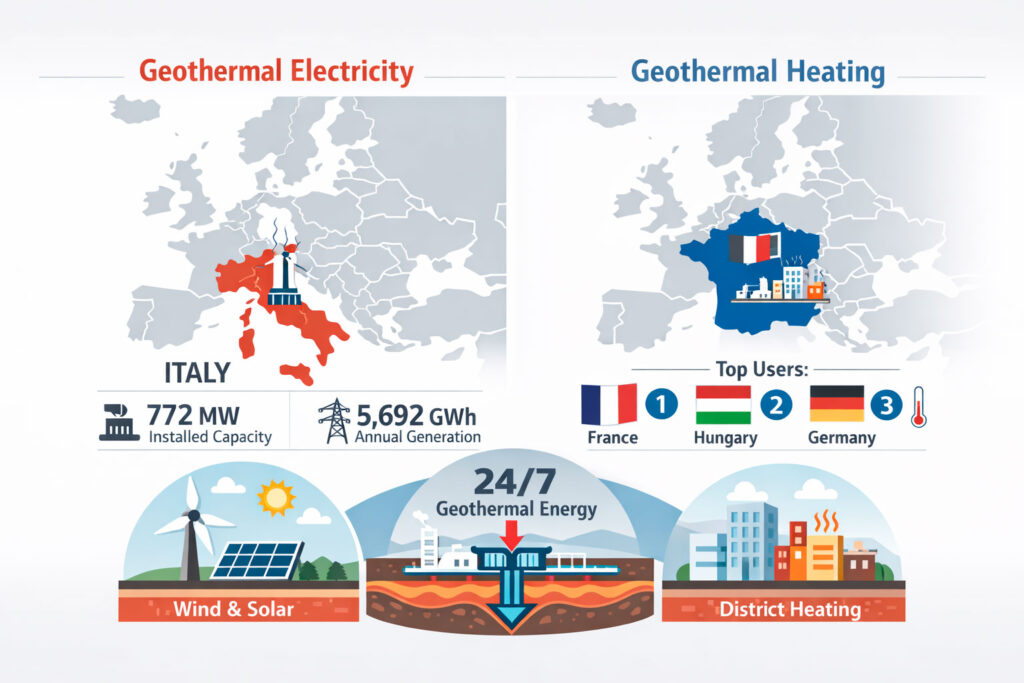
Geothermal energy in Europe, Graphic by Energy Europe Editorial Team
Germany seeks to scale up
This development is particularly relevant for Germany. For years, the heat transition has been regarded here as one of the biggest challenges of the energy transition. According to the Federal Environment Agency, the share of renewable energy in final energy consumption for heating and cooling stood at 18.1 percent in 2024. The federal government has therefore explicitly described geothermal energy as a “reliable energy source available year-round,” whose potential has so far been “insufficiently tapped.” The political will to expand it is therefore there, the crucial question is how quickly this will translate into actual projects.
In any case, there is no shortage of potential. The German Research Centre for Geosciences and the industry have been pointing out for years that deep geothermal energy, supplemented by thermal storage and mine water, could cover a significant portion of Germany’s heating needs. “The potential for geothermal energy in Germany is immense,” says Gregor Dilger, managing director of the German Geothermal Association. Natural thermal water resources alone could potentially cover around a quarter of the country’s heating and cooling needs.
The reality is still far from that. At the beginning of 2025, 42 deep geothermal plants were in operation in Germany. Thirty-one generated heat exclusively, two generated electricity exclusively, and nine operated in combined heat and power mode. The installed capacity was 408 megawatts of thermal power and 55 megawatts of electrical power. In 2024, approximately 214 gigawatt-hours of electricity and 1,795 gigawatt-hours of heat were supplied. Measured against the entire German energy system, this remains a small contribution about 0.04 percent of gross electricity consumption and around 0.2 percent of final energy consumption in the heating sector.
Efforts to accelerate the expansion are underway
At the same time, there are many signs that the pace is picking up. According to industry figures, 16 plants are under construction, with another 155 in the planning stages. Municipal utilities and local providers, in particular, are embracing the technology as a key component in the transformation of their heating networks. This is driven not only by climate policy but also by considerations of industrial and security policy: those who generate heat from the ground need to import less energy.
For many advocates, this is precisely where its greatest strength lies. “Geothermal energy is reliably available around the clock, all year round, and is completely climate-neutral,” says Markus Bieder of Stadtwerke Münster. “Geothermal energy is generated right on site, is independent of imported fuels, and makes heat a true local product.” For district heating systems, this is a strong promise: reliable, local heat without ongoing fuel imports.
Progress made, challenges remain
But the path to achieving this remains challenging. High initial investments, lengthy permitting processes, and the risk of failing to find geothermal resources during drilling are holding back many projects. This is precisely why the industry has been calling for years for faster permitting processes, more reliable policy frameworks, and instruments to hedge against geological risks. From the perspective of researchers and many companies, the sector must also make the transition from project mode to full-scale industrial deployment if geothermal energy is to be more than just a much-cited technology of the future.
Across Europe, a clear picture emerges: geothermal energy is technologically proven, politically desired, and associated with high expectations. Yet expansion has so far proceeded more slowly than climate targets, the heating transition, and supply security would actually suggest. Germany serves as a prime example of this. Beneath the surface lies a vast domestic energy potential – the key question is how quickly we can turn it into a cornerstone of a low-fossil-fuel energy system.