


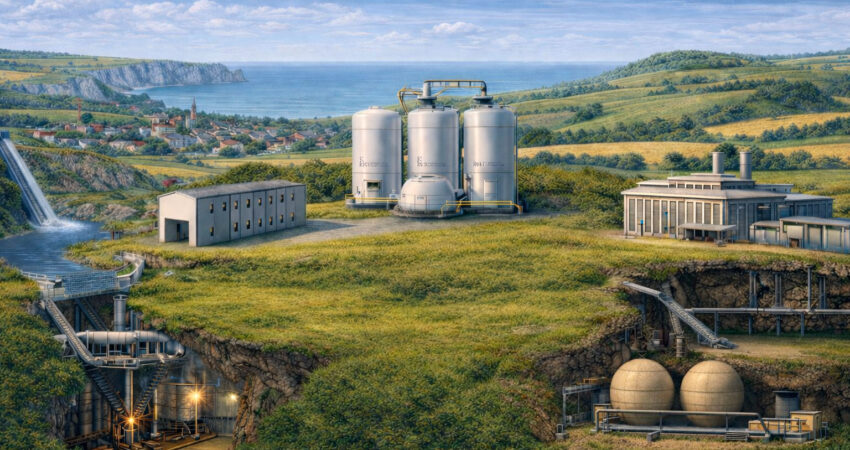
A Berlin blackout caused by a January 2026 arson attack was a stark warning that clean power alone will not secure Europe’s energy future. As renewables surge, the real constraint is shifting from generation to flexibility and long-duration energy storage is emerging as one of the most contested tools to close that gap.
In January 2026, an arson attack on a cable bridge near Berlin’s Lichterfelde power plant left tens of thousands of households and businesses in the southwest of the city without electricity, and in many cases heating, for several days. The blackout quickly became a stark reminder that Europe’s energy transition is not only about producing more clean power. It is also about making energy systems more resilient, flexible and capable of coping with disruption – whether caused by weather, technical failure or sabotage. That is where long-duration energy storage, or LDES, enters the debate.
Europe Moves to Close the Storage Gap
Europe is making steady progress in renewable power generation. In 2025, renewables accounted for 47.3% of all electricity generated in the EU, according to Eurostat. But more clean electricity does not automatically mean a more efficient system. As wind and solar capacity expands, grids increasingly struggle to absorb surplus generation during periods of low demand. The result is curtailment – electricity that could have been used, but is instead reduced or switched off because the system cannot transport, store or consume it in time.
This is the new flexibility gap in Europe’s energy transition. Reaching the bloc’s 2030 climate and energy goals will require not only more renewable generation, but also far greater capacity to shift energy across time. In practical terms, Europe needs technologies that can store electricity for much longer than conventional lithium-ion batteries, which are best suited to shorter balancing periods. LDES refers to a broad family of solutions designed to store energy for many hours, several days, or even longer. “The road to a zero-carbon electricity system runs through long-duration energy storage – and the EU must make it a policy and political priority,” Seán Kelly MEP from Ireland was quoted as saying to the European Parliament in 2026, while his compatriot Billy Kelleher called energy storage a Holy Grail back in 2023.
Long-Duration Storage Takes Shape in Europe
The technologies vary widely. Some are electrochemical, such as flow batteries that store energy in liquid electrolytes held in external tanks. Others are mechanical, such as compressed-air energy storage systems, which use surplus electricity to compress air and later release it to drive a turbine. Pumped hydropower stores energy by moving water uphill and releasing it when needed. Thermal systems store heat or cold. Hydrogen can also play a role, with excess electricity used to split water and store hydrogen as a fuel for later use. What unites these technologies is not their chemistry or engineering, but their purpose: to provide flexibility over much longer periods than standard battery systems can offer. “Our technology is ready. The projects are live. But in too many cases, policy hasn’t caught up,” – points out Julia Souder, CEO of Long Duration Energy Storage Council.
Supporters of LDES argue that such technologies could become essential as Europe builds an electricity system dominated by variable renewables. They see storage not as a luxury, but as critical infrastructure for a decarbonized grid. Yet enthusiasm still runs ahead of deployment. While the sector is advancing, most European projects remain at pilot or early commercial stage. The technology exists, but scaling it remains slow, expensive and politically complex.
A good example is the Dutch startup Ore Energy, which in early 2026 completed what it described as Europe’s first iron-air LDES pilot connected to the grid in a realistic utility setting. The system was tested under different operating conditions and demonstrated discharge over roughly 100 hours – about four days. The technology has attracted attention not only because of its duration, but also because it relies on widely available materials such as iron, water and air rather than rare or highly constrained inputs. For Europe, that raises the prospect of building parts of the supply chain closer to home. Even so, promising pilots do not automatically translate into system-wide deployment. Commercial scaling still takes time, capital and regulatory support.
That is why Brussels is now trying to accelerate the industrial side of the energy transition. On 4 March 2026, the European Commission proposed the Industrial Accelerator Act (IAA), or IAA, a new legislative package designed to strengthen industrial capacity and decarbonization in strategic sectors. The proposal is part of a broader push to ensure that more clean technologies used in Europe are also manufactured in Europe.
Among other things, it introduces “Made in EU” and low-carbon requirements in selected public procurement and support schemes and links industrial policy more tightly to strategic technologies.
For Europe’s LDES sector, that creates both opportunity and tension. On the one hand, stronger domestic manufacturing could reduce strategic dependence on imported clean-tech equipment and help build an industrial base around storage. On the other, Europe risks slowing near-term deployment if local-content rules make it harder or more expensive to use technologies that are already available elsewhere. This dilemma is especially clear in relation to China, which currently dominates much of the global clean-tech supply chain and has moved faster than Europe in scaling storage technologies.
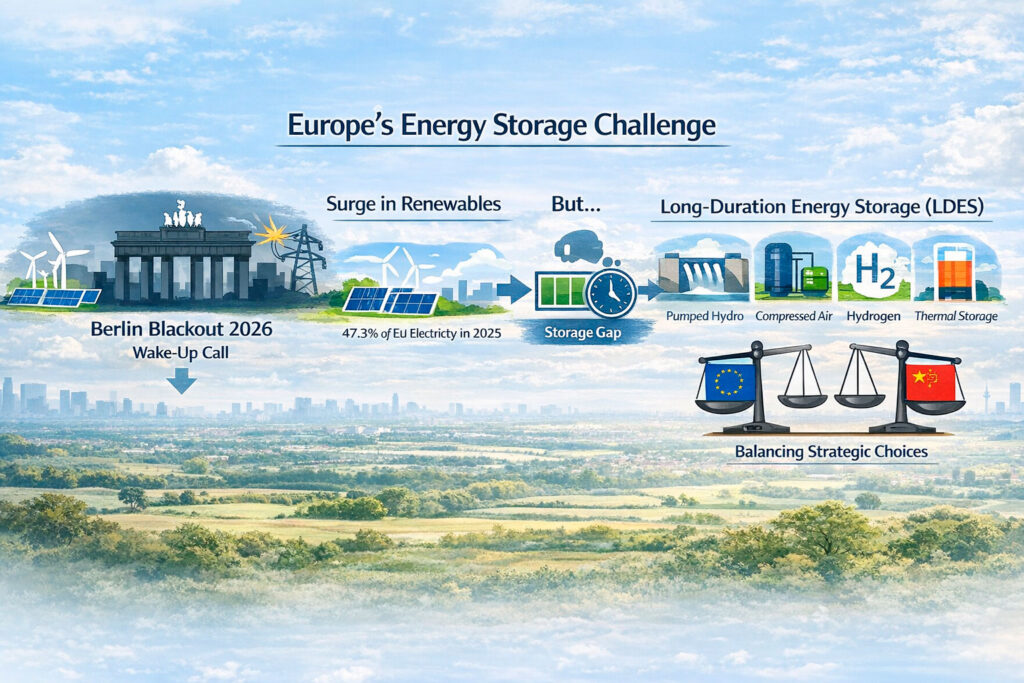
Long-Duration Energy Storage in Europe, Graphic by Energy Europe Editorial Team
A Trade-Off Defines Europe’s LDES Strategy
The debate inside the EU reflects this trade-off. France and some other member states have pushed for a strict “EU-only” approach in strategic sectors. Germany has tended to favor a more pragmatic “Made with Europe” model that would leave more room for trusted international partners and joint industrial projects. Underlying it all is Commission Executive Vice-President Stéphane Séjourné’s warning, made at a press conference: “If we do nothing, it is quite clear that, before long, 100% of clean technologies will be produced in China”.
In practice, the final outcome will matter greatly for LDES. A rigid approach could strengthen industrial sovereignty but slow rollout. A more open model could accelerate deployment while still anchoring more value creation inside Europe.
The reality is likely to be mixed rather than ideological. Even as the EU talks about strategic autonomy, it is also leaving the door open to foreign investment under certain conditions. The Commission’s broader framework allows large external investors to participate in strategic sectors, provided this supports industrial capacity, jobs and technology development in Europe. In that sense, the future of LDES in Europe may not be purely European or purely imported. It may depend on hybrid models – foreign technology combined with European manufacturing, European research partnerships and local workforce requirements. (Internal Market and SMEs)
Europe also has assets that go beyond manufacturing cost. It offers sophisticated power markets, strong research institutions and an unusually valuable testing environment. Demonstration projects in Europe can prove whether a technology works not only in the lab, but under real grid conditions, within a highly regulated and increasingly renewables-heavy system. That makes the continent attractive for pilot projects, joint ventures and industrial partnerships, even if deployment remains slower than many advocates would like.
Flexibility Becomes the Missing Link in Europe’s Energy Transition
Still, the Berlin blackout is a useful reminder of what storage can and cannot do. Bulk LDES alone would not have prevented an outage caused by physical sabotage of local infrastructure. Resilience in such cases depends on a broader mix of tools: grid redundancy, decentralized backup systems, islanding capability, local generation and storage working together. But the incident does highlight a larger point. A decarbonized power system must also be a resilient one, and resilience requires flexibility at every level.
That is why Europe’s LDES gamble matters. The continent is betting that it can build a domestic clean-tech base, reduce strategic dependence and deploy new flexibility tools fast enough to support a power system increasingly shaped by wind and solar. If it succeeds, long-duration storage could become one of the key enablers of a more secure and more affordable low-carbon grid. If it moves too slowly, Europe may find itself with rising renewable generation, but too little flexibility to make full use of it. In that sense, LDES is not the whole answer to Europe’s energy future. But it may become one of its most important missing pieces. Berlin’s blackout was a reminder that in an age of cyber and physical threats, flexibility is not just about balancing renewables, but about keeping power systems functioning when things go wrong.