


Europe is redrawing its energy map around the Mediterranean. With the EU aiming to mobilise €25 billion in investment by 2035, pipelines, LNG terminals and new energy links are bringing North Africa, the Eastern Mediterranean and Southern Europe into an increasingly interconnected energy system.
Following the 2022 energy crisis, the Mediterranean is gradually returning to Europe’s energy map in a new role. Whereas large-scale pipeline flows from the east previously formed the backbone of Europe’s gas supply, the EU is now building a more complex system in which supplies from the south are intended to complement those from Norway, the US, Qatar, Azerbaijan and other sources.
This is not about a single new route, let alone an attempt to find a single replacement for Russian gas. A network of existing and planned gas pipelines, LNG terminals, gas fields and transit hubs is taking shape around the Mediterranean. It includes Algeria and Italy in the west, Egypt, Israel and Cyprus in the east, as well as routes through which gas from other regions reaches the European market via the Mediterranean.
This approach is in line with the EU’s overall strategy of diversifying supply sources and routes. The region’s potential stems from several factors: North African reserves, new fields in the Eastern Mediterranean, existing LNG infrastructure and pipeline connections to the European market.
However, the Mediterranean alone cannot replace the previous volumes of Russian gas. Its main role is different: to provide additional routes that make the European energy system less dependent on a single supplier, a single transit country or a single supply corridor.
NORTH AFRICA AND ITALY AS A SOUTHERN GATEWAY
The western part of the emerging Mediterranean energy corridor relies primarily on existing infrastructure. Unlike the Eastern Mediterranean, where a significant part of the future system is still under development, major pipeline routes between North Africa and Southern Europe have been operating for decades.
Algeria occupies a particularly important position as one of the main suppliers of pipeline gas to the EU. The country is connected to Italy via the TransMed system, which runs through Tunisia and across the Mediterranean, and to Spain via the Medgaz pipeline. Algeria therefore does not need to build an export route to the European market from scratch: much of the necessary infrastructure is already in place.
At the same time, Italy’s role is growing. Its geographical location and pipeline connections allow the country to serve as one of the main entry points for gas flowing into the EU from the south. This is where the North African route and the Southern Gas Corridor converge, with the latter carrying gas from Azerbaijan’s Shah Deniz field through Georgia, Türkiye, Greece and Albania to Italy.
The Mediterranean energy system therefore encompasses not only the resources of countries directly situated on its shores, but also routes that link the EU with more distant gas sources through the region.
In the east, the situation is different. A major gas basin has emerged, but fields in Israel and Cyprus still need sufficient export capacity. This is precisely why Egypt is acquiring a significance that far exceeds the scale of its own export capabilities.
EGYPT AS A HUB OF THE EASTERN MEDITERRANEAN
Egypt has two large LNG plants – Idku and Damietta – with a combined nominal capacity of around 12 million tonnes per year. These facilities can potentially process not only Egyptian gas but also gas from neighbouring countries, before shipping the resulting LNG by sea to European and global markets.
Egypt’s main value to the future energy system of the Eastern Mediterranean therefore lies not so much in its own reserves as in its infrastructure. The country could become a processing and export hub for gas from several fields across the region.
This model is particularly evident in the case of Cyprus. Cronos will be Cyprus’s first gas development. The plan is to transport the gas by subsea pipeline to Egypt, process it using existing infrastructure and liquefy it at the Damietta LNG terminal before exporting it to Europe. Production is scheduled to begin in 2028.
This creates a fundamentally new arrangement: gas is extracted off the coast of one country, processed in another and then reaches the European market via the Mediterranean. Instead of building costly export infrastructure for each individual field, producers can make use of Egypt’s existing facilities.
A similar interdependence exists between Egypt and Israel. The Israeli Tamar and Leviathan fields have become two of the main sources of gas in the Eastern Mediterranean, with a significant share of Israeli exports going to Egypt and Jordan.
In January 2026, Chevron made a final investment decision to expand Leviathan. Once the project is completed, total gas supply from the field is expected to increase to approximately 21 billion cubic metres per year, with the new capacity expected to come on stream by the end of the decade. The expansion is therefore likely to further strengthen Israel’s role as one of the region’s key gas suppliers, with additional volumes potentially playing an important role in neighbouring markets.
Chevron itself views the Leviathan expansion in a regional context. As Chevron Upstream President Clay Neff stated, “Our decision to invest in the expansion of Leviathan’s production capacity reflects our confidence in the future of energy in the region. Pragmatic U.S. and regional energy policies are helping to strengthen energy security across the Eastern Mediterranean.”
The expanded agreement provides for the supply of approximately 130 billion cubic metres of gas from Leviathan to Egypt, worth around $35 billion. Part of this gas will be required by Egypt itself, while additional volumes could potentially be used to supply Egyptian LNG plants and for subsequent export.
THE PARADOX OF THE EGYPTIAN HUB
However, this is precisely where one of the main contradictions of the emerging Eastern Mediterranean hub becomes apparent. Egypt aspires to become the region’s export hub, yet at the same time it is itself facing a gas shortage.
Declining domestic production and rising demand have once again turned the country into a net importer of gas. The Idku and Damietta plants are operating well below their potential capacity, not because of a lack of export infrastructure, but primarily because of insufficient feedstock.
The scale of the problem is clearly illustrated by Cairo’s own plans. According to Reuters, Egypt is in talks with Shell, TotalEnergies, BP and Hartree Partners to purchase 15-18 LNG cargoes per month under multi-year contracts. The agency reported that the agreements would run for at least three years, with contracts potentially spanning three to five years, and that purchases on this scale could cost the country $8-11 billion annually.
This creates a paradoxical situation: in order to become a major gas export hub, Egypt itself has to import gas. Consequently, the viability of the Eastern Mediterranean hub increasingly depends not on Egyptian production alone, but on the country’s ability to combine several gas streams – its own production, Israeli supplies and, in the future, gas from Cypriot fields.
This is both the strength and the weakness of the Egyptian model. The infrastructure already exists, so Egypt does not need to build an export system from scratch. However, its utilisation increasingly depends on the stability of supplies from neighbouring countries and on how much gas Egypt itself consumes.
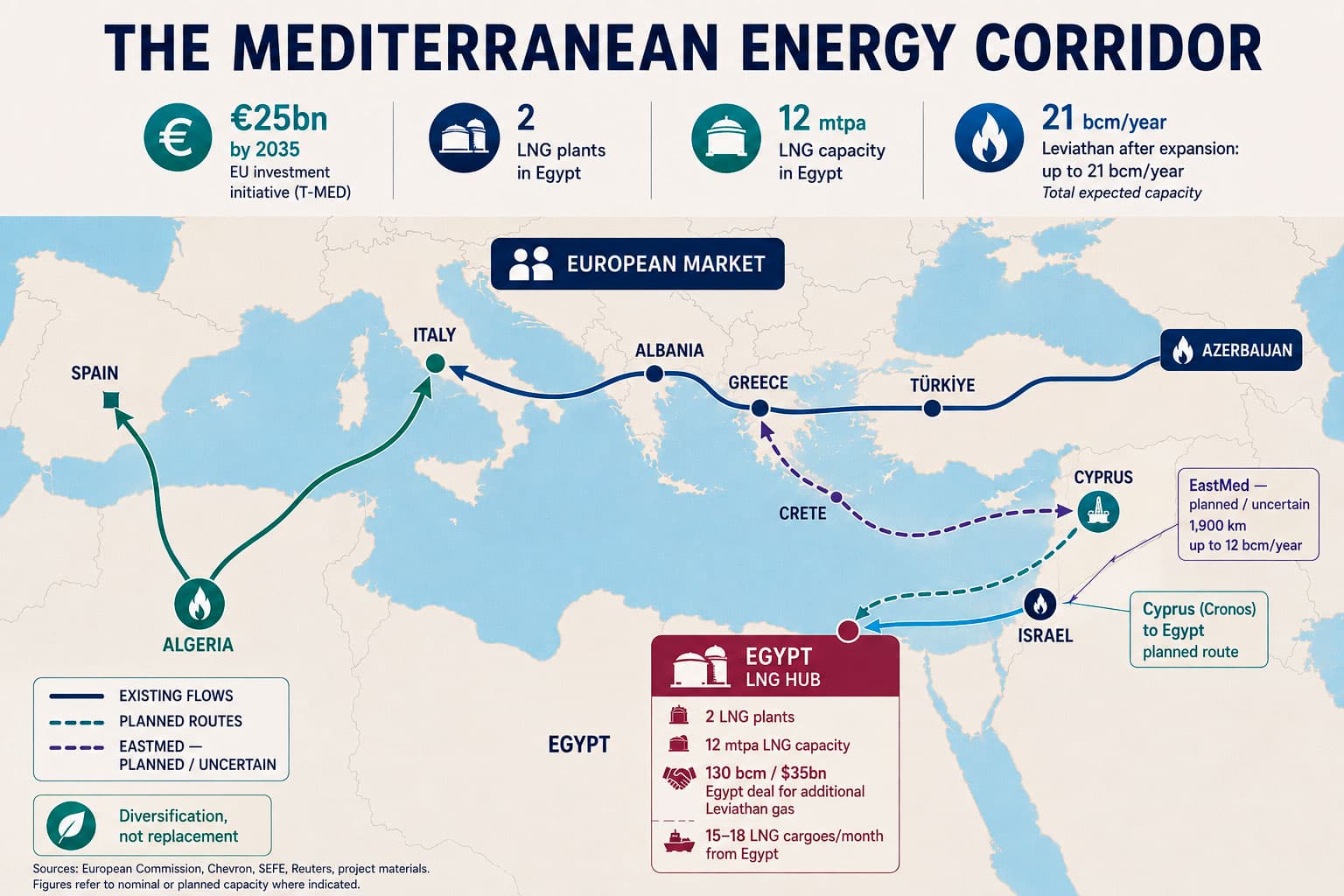
The Mediterranean: Europe’s new energy map. Graphic by the Energy Europe Editorial Team.
GERMANY AND THE EUROPEAN LNG MARKET
For Germany and other EU countries, this model is of interest primarily as an additional safeguard. Back in 2022, Germany and Egypt laid the political foundations for expanding energy cooperation. Contacts continued in the following years, including at the level of the relevant ministries.
However, there is still no publicly announced long-term contract for the direct supply of Egyptian LNG to Germany. In the absence of such a contract, any Egyptian or Egypt-linked LNG would have to compete on the broader market.
On 30 March 2026, SEFE announced a large-scale tender for LNG supplies to Europe between 2027 and 2036, with contracts ranging from one to ten years in duration. Suppliers from Egypt or operating via Egypt must compete for this demand with US, Qatari and other players in the global LNG market.
SEFE’s Chief Commercial Officer, Frédéric Barnaud, explicitly linked the new tender to the aim of protecting Europe from supply disruptions elsewhere: “With this LNG tender, we want to engage the market, aiming to mitigate supply disruptions in the Middle East and strengthen Europe’s security of supply, while complementing our recent long-term LNG deals, including that with Argentina.”
In this sense, the Mediterranean is not becoming a new dominant energy supplier to Europe in place of Russia. On the contrary, the point of the changes now taking place is precisely to move away from this kind of dependence.
A NETWORK RATHER THAN A SINGLE ROUTE
The region’s energy map is becoming increasingly multi-layered. Algeria supplies gas to Southern Europe via existing pipelines. Azerbaijani gas reaches Italy through the Southern Gas Corridor. Israel is expanding production and exports to neighbouring countries. Cyprus is preparing to develop its own offshore fields. Egypt is seeking to use its geographical location and LNG plants to connect these resources to the global market.
At the same time, the idea of a more direct route from the Eastern Mediterranean to the EU remains on the table. The EastMed project envisages a gas pipeline from Eastern Mediterranean fields via Cyprus and Crete to mainland Greece, with the potential for further access to the Italian market. However, its implementation remains uncertain, so EastMed cannot yet be regarded as a guaranteed future route.
The Mediterranean is also gradually gaining significance for Europe beyond the gas market. Electricity interconnector projects between countries in the region are being developed, while, in the longer term, southern routes are also being considered as potential infrastructure for imports of hydrogen and its derivatives.
This rationale was set out in June 2026 by Dan Jørgensen, European Commissioner for Energy and Housing, at the launch of the Trans-Mediterranean Renewable Energy and Clean Tech Cooperation (T-MED): “The current energy crisis underscores how energy security cannot only rely on diversifying fossil fuel imports. We must move towards electrified energy systems based on clean energy, strong interconnections and efficient networks.”
T-MED is intended to accelerate the development of renewable energy, hydrogen, clean technology manufacturing and modern electricity grids across the Mediterranean. The EU expects to mobilise up to €25 billion in investment under the initiative by 2035. The current restructuring of the gas system is therefore gradually becoming part of a broader transformation of energy links between Europe, North Africa and the Eastern Mediterranean.
The Mediterranean’s importance to Europe is consequently determined not so much by how much gas any single country can produce, but by the potential to establish a network of complementary routes across the region. Gas can flow from Algeria by pipeline, from Israel to Egypt, from Cyprus to Egyptian LNG plants, from Azerbaijan via Türkiye and the Southern Gas Corridor, and from the global market through European LNG terminals.
DIVERSIFICATION CHANGES THE RISKS
Such a system has an obvious advantage: the loss of a single route poses less of a threat to the system as a whole than it would under heavy dependence on a single supplier or supply corridor.
But there is also a downside. The more Europe depends on the global LNG market and an extensive network of southern routes, the more exposed it becomes to events far beyond the EU’s borders – from conflicts in the Eastern Mediterranean to developments in the Persian Gulf and the Strait of Hormuz. Alongside diversification, Europe has become more exposed to global LNG market conditions.
The emerging Mediterranean energy corridor should therefore be viewed not as a new version of the old system, in which one major supplier simply replaces another, but as part of a fundamentally different model of energy security. It is based on multiple suppliers, several pipeline routes, LNG, interconnected national networks and the ability to redirect flows between different routes.
No single country in the region is capable of taking the place of Europe’s former largest supplier on its own. Egypt could become an important processing and export hub. Israel and Cyprus could provide additional volumes. Algeria remains a major supplier to Southern Europe, while Italy is strengthening its role as one of the main entry points into the European gas system.
Overall, the Mediterranean may become not Europe’s new single source of gas, but an additional network of routes and suppliers that makes the loss of any one of them less critical to the system as a whole.