

'/%3E%3C/svg%3E)

Europe is facing new challenges in the energy sector that are fundamentally reshaping its strategy. The pivotal decision to abandon energy supplies from Russia opens the door to a deeper transatlantic partnership. The US is emerging as a confident leader in liquefied natural gas (LNG) supply and is ready to provide reliable, long-term exports. For both sides, this presents an opportunity to strengthen transatlantic ties and reshape the architecture of energy security.
American LNG – A Key Pillar of European Energy Stability
LNG imports from the US have become a strategic cornerstone for Europe in the current geopolitical context, as war continues on the continent and former energy ties have been largely severed. According to the Institute for Energy Economics and Financial Analysis (IEEFA), the US has accounted for a significant share of European LNG imports in recent years. At the same time, the EU has remained the largest buyer of American gas, consuming more than half of US LNG exports in 2024.
From the standpoint of European security, this resource is essential: breaking away from Russian pipeline dependency requires alternatives, and American LNG provides a viable option even in an environment of geopolitical volatility.
However, energy has also become part of a broader trade strategy — as recent comments by Donald Trump have illustrated. In a White House press conference, he stated: “They’re going to have to buy our energy from us… we can knock off $350 billion in one week.” He suggested this would help reduce the US trade deficit with Europe.
But experts urge caution: such a purchase volume appears unrealistic. To fulfill the $350 billion goal, the EU would need to replace virtually all other suppliers, which would require sweeping commercial commitments and major infrastructure adjustments. Contracting such volumes would be extremely difficult, especially given the EU’s climate goals and existing long-term contracts.
The Price Burden on Germany
For Germany, this transition is not just a strategic shift — it is also a financial strain. According to McKinsey, Germany’s gas consumption may only decline by 3–7% by 2030 — from approximately 740 TWh to 690–720 TWh. Experts attribute this to the slow replacement of gas boilers with heat pumps and the continued demand for heating and electricity generation.
“Germany will probably be dependent on natural gas for longer than previously assumed,” said Thomas Wallenkamp, senior partner at McKinsey. In other words, even after phasing out Russian gas, Germany will remain deeply integrated into the global LNG market — and that could expose it to significant price volatility.
The Pitfalls of a New Energy Reliance
The core paradox is this: by eliminating its dependence on Russia, Europe risks falling into a new dependency — on the US. A strategy based on massive purchases of American gas increases Washington’s leverage. At some point, the US may be tempted to use energy exports as a geopolitical tool. Anne-Sophie Corbeau, a researcher at the Center on Global Energy Policy at Columbia University, warns: “If the EU were to double its US LNG imports in line with the US doubling its LNG exports by 2030, that would dramatically increase the region’s dependency on one supplier — something the EU is not likely eager to do.”
While the US has been a stable and reliable partner for decades, some European officials and analysts are concerned that new energy commitments could limit the EU’s strategic autonomy. There are also fears that they may hinder Europe’s green transition and the broader shift toward emissions reduction. Sascha Müller-Kraenner, managing director of the NGO Environmental Action Germany, described the growing EU-US energy ties as “a disastrous signal for climate action.” He added: “Such a ‘deal’ not only sets the EU back in terms of climate policy but also deepens its dependence on a US president who uses energy supplies as a means of geopolitical pressure.”
Qatar: An Unreliable Alternative?
Alternative suppliers such as Qatar also come with drawbacks. Long-term LNG contracts with Qatar often span 20 to 25 years — in line with the exporter’s preferences. Signing such agreements could tie Europe’s hands. Moreover, Qatar has shown a willingness to exert political pressure. In the ongoing dispute over the EU’s Corporate Sustainability Due Diligence Directive (CSDDD), Qatar has demanded the regulation be repealed — not through dialogue, but through threats.
This makes Qatar an unreliable partner. It demands guaranteed long-term demand and seeks to impose conditions that may clash with Europe’s climate ambitions. In comparison, relations with the US are more transparent and predictable, making American LNG a preferable option — for now.
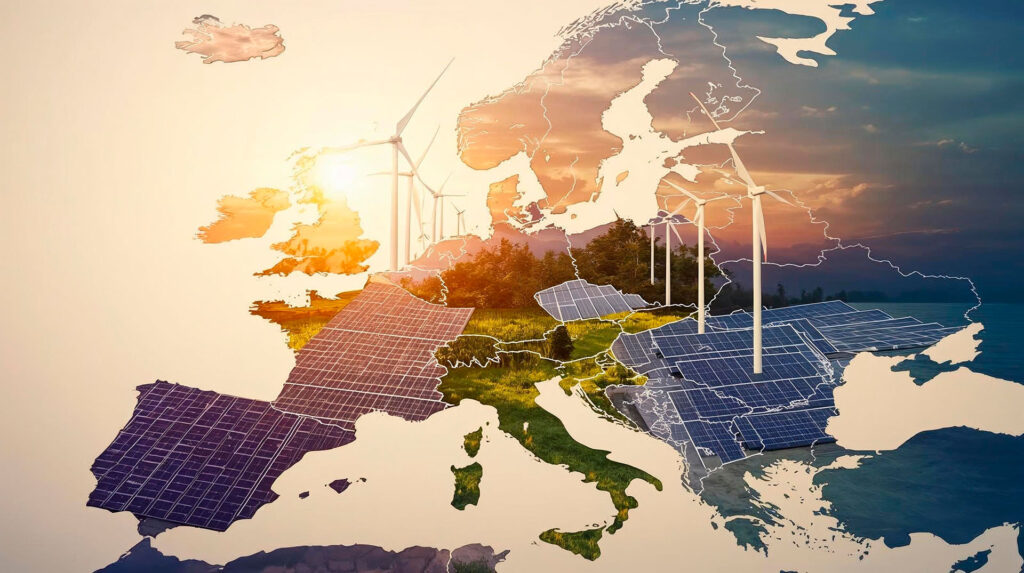
Copyright: Canva. European Energy Sovereignty
A Long-Term Vision Beyond LNG
Experts increasingly argue that Europe must not only diversify its suppliers but also reduce the role of fossil gas in its energy mix. The IEA, along with its Executive Director Fatih Birol, has repeatedly stressed that accelerating gas demand reduction and renewable energy deployment is critical to reducing Europe’s dependence on imported gas.
EU leaders echo this stance. In her State of the Union address, Ursula von der Leyen stated: “As our energy dependency on fossil fuels goes down, our energy security goes up.”
According to IEEFA, Europe’s LNG regasification capacity could exceed actual demand — especially if the green transition speeds up. This creates a risk of overbuilding expensive infrastructure that could end up underutilized, negatively affecting investment confidence.
Long-term forecasts, including scenarios for Germany, highlight the growing importance of hydrogen and synthetic fuels by 2050. While such technologies require decades of R&D and investment, they offer a clear path toward reduced import dependency and stronger energy sovereignty.
Conclusion: Beyond LNG – Building Real Energy Sovereignty
The strategic energy partnership between the US and the EU offers a real opportunity to reinforce the transatlantic alliance and ensure supply security — a role once filled by Russian pipeline gas. But this is more than a commercial arrangement — it is a geopolitical decision with long-term implications.
To truly break free from dependency, Europe must not only leave Russia behind but must also build a roadmap toward energy sovereignty. Otherwise, it risks falling into a new trap — substituting one dependency for another.
According to most experts, the ultimate goal should not be to replace one supplier with another, but to overhaul the entire energy system.
This is particularly crucial for Germany: it must pursue a strategy that pushes Russian gas out of the market, while emphasizing sustainability, clean energy, and independence from external sources. This path may seem idealistic to some, especially in current circumstances — but it is the only way Europe can achieve genuine strategic flexibility and true energy independence.