


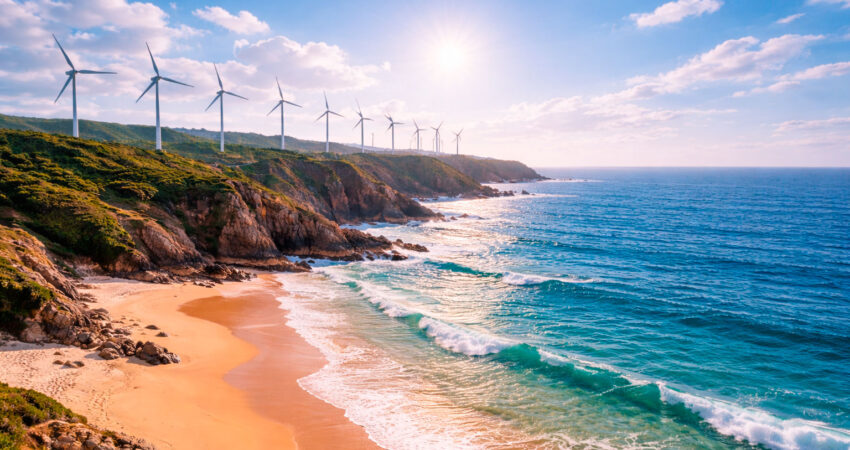
The “30 Renewable Islands for 2030” initiative, unveiled on 30 November 2023, turns 30 islands and island groups from 10 EU countries into real-world testbeds for the energy transition. Rather than imposing a one-size-fits-all model, it backs each island’s own bottom-up push to break free from fossil fuels and move towards genuine energy independence.
When it comes to the energy transition, islands occupy a unique position. Geographically isolated and often disconnected from mainland grids, they face structural vulnerabilities that continental regions do not. According to the International Energy Agency (IEA), electricity generation on islands can be up to ten times more expensive than on the mainland due to reliance on imported fossil fuels and limited grid interconnections.
In November 2023, the European Commission handpicked 30 islands and island groups across ten EU countries to blaze the trail toward energy independence. Dubbed “30 Renewable Islands for 2030,” the initiative fuels their unique, bottom-up transformations—turning these outposts into bold, real-world labs for decentralized clean energy. As coordinator Edita Dranseikaite put it, an island clean energy shift is simply inevitable.
Now, halfway to the 2030 deadline, three major trends are becoming increasingly clear.
From State-Led to Community-Owned
Energy systems on islands have traditionally been shaped by national policy frameworks. Yet approaches designed for large interconnected grids often fail in small, isolated environments. One of the most visible shifts within the “30 by 2030” initiative is therefore institutional agility, bringing decision-making closer to local actors.
While the EU provides coordination and support, renewable energy solutions remain highly place-specific. Solar potential, wind conditions, geothermal activity, tidal strength and population density vary dramatically from island to island. As a result, unified policy templates are less effective than adaptive local governance.
Under the EU-funded LIFE ISLET project https://fedarene.org/project/islet/, the Croatian islands of Cres and Korčula have adopted cooperative governance models. Energy cooperatives bring together municipal authorities, businesses and residents to raise capital, vote on investments and develop step-by-step transition plans toward carbon neutrality by 2030.
On Cres, the energy cooperative Apsyrtides is advancing a solar power plant project, moving from asset acquisition to the installation of photovoltaic systems. Beyond project implementation, cooperatives are also involved in broader infrastructure discussions. In recent years, local actors participated in consultations regarding the replacement of outdated high-voltage cables under the Adriatic Sea.
By 2026, some form of participatory governance is expected to exist on almost every island within the initiative, whether in the form of cooperatives, advisory boards or local associations. Denmark’s Fejø, home to fewer than 500 residents, has launched a structured citizen dialogue on green energy with support from the Danish Islands Secretariat. Residents are debating whether an existing nature protection zone should be reorganized to accommodate a wind power project.
By shifting energy projects to civil society institutions, islands are building resilience against political cycles while ensuring that economic benefits – jobs, revenues and energy savings – remain within the local community.
Diversification Beyond Solar and Wind
While photovoltaics dominate in southern Europe and wind energy prevails in the North, several islands are moving toward broader technological diversification.
Lesvos in Greece is emerging as a test case for geothermal energy, alongside bioenergy generation from organic waste. The island is well known for its geothermal springs, historically used primarily for recreational purposes. Some hotels already utilize geothermal heat, but large-scale electricity production has yet to materialize.
According to a February 2025 report, PPC Renewables is developing a 0.25 MW pilot geothermal power plant on Lesvos. Geophysical surveys have been completed, and the facility is expected to become operational in 2026. Although modest in scale, the project is designed to test technical and economic feasibility before potential expansion.
Further north, the Dutch island of Ameland is exploring tidal power. Unlike Mediterranean islands, Ameland benefits from strong tidal currents. The SeaQurrent project has developed an underwater “energy kite” that converts tidal motion into electricity. A large aluminum wing moves in a figure-eight pattern beneath the surface, driving a generator anchored to the seabed.
Launched in 2024, the project aims in its initial phase to provide electricity to around 700 of the island’s 1,700 households. While still experimental, it illustrates how island-specific natural conditions can determine technological pathways.
Not every island has the wind profile of the Aegean or the solar irradiance of the Mediterranean. What the initiative demonstrates is a broader principle: the EU can act as a catalyst, helping match diverse renewable resources with appropriate technologies rather than prescribing uniform solutions.
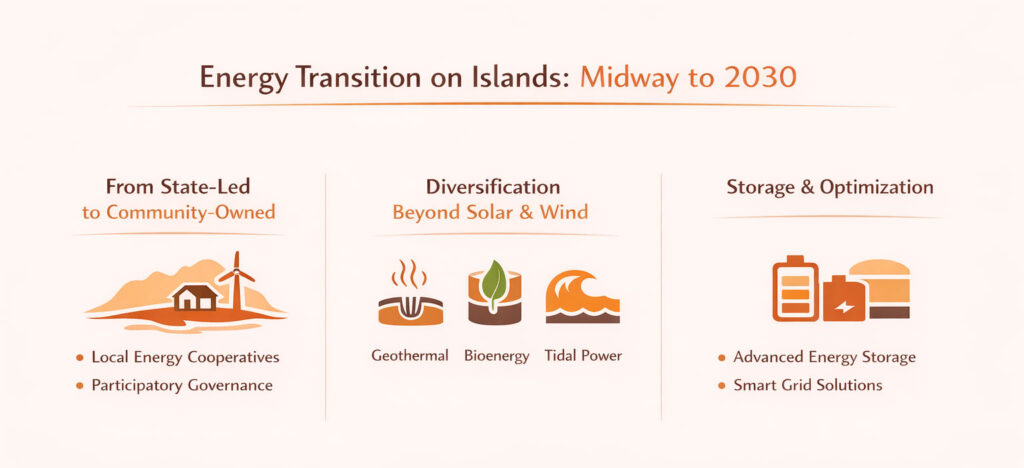
Storage and Optimization as the New Frontier
The most technically complex developments are unfolding on islands where renewable generation is already established, and the focus has shifted toward optimization and storage.
Madeira, Portugal, began producing renewable electricity in 1953 with hydropower. During the 1980s and 1990s, the island expanded into wind and solar energy. Yet despite decades of progress, renewables accounted for just over one third of its electricity mix in 2025, reaching 36.4 percent according to regional statistics.
Unlike near-shore islands such as Estonia’s Saaremaa, which seek integration into offshore grid networks, Madeira’s geographic isolation leaves little room for interconnection. Located nearly 900 kilometers from mainland Portugal, the island must balance supply and demand internally.
Within the “30 by 2030” framework, Madeira is exploring advanced storage solutions, including underground storage facilities, thermal water storage systems and decentralized off-grid installations. The emphasis is no longer simply on expanding capacity, but on stabilizing and optimizing fluctuating renewable generation.
Ikaria in Greece presents a similar case. The island already operates a pumped-storage hydropower facility, yet researchers continue to explore ways to maximize system efficiency. A 2024 study assessed the potential of equipping photovoltaic installations with dual-axis tracking systems that follow the sun and minimize shading. According to the analysis, such tracking technology could increase annual PV output by up to 21.3 percent compared to fixed panels, with the largest gains occurring during peak tourist season when electricity demand is highest.
This shift signals a new phase of the transition. Even the most advanced solar and wind installations rarely cover 100 percent of energy needs in isolated systems without storage and smart optimization. The frontier is no longer expansion alone, but intelligent system management.
Blueprint for a Decentralized Future
Taken together, the trends emerging from the “30 Renewable Islands for 2030” initiative reveal a transformation that is democratic, technologically diverse and increasingly data-driven.
Decision-making is moving closer to communities. Technology portfolios are broadening beyond conventional solar and wind. Storage, optimization and system intelligence are becoming central to energy autonomy.
For mainland Europe, the lessons are significant. While continents benefit from interconnected grids and economies of scale, they face similar challenges of resilience, volatility and decarbonization. Islands may be smaller in size, but they are operating at the cutting edge of decentralized energy design.
No longer just picturesque destinations, these islands are becoming test beds for a resilient and adaptable European energy future.