


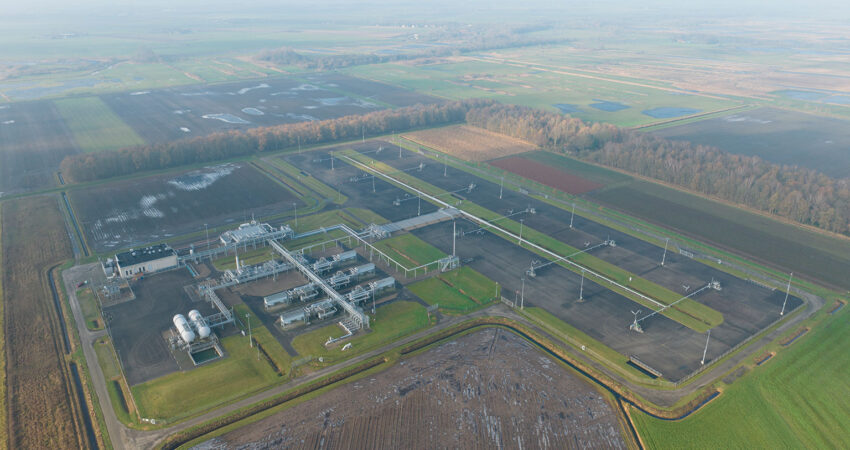
In the face of energy crises and high gas prices, not to mention the desire for greater security of supply, the topic of fracking is a recurring one in Europe. At first glance, the idea seems appealing: extracting domestic gas would reduce imports and cut dependencies. In practice, however, the situation is far more complicated, particularly in Germany, which banned unconventional fracking in 2017 and has since significantly diversified its gas supply.
What fracking could do – and what it cannot
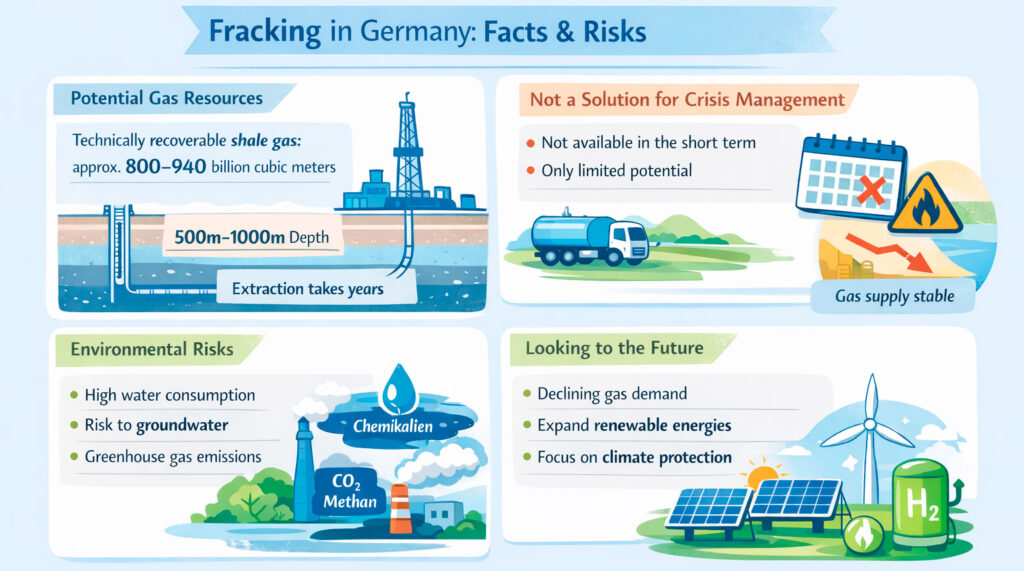
Fracking can unlock natural gas trapped in dense rock layers that are largely inaccessible to conventional extraction methods. In Germany, the Federal Environment Agency, citing the BGR, estimates the average technically recoverable shale gas volume at around 940 billion cubic metres. Excluding the shallower reserves at depths of 500 to 1,000 metres, the figure falls to around 800 billion cubic metres. At first glance, that sounds substantial. Yet Germany’s natural gas consumption in 2021 still stood at roughly 104 billion cubic metres, and the Federal Environment Agency itself stresses that such reserves could neither be developed quickly nor brought to market at will. Exploration, permitting, drilling and the necessary infrastructure would all take years.
For that reason, the agency does not regard fracking as a credible tool for short-term crisis management. It states explicitly that shale gas production in Germany is “neither necessary nor can it contribute in the short term to avoiding gas shortages and significant price spikes”. Nor is Germany currently facing an acute gas shortage. According to the Federal Network Agency, gas consumption in 2025 amounted to 864 TWh. While that was 2.2 per cent higher than in 2024, it remained around 13.5 per cent below the average for the years 2018 to 2021.
Focus on environmental and water resources
Water remains one of the central points of criticism. Fracking involves injecting a mixture of water, sand and chemical additives deep underground under high pressure. The Federal Environment Agency refers to several thousand cubic metres of water per well. The Federal Environment Ministry gives an even more striking example: a single well with six horizontal drill strings may require up to 174,000 cubic metres of water – roughly equivalent to the daily water consumption of all Munich residents. In addition, the process generates formation water and so-called flowback, contaminated return fluids that must be collected, treated and disposed of.
The risk to groundwater is one of the main reasons for Germany’s strict rules. The UBA has explicitly warned that fracking can lead to groundwater contamination, above all through the chemicals used and the handling of the resulting wastewater. That is why a far-reaching ban on unconventional fracking has been in place in Germany since 2017. Even conventional projects remain subject to environmental impact assessments and are prohibited in water protection and nature conservation areas.
Climate policy perspective
From a climate policy perspective, fracking is equally difficult to reconcile with Germany’s and the EU’s long-term goals. Natural gas may emit less CO2 than coal when burned, but its overall climate balance depends heavily on how it is extracted, processed and transported – and on how much methane escapes along the way. RIFS Potsdam points out that the actual CO2 emissions expected from shale gas extraction are likely to be higher than those from Germany’s current domestic gas production. Environmental experts therefore reach a clear conclusion: as a fossil-fuel technology, shale gas extraction has “no medium- or long-term future in a greenhouse gas-neutral energy supply”.
At the same time, gas demand is expected to fall significantly in the years ahead. In its RESCUE study, the UBA assumes that demand in Germany could drop to as little as 140 TWh by the time greenhouse gas neutrality is achieved – equivalent to only around 15 per cent of the country’s 2021 gas consumption. In other words, fracking would require investment in infrastructure whose economic rationale is likely to shrink as the energy transition gathers pace.
Political and legal situation in Germany
Legally, the situation is more straightforward than public debate sometimes suggests. The amendments to the Water Resources Act have been in force since 11 February 2017. Unconventional fracking for commercial purposes is prohibited in Germany. Only four scientific pilot projects are permitted nationwide, and each of those would also require approval from the relevant state government. Conventional fracking, particularly in sandstone, has not been banned outright, but it is allowed only under strict conditions – for example, where the injected substances pose no or only a low risk to water, and where a mandatory environmental impact assessment has been carried out. In March 2026, the German Government once again confirmed to the Bundestag that fracking has been banned in Germany since 2017, referring specifically to unconventional fracking under the Water Resources Act.
Fracking in Europe, Graphic by Energy Europe Editorial Team
Economic reality in Europe
Economically, fracking has never become a sure-fire success story in Europe. Unlike the United States, many European countries lack the combination of large contiguous deposits, a dense service infrastructure, favourable land conditions and broad political support. The UBA cites an older EWI estimate that puts the full costs of German shale gas at around 10 US dollars per MBtu, while also stressing that economically viable extraction would be conceivable only during phases of high prices – not as a durable business model. Even Germany’s conventional domestic gas production now plays only a marginal role. In 2024, it stood at 40.9 TWh, covering just 4.8 per cent of domestic gas consumption.
Seen from a supply-security perspective, that further limits the appeal of fracking. Even researchers at ifo speak only of modest potential: according to economic estimates, fracking in Germany could cover no more than around 6 to 12 per cent of gas demand. At the same time, the EU has fundamentally restructured its import system, and the European Commission currently sees no immediate supply gap. All this suggests that fracking would be, at best, a slow and costly supplementary option rather than a cornerstone of European energy security.
A better path than fracking
The further the energy transition advances, the weaker the case for new fossil-fuel extraction projects becomes. The UBA points to the accelerated expansion of renewable energy, growing electrification in buildings and industry, and the expected decline in gas-fired power generation. In its view, launching shale gas extraction would send entirely the wrong signal, creating new fossil infrastructure at a time when gas demand is set to fall over the long term. Under these conditions, security of supply is far more likely to be strengthened through renewable energy, grid expansion, storage, efficiency gains and the gradual ramp-up of hydrogen than through new fracking projects.
More risk than reward
Fracking is technically possible, but it offers no convincing long-term prospect for either Germany or Europe. Significant geological reserves may exist, but developing them would be expensive, slow and politically contentious. The environmental risks to water and climate would remain considerable, while public acceptance is low. At the same time, the supply situation has eased markedly. Since the start of the war, the EU has sharply reduced its dependence on Russian gas – from 45 per cent to just 12 per cent by 2025 – and gas demand is expected to continue falling in the years ahead. Against this backdrop, the stronger case is clearly for accelerating renewable energy and energy efficiency, not for reopening the debate on a new era of fossil fuel extraction.