


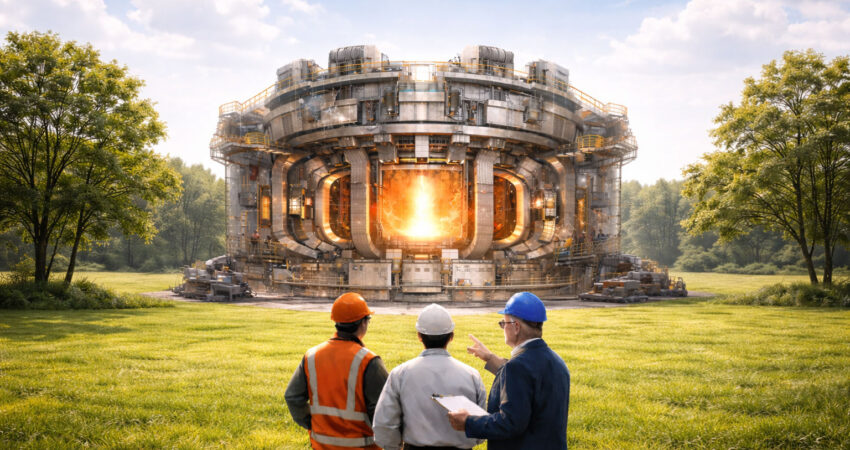
For decades, the International Thermonuclear Experimental Reactor (ITER) has carried a promise that sounds almost mythic: to build a machine on Earth that can safely and controllably reproduce the physics of the Sun at an industrial scale. Hosted in Cadarache in southern France, the project is still the largest fusion experiment ever attempted and remains a bellwether for the potential of magnetic-confinement fusion to transition from laboratory ambition to power-plant reality.
However, over the past two years, ITER has quietly changed the narrative surrounding the project. The headline is no longer first plasma soon. Instead, it’s “start meaningful research as soon as possible”, even if that means reorganising the entire build plan.
A new baseline: less ceremony, more “real” science
At the 35th ITER Council meeting in November 2024, ITER’s management and member governments endorsed an overall approach for a new “Baseline 2024”, asking the organisation to continue to focus on reducing risk and optimising costs. What prompted the reset? The official explanation is pragmatic: ITER is a unique machine made from unique components, and the project has also experienced delays due to the pandemic. The new baseline therefore prioritises consolidating assembly stages, increasing pre-assembly testing and reducing the risk of commissioning downstream. In essence, it’s a case of “measure twice, cut once”, but on the scale of a cathedral-sized superconducting machine.
Crucially, ITER’s leadership has also redefined what constitutes the “start” of the scientific mission. Rather than a limited early plasma phase, the plan aims to achieve a robust initial operations phase more quickly. This will involve an opening campaign that produces research-grade data and proves the integration of key systems.
When is ITER expected to start running?
The revised public milestones most often cited by European fusion stakeholders now look like this:
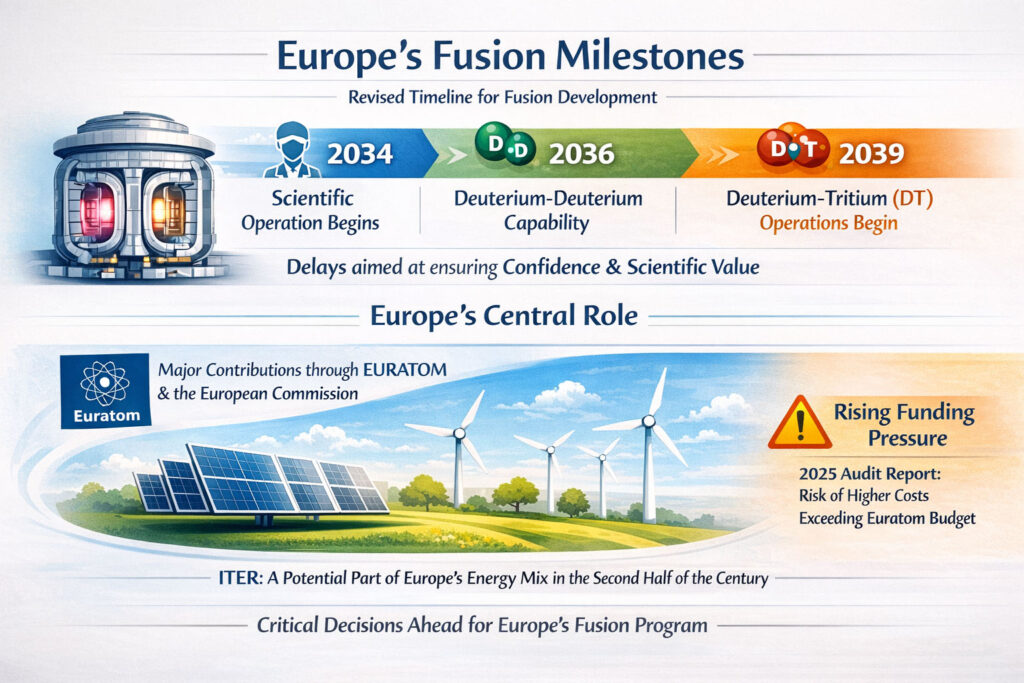
- Scientific operation begins in 2034.
- Deuterium: Deuterium capability in 2036
- Deuterium: Tritium (DT) operations will begin in 2039.
This is later than previous baselines, but the argument is that the reorganisation will inspire confidence and add scientific value once operations begin.
In its own communications around the Baseline 2024 proposal, ITER emphasises that the initial operational phase is designed to include deuterium – deuterium fusion operations in 2035, followed by full magnetic energy and plasma current operations – stepping stones towards full DT fusion power in the future.
What ITER сan do that Fusion start-ups can’t
ITER was conceived in a different era, long before the current boom in private fusion start-ups and the widespread adoption of renewable energy sources. This shift has fuelled criticism of the project – some argue that public funding should go to technologies that can cut emissions immediately.
Yet many researchers still recognise ITER’s unique value: not because it will generate electricity, but because it is designed to address the most challenging and complex issues that will be faced by future fusion plants, such as high-power plasmas, continuous heating and control, neutron loads, and ultimately, tritium breeding concepts in test blanket modules.
Interestingly, rather than ignoring the shift in the ecosystem, ITER is embracing it. The ITER Council has encouraged the organisation to engage with the private fusion sector, and ITER reports strong participation from start-ups and suppliers in dedicated workshops. This positions ITER as a platform that can transfer valuable engineering knowledge to a broader industry.
Fusion Redesign: tungsten walls and brutal new heating
One underappreciated aspect of the Baseline 2024 rethink is that it incorporates technical updates reflecting decades of progress with existing machines. For example, European fusion scientists have noted that ITER’s design now uses tungsten for the first wall instead of beryllium, as in earlier concepts, and features more powerful plasma heating than originally anticipated. These changes have been influenced by operational experience with devices such as ASDEX Upgrade. These aren’t cosmetic changes. Material choices determine how the machine handles heat, erosion, and impurity control – exactly the kinds of ‘small’ engineering details that can determine whether a high-performance plasma is reproducible or fleeting.
The price tag is still huge and politically sensitive
The cost of ITER has always been difficult to summarise because contributions are often ‘in kind’: member regions build major components such as magnets, vacuum vessel sectors, cryostat parts and heating systems, and deliver them to the site. This makes it difficult to compare the true total cost with that of a conventional procurement project.
What is clear, however, is that Europe’s role is central. Through Euratom, the EU is a major contributor, and the European Commission has described fusion, and specifically ITER, as a potential component of Europe’s energy mix in the second half of the century. The Commission also notes that €5.6 billion has been allocated to ITER in the EU budget for 2021-2027. However, funding pressure is rising. In late 2025, a report by European auditors warned of the risk that future, higher European contributions might exceed Euratom’s budget, an issue that could become more acute as ITER’s revised baseline translates into updated cost requirements.
For now, Russia remains a formal member of ITER, alongside the European Union, the United States, China, Japan, South Korea, and India, and continues to contribute to the project. However, the war in Ukraine has severely restricted cooperation, with European stakeholders imposing measures and increasing pressure to limit collaboration and interaction while the conflict continues.
The 2026 verdict
Even if ITER succeeds, fusion power plants will not appear overnight. ITER is an experiment; it is not designed to export electricity to the grid. Its role is closer to aviation’s X-planes: proving the physics and integrated engineering needed to move on to “DEMO”-type prototypes and, eventually, commercial designs.
ITER is no longer promising a near-term energy revolution. Instead, it is repositioning itself around a more defensible claim: fusion is hard, and a machine built to tackle the most difficult problems will take time. The technical lessons and validated solutions it produces could be invaluable if the world ultimately needs dependable, low-carbon power in addition to what renewables, storage, and fission can deliver.
In that sense, ITER’s revised baseline is both a concession and a gamble: a concession that the original pace was unrealistic, and a bet that prioritising a scientifically meaningful start over early symbolic milestones will make the longer wait worthwhile.